Releasing/burning more fat can
> Cause insulin resistance
> Ruin metabolism
> Ruin thyroid function
> Slow fat loss
Elevated free fatty acids, caused by “fat loss” diets, are also seen in cancer, T2D, obesity, and fatty liver.
Is this a good idea for long-term health?🧵


> Triglycerides are key
> Nearly all fat is stored in trigs
> Trigs = 3 fatty acids + glycerol
> Lipolysis breaks them apart
> Releases fatty acids + glycerol
> The main enzymes involved are ATGL, HSL, MGL
> Nearly all fat is stored in trigs
> Trigs = 3 fatty acids + glycerol
> Lipolysis breaks them apart
> Releases fatty acids + glycerol
> The main enzymes involved are ATGL, HSL, MGL

HSL is the most significant driver of above-baseline lipolysis
> HSL is increased by:
> Adrenaline/noradrenaline
> Glucagon
> Growth hormone
> Cortisol
> The main HSL inhibitor is insulin
> HSL is increased by:
> Adrenaline/noradrenaline
> Glucagon
> Growth hormone
> Cortisol
> The main HSL inhibitor is insulin

Glycerol and free fatty acids are released by lipolysis
> Glycerol is a good proxy for free fatty acid levels
> Glycerol is increased by 50% in cancer/wasting
> Glycerol is a good proxy for free fatty acid levels
> Glycerol is increased by 50% in cancer/wasting


Free fatty acids are elevated in:
> Type 2 diabetes
> Obesity
> Insulin resistance
> Obesity is associated with "insulin resistance"
PMID: 36530555
> Type 2 diabetes
> Obesity
> Insulin resistance
> Obesity is associated with "insulin resistance"
PMID: 36530555

The physiological link between obesity and insulin resistance must:
> Be elevated in the blood of obese people
> Raising it should increase insulin resistance
> Lowering it should decrease insulin resistance
Only free fatty acids meet all these criteria
> Be elevated in the blood of obese people
> Raising it should increase insulin resistance
> Lowering it should decrease insulin resistance
Only free fatty acids meet all these criteria

> Increasing Free fatty acids (FFAs) causes insulin resistance

> Free fatty acids are elevated in obesity
> 61% higher baseline FFAs in obesity
PMID: 5806343
> 61% higher baseline FFAs in obesity
PMID: 5806343

Elevated free fatty acids are driven by “stress”
↑Low-carb diets
↑Fight or flight
↑Fasting, exercise,
↑Psychological stress
↑Toxins, disease
PMID: 20107198
↑Low-carb diets
↑Fight or flight
↑Fasting, exercise,
↑Psychological stress
↑Toxins, disease
PMID: 20107198

During long-term stress-induced increases in lipolysis/fat-burning:
> Fat loss can occur initially
> FFAs lower thyroid metabolism
> Fat loss slows/stops
> Metabolism is ruined
> Fat loss can occur initially
> FFAs lower thyroid metabolism
> Fat loss slows/stops
> Metabolism is ruined
View Tweet
Elevated free fatty acids:
> Inhibit thyroid hormone conversion
> Inhibit thyroid hormone binding
> Cause stress-induced hypothyroidism
> Inhibit thyroid hormone conversion
> Inhibit thyroid hormone binding
> Cause stress-induced hypothyroidism


HSL drives stress-lipolysis
HSL-deficient mice have:
> Lower lipolysis/FFAs
> DECREASED fat accumulation
> Excess fat is not created...
> Because glucose oxidation is not impaired...
Otherwise:
> High FFAs cause metabolic damage
> Then FFAs get REINCORPORATED into fat
HSL-deficient mice have:
> Lower lipolysis/FFAs
> DECREASED fat accumulation
> Excess fat is not created...
> Because glucose oxidation is not impaired...
Otherwise:
> High FFAs cause metabolic damage
> Then FFAs get REINCORPORATED into fat

In mice, lowering lipolysis led to:
> Much less fat gain
> Less lipolysis -> less fat
"The reduced FFA production is counteracted by a drastic reduction of FFA reesterification (back into trigs)... These metabolic adaptations result in decreased fat mass..."
PMID: 12923228
> Much less fat gain
> Less lipolysis -> less fat
"The reduced FFA production is counteracted by a drastic reduction of FFA reesterification (back into trigs)... These metabolic adaptations result in decreased fat mass..."
PMID: 12923228

Stimulating HSL in mice with a compound called isoproterenol
> Mimics stress-induced lipolysis
> 3-4x increase in fat gain
Compared to HSL knockout mice + isoproterenol
isoproterenol
> Mimics stress-induced lipolysis
> 3-4x increase in fat gain
Compared to HSL knockout mice + isoproterenol
isoproterenol

Ketosis in obese men on isocaloric diets
> Ketosis increased lipolysis
> Ketosis increased fat burning
> Ketosis led to 49% increased weight loss
> Ketosis led to 45% LESS/ fat loss
[Daily avg. fat loss]
> Ketosis increased lipolysis
> Ketosis increased fat burning
> Ketosis led to 49% increased weight loss
> Ketosis led to 45% LESS/ fat loss
[Daily avg. fat loss]

> 15 days non-ketosis - 5 kg fat loss
> 28 days ketosis - 5 kg fat loss
"The carbohydrate-insulin model of obesity posits that habitual consumption of a high-carbohydrate diet sequesters fat within adipose tissue because of hyperinsulinemia and results in adaptive suppression of energy expenditure... The isocaloric ketogenic diet was not accompanied by increased body fat loss."
> 28 days ketosis - 5 kg fat loss
"The carbohydrate-insulin model of obesity posits that habitual consumption of a high-carbohydrate diet sequesters fat within adipose tissue because of hyperinsulinemia and results in adaptive suppression of energy expenditure... The isocaloric ketogenic diet was not accompanied by increased body fat loss."

Insufficient sleep is a stress
> It increases lipolysis
> It increases free fatty acids
> It lowers "insulin sensitivity"
> It increases lipolysis
> It increases free fatty acids
> It lowers "insulin sensitivity"
View Tweet
In NAFLD (fatty liver)
> 59% of liver fat comes from free fatty acids
> 15% comes from dietary fat
> Only 26% comes from glucose
> Lipolysis is elevated by 50%
> Liver production of sugar +30%
> 59% of liver fat comes from free fatty acids
> 15% comes from dietary fat
> Only 26% comes from glucose
> Lipolysis is elevated by 50%
> Liver production of sugar +30%


Lipid peroxidation is the breakdown of PUFAs, unstable fatty acids from seed oils, etc.
> Lipid peroxidation byproducts are inflammatory
> Lipid peroxidation drives many chronic diseases
> Lipid peroxidation byproducts are inflammatory
> Lipid peroxidation drives many chronic diseases
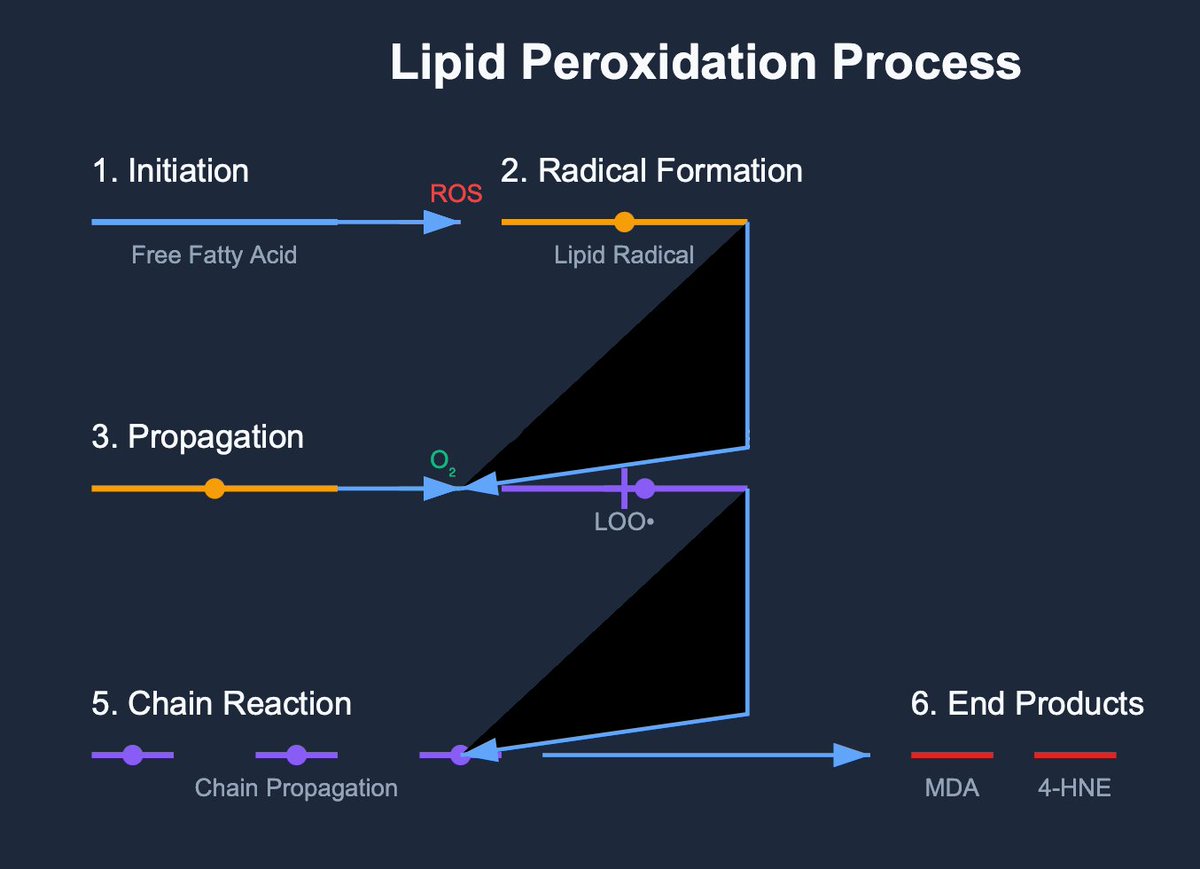
Diseases involving lipid peroxidation:
> Type 2 diabetes
> Obesity
> Atherosclerosis
> Hypertension
> Colon cancer
> Breast cancer
> Heart failure
> Alzheimer's disease
> Parkinson's disease
> Huntington's disease
> Fatty liver disease
> COPD
> Asthma
> Pulmonary fibrosis
> Rheumatoid arthritis
> Systemic lupus erythematosus
> Liver cancer
> Cataracts
> Macular degeneration
> Chronic kidney disease
> Type 2 diabetes
> Obesity
> Atherosclerosis
> Hypertension
> Colon cancer
> Breast cancer
> Heart failure
> Alzheimer's disease
> Parkinson's disease
> Huntington's disease
> Fatty liver disease
> COPD
> Asthma
> Pulmonary fibrosis
> Rheumatoid arthritis
> Systemic lupus erythematosus
> Liver cancer
> Cataracts
> Macular degeneration
> Chronic kidney disease

Generated by Thread Navigator
Press ⌘ + S to quick-export