Have you noticed that people seem younger at the same ages? 40 is the new 30, 30 is the new 25, and so on?
There's something to it. People nowadays are aging more gracefully, and what makes this more interesting is that it's a global phenomenon.
Let's talk five "capacities"🧵


Psychological capacity is indexed by self-reports: How do you feel, how are you sleeping, etc.
Locomotor capacity is indexed by measured walking speeds, the classic chair stand test, etc.
Vitality capacity is indexed by grip strength, forced expiratory volumes, and hemoglobin A
Locomotor capacity is indexed by measured walking speeds, the classic chair stand test, etc.
Vitality capacity is indexed by grip strength, forced expiratory volumes, and hemoglobin A
In a large British longitudinal study of people born from the 1920s through the 1950s and measured again at various ages, what we see in terms of these measures is that people are clocking in higher, and they're aging more gracefully.

People are walking better in old age, their respiration is stronger, and they report feeling better, too.
Isn't that nice? It's great, but that's not all either!
Isn't that nice? It's great, but that's not all either!
Sensory capacity is indexed by reported hearing and visual impairments.
Cognitive capacity is indexed by tests of memory and time orientation.
Above all of these capacities, we also have an overarching measure called "intrinsic capacity" that's like generalized capability.
Cognitive capacity is indexed by tests of memory and time orientation.
Above all of these capacities, we also have an overarching measure called "intrinsic capacity" that's like generalized capability.

In terms of each of those capacities, we see the same thing: people in more recent generations are generally doing better.

How much better are people aging? Sometimes quite a bit!
The smallest improvements are for comparisons of those born in the 1920s vs the 1930s, and the largest gains are usually for comparisons of the most-recent cohorts to later ones, implying recently accelerating improvement.
The smallest improvements are for comparisons of those born in the 1920s vs the 1930s, and the largest gains are usually for comparisons of the most-recent cohorts to later ones, implying recently accelerating improvement.
One thing to ask about these results is... are they legit? People might self-report feeling better, but are they actually?
Well, firstly, some of these measures are objective, so the improvements on those must be real. This lends credence to the self-reported measures.
Well, firstly, some of these measures are objective, so the improvements on those must be real. This lends credence to the self-reported measures.
Secondly, the authors of this paper actually tested if the subjective measures could be compared over time by testing for measurement invariance.
If the self-report measures are invariant, that means they can be compared over time because they measure the same things.
If the self-report measures are invariant, that means they can be compared over time because they measure the same things.
Does invariance hold?
Eh... maybe? The authors actually don't report this clearly enough, so we're left somewhat in the dark. They also only tested three quarters of the way, so... not a good showing, but at least it looks like things probably hold up well enough.
Eh... maybe? The authors actually don't report this clearly enough, so we're left somewhat in the dark. They also only tested three quarters of the way, so... not a good showing, but at least it looks like things probably hold up well enough.

Now what about how this holds up globally?
In the British data, participants were measured between 2002 and 2019.
In comparison Chinese data, participants were measured between 2011 and 2015, and the results look directionally comparable.
Replication success!
In the British data, participants were measured between 2002 and 2019.
In comparison Chinese data, participants were measured between 2011 and 2015, and the results look directionally comparable.
Replication success!

As to whether this holds up in even more locations? I'd have to guess the answer is "yes" if they're developing and "no" if they're stagnant or they've been actively getting worse, as in war-torn locales like Syria and increasing portions of Sub-Saharan Africa.
Finally, is this sex-biased? That is, are just men or just women driving these trends?
I think not! Firstly, look at the women of Britain:
I think not! Firstly, look at the women of Britain:
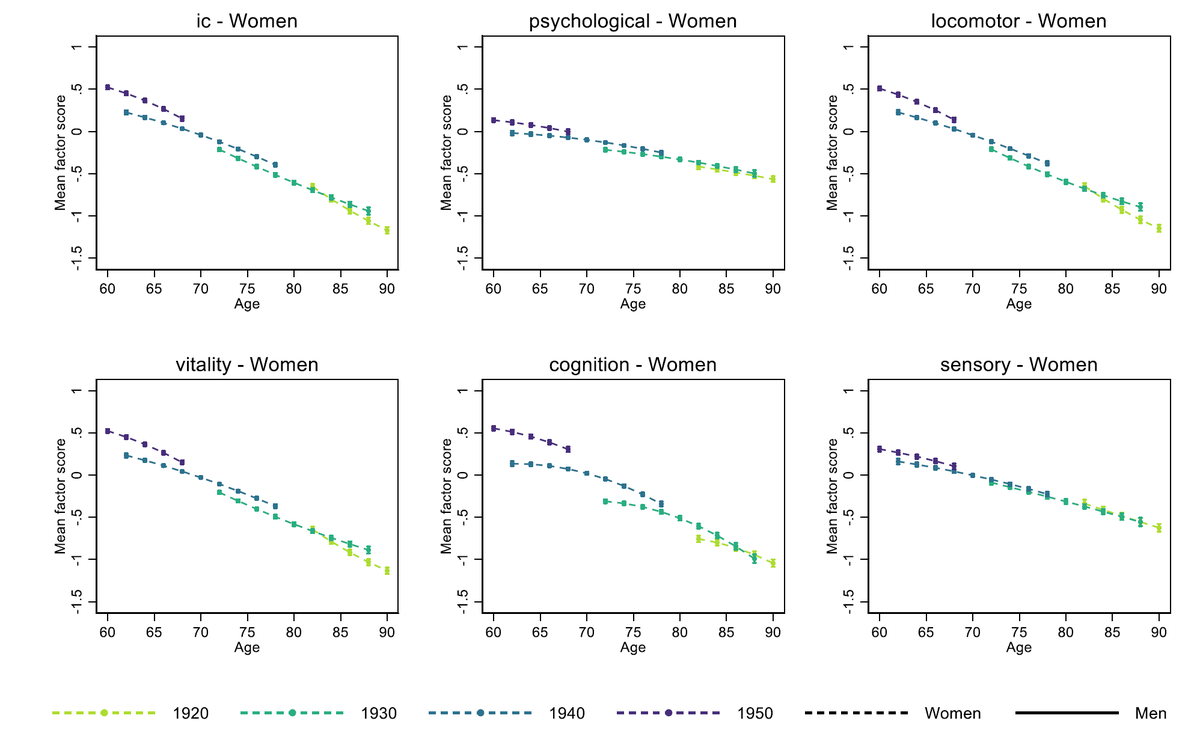
Now look at the men of Britain:

Those pictures are about the same, and the Chinese results are similar.
Hurrah!
Hurrah!
People really are aging more gracefully, at least at older ages.
As to why, I'm not sure, but we live in a richer time with better healthcare than at any point in history. I have to imagine that has something to do with it. People also exercise and stay cognitively engaged more!
As to why, I'm not sure, but we live in a richer time with better healthcare than at any point in history. I have to imagine that has something to do with it. People also exercise and stay cognitively engaged more!
If you want to learn more, these results came out last month in this study: nature.com/articles/s4358…
Generated by Thread Navigator
Press ⌘ + S to quick-export