Most people spend 10,000 hours mastering a skill.
But top performers do it in 1,000.
The difference isn't talent—it's *how* they learn.
Here's the 3-part framework I use to rapidly learn anything:🧵


The key to learning anything:
Seeing it as a game. And this framework helped me become a:
• Top 100 Call of Duty 4 player
• Hedge fund trader at BlackRock
• And now a full-time digital builder
Here's how:
Seeing it as a game. And this framework helped me become a:
• Top 100 Call of Duty 4 player
• Hedge fund trader at BlackRock
• And now a full-time digital builder
Here's how:
Every skill is game.
So there are:
• Rules
• Prizes
• Shortcuts
• Different levels
And here's the 3-part framework to win every time:
So there are:
• Rules
• Prizes
• Shortcuts
• Different levels
And here's the 3-part framework to win every time:
It's simple:
1. Immediately start playing
2. Totally immerse yourself
3. Iterate & tighten your feedback loops
Let's dive in:
1. Immediately start playing
2. Totally immerse yourself
3. Iterate & tighten your feedback loops
Let's dive in:
Step 1: Immediately start playing
This is the most important part of learning any new skill.
No "thinking" about starting or "preparing" to start.
All of that is procrastination.
You have to start playing and losing—here's why:
This is the most important part of learning any new skill.
No "thinking" about starting or "preparing" to start.
All of that is procrastination.
You have to start playing and losing—here's why:
You will suck for your first 20 tries of any new game.
• Your first 20 ads
• Your first 20 threads
• Your first 20 workouts
All of them will suck.
And that's a good thing—here's why:
• Your first 20 ads
• Your first 20 threads
• Your first 20 workouts
All of them will suck.
And that's a good thing—here's why:
Most people have too fragile of an ego to start something and suck at it.
But you will learn more in those first 20 reps than you will from any book, Ted Talk, or course.
You will learn:
• The rules of the game
• What winning & losing looks like
And most importantly:
But you will learn more in those first 20 reps than you will from any book, Ted Talk, or course.
You will learn:
• The rules of the game
• What winning & losing looks like
And most importantly:
In those first 20 reps, you will experience your first win.
And that is all you need to get hooked.
Yes, your first 20 will suck.
But one of them will click—and that dopamine rush will keep you wanting to play forever.
Which takes us into Step 2:
And that is all you need to get hooked.
Yes, your first 20 will suck.
But one of them will click—and that dopamine rush will keep you wanting to play forever.
Which takes us into Step 2:
Step 2: Total Immersion
At this point in the game, you've figured out the basics.
But it's only after learning the basics that you figure out just how little you know—and how far you have to go.
This is the Dunning Kreuger effect in action.
Here's how to overcome it:
At this point in the game, you've figured out the basics.
But it's only after learning the basics that you figure out just how little you know—and how far you have to go.
This is the Dunning Kreuger effect in action.
Here's how to overcome it:
During your first 20 reps, chances are you came across one of the best players.
No matter the game, there is someone at the top of the leaderboard.
And now you're going to inhale everything they've put out—completely immersing yourself in their worldview.
Here's an example:
No matter the game, there is someone at the top of the leaderboard.
And now you're going to inhale everything they've put out—completely immersing yourself in their worldview.
Here's an example:
Let's say you want to learn YouTube.
At the top of the leaderboard is Ali Abdaal.
So you would study everything he's said about YouTube:
• Taking his course
• Listening to his interviews
• Exploring the ins & outs of his channel
But here's an important point:
At the top of the leaderboard is Ali Abdaal.
So you would study everything he's said about YouTube:
• Taking his course
• Listening to his interviews
• Exploring the ins & outs of his channel
But here's an important point:
This is where most people go wrong.
They step straight back into productive procrastination—passively "learning" but not actually moving the needle.
So this has to be *active* learning.
And to do that, you need to distill & share everything you're discovering.
Here's why:
They step straight back into productive procrastination—passively "learning" but not actually moving the needle.
So this has to be *active* learning.
And to do that, you need to distill & share everything you're discovering.
Here's why:
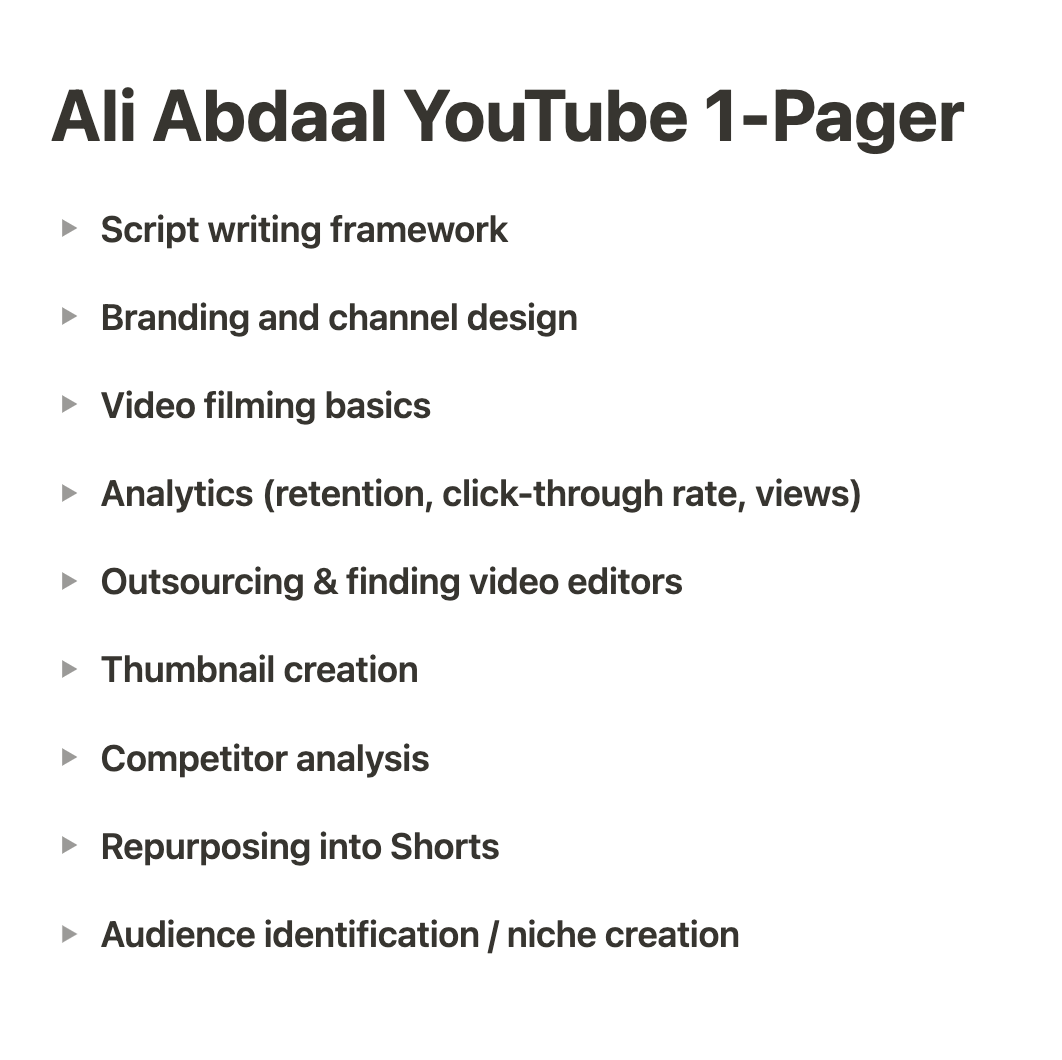
Your goal during the total immersion phase:
Create a 1-page cheatsheet of the frameworks you learn.
This forces you to not just "learn" but to distill, which leads to 10x faster learning.
All the while, you continue playing and applying what you learn.
Then it's on to Step 3:
Create a 1-page cheatsheet of the frameworks you learn.
This forces you to not just "learn" but to distill, which leads to 10x faster learning.
All the while, you continue playing and applying what you learn.
Then it's on to Step 3:
Step 3: Iterate & tighten your feedback loops
At this point, you are a solid player.
So that means you are competing with other solid players.
And the only difference between the good and great players?
How quickly you can continue to improve—and that involves 2 skills:
At this point, you are a solid player.
So that means you are competing with other solid players.
And the only difference between the good and great players?
How quickly you can continue to improve—and that involves 2 skills:
To continue to level up, you need to:
1. Choose the right next thing to learn
2. Quickly learn that thing and move on to the next thing
Then, you repeat this cycle again and again and again.
But here's where the average player goes wrong:
1. Choose the right next thing to learn
2. Quickly learn that thing and move on to the next thing
Then, you repeat this cycle again and again and again.
But here's where the average player goes wrong:
At any time, there is a single bottleneck to your improvement.
Which means you need to spend 100% of your time solving that bottleneck.
Unfortunately, most people spend time learning things that aren't their bottleneck (which is a waste).
Here's what I mean:
Which means you need to spend 100% of your time solving that bottleneck.
Unfortunately, most people spend time learning things that aren't their bottleneck (which is a waste).
Here's what I mean:
Most people learn "just-in-case."
They read books & articles & watch videos on things they *think* will be useful in the future.
But the truth is, most if it isn't useful—so this is once again productive procrastination.
Instead, the best players learn "just-in-time":
They read books & articles & watch videos on things they *think* will be useful in the future.
But the truth is, most if it isn't useful—so this is once again productive procrastination.
Instead, the best players learn "just-in-time":
The best players are keenly self-aware.
• They play
• They identify a bottleneck
• They surgically solve that bottleneck
• They repeat the cycle
Their feedback loops are 10x faster than than the average player.
And this compounds day after day after day.
This is the goal.
• They play
• They identify a bottleneck
• They surgically solve that bottleneck
• They repeat the cycle
Their feedback loops are 10x faster than than the average player.
And this compounds day after day after day.
This is the goal.
Let's recap:
You need to view every skill as a game:
1. Immediately start playing
2. Totally immerse yourself
3. Iterate & tighten your feedback loops
You can apply this to *anything*—now start playing.
You need to view every skill as a game:
1. Immediately start playing
2. Totally immerse yourself
3. Iterate & tighten your feedback loops
You can apply this to *anything*—now start playing.
And that's it!
If you found this framework helpful:
1. Follow me @dickiebush for more threads like this
2. Jump back to the top of the thread and repost it so you can find it later & others can find it too!
Here's the link to the top:
If you found this framework helpful:
1. Follow me @dickiebush for more threads like this
2. Jump back to the top of the thread and repost it so you can find it later & others can find it too!
Here's the link to the top:
View Tweet
Generated by Thread Navigator
Press ⌘ + S to quick-export