I love Origen, an Alexandrian, but he will be used against the faith. Also known as Origen Adamantius (...) he was an early Christian Scholar, ascetic, and theologian who,among other things which we will discuss shortly, contributed significantly to the development of the idea of the Trinity and was also rumored to have castrated himself (eunuch). He is one of the most prolific Christian writers of the time. Until his work "Contra Celsum" Christianity was seen by many as a folk religion for the illiterate and uneducated. What did he believe? Let's get into it.
Origen Christology is problematic, he believed humans existed only in heaven as souls and that humanity was formed by the fall (gnostic) he believed that Jesus was a soul that stayed close to God and remained faithful to him when the other souls fell away. It was at the incarnation that Jesus' human soul fused with the Logos to become one according to Origen. He did believe Jesus was divine and human but not God.
He is also the first to propose ransom atonement theory. According to this theory, Christ's death on the cross was a ransom to Satan in exchange for humanity's liberation. This theory holds that Satan was tricked by God because Christ was not only free of sin, but also the incarnate Deity, whom Satan lacked the ability to enslave. Eeeck.
One of Origen's main teachings was the doctrine of the preexistence of souls, which held that before God created the material world he created a vast number of incorporeal "spiritual intelligences" (ψυχαί). All of these souls were at first devoted to the contemplation and love of their Creator, but as the fervor of the divine fire cooled, almost all of these intelligences eventually grew bored of contemplating God, and their love for him "cooled off" (ψύχεσθαι). When God created the world, the souls which had previously existed without bodies became incarnate. Those whose love for God diminished the most became demons. Those whose love diminished moderately became human souls, eventually to be incarnated in fleshly bodies. Those whose love diminished the least became angels. One soul, however, who remained perfectly devoted to God became, through love, one with the Word (Logos) of God. The Logos eventually took flesh and was born of the Virgin Mary, becoming the God-man Jesus Christ. Again not my ideas, Origen's, it gets worse and it's because he is considered so very influential and introduced concepts that, at least in writing, had not been codified yet.
Origen may or may not have believed in the Platonic teaching of metempsychosis ("the transmigration of souls"; i.e. reincarnation). Many argue that he must have believes in reincarnation because his eschatology (which is the real bombshell) seems to hint at it.
Origen believed that, eventually, the whole world would be converted to Christianity, "since the world is continually gaining possession of more souls." He believed that the Kingdom of Heaven was not yet come,(despite Jesus saying otherwise, which will lead people to the conclusion that Jesus didn't say that in the writings he was familiar with, oy vey) but that it was the duty of every Christian to make the eschatological reality of the kingdom present in their lives.
Origen believed that even disembodied souls have the power to make their own decisions. Furthermore, in his interpretation of the story of Jacob and Esau, Origen argues that the condition into which a person is born is actually dependent upon what their souls did in this pre-existent state... Ruh-roh. According to Origen, the superficial unfairness of a person's condition at birth—with some humans being poor, others rich, some being sick, and others healthy—is actually a by-product of what the person's soul had done in the pre-existent state.
He saw the scriptures as divinely inspired and was cautious never to contradict his own interpretation of what was written in them. Nonetheless, Origen did have a penchant for speculating beyond what was explicitly stated in the Bible, and this habit frequently placed him in the hazy realm between strict orthodoxy and heresy.
Origen saw the "spiritual" interpretation as the deepest and most important meaning of the text and taught that some passages held no literal meaning at all and that their meanings were purely allegorical. Nonetheless, he stressed that "the passages which are historically true are far more numerous than those which are composed with purely spiritual meanings"and often used examples from corporeal realities. Origen noticed that the accounts of Jesus's life in the four canonical gospels contain irreconcilable contradictions, but he argued that these contradictions did not undermine the spiritual meanings of the passages in question.
Origin believed in 2 creation accounts (I'm scared to ask, but I will). Origen's idea of a twofold creation was based on an allegorical interpretation of the creation story found in the first two chapters of the Book of Genesis. The first creation, described in Genesis 1:26, was the creation of the primeval spirits, who are made "in the image of God" and are therefore incorporeal like Him; the second creation described in Genesis 2:7 is when the human souls are given ethereal, spiritual bodies and the description in Genesis 3:21 of God clothing Adam and Eve in "tunics of skin" refers to the transformation of these spiritual bodies into corporeal ones. Thus, each phase represents a degradation from the original state of incorporeal holiness.
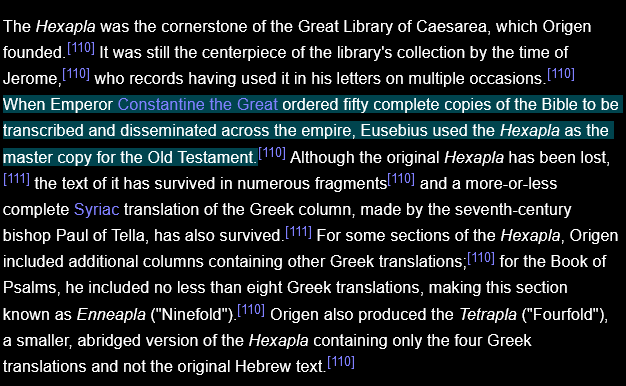
Constantine's 50 bibles are believed to be lost to time, and its undecided if the Codex Vaticanus and Siniaticus were part of this order. We know that Origin's Hexapla was though. Hexapla literally means 6 fold, and was arranged of translations of the OT in 6 columns... However, according to Epiphanius, the original Hexapla compiled by Origen had a total of 8 columns and included two other anonymous Greek translations, one of which was discovered in wine jars in Jericho during the reign of Caracalla. The so-called "fifth" and "sixth editions" were two other Greek translations supposedly discovered by students outside the towns of Jericho and Nicopolis: these were later added by Origen to his Hexapla to make the Octapla. Unfortunately, only the version with 6 remains though... I have the nagging feeling Contantine's 50 will resurface at some point here.
I want to believe Origen's heart was in the right place but he said a lot of things that would be considered gnostic by modern Christians. He did believe in Jesus's divinity, the resurrection, and that the sciptures were divinely inspired (but not inerrant). He also took an allegorical approach to all the Scriptures, he did not believe in a literal flood or 7 days of creation, or even a single creation. He may have just been a product of not having (rejecting because of pride) someone greater in the faith guiding him and also intellectualizing a lot of the faith. He was not shy about calling himself a philosopher and believed Greek thought was not at odds with Christianity and could be incorporated without losing the meaning (eek). He was one of the first to begin to codify the Christian faith, and any post-mortem of Constantine Christianity will have to parse through his significant influence on doctrine, and there is a lot there that was ignored by Constantine and others but may be promoted now as being part of the "truth" that was suppressed.
What a name, Origen Adamantius, notably, not canonized as saint, which is odd for someone of this status.

Generated by Thread Navigator
Press ⌘ + S to quick-export