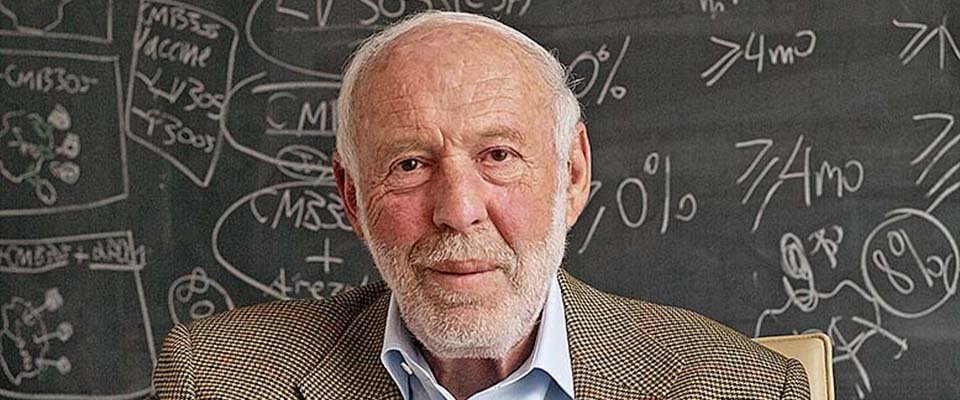
This is Jim Simons.
He is the founder of the most secretive and successful hedge fund in the world.
As of 2024, Renaissance Technologies has $106,000,000,000 under management.
His net worth is around $31,000,000,000.
Here’s Jim's story:

1) The Benefit of Being the Best
At one point, Renaissance charged the highest fees in the world.
A traditional hedge fund charges 2% flat fee and 20% performance fee.
Renaissance charged 5% flat and 44% performance.
Why did they charge more than double than other funds?
At one point, Renaissance charged the highest fees in the world.
A traditional hedge fund charges 2% flat fee and 20% performance fee.
Renaissance charged 5% flat and 44% performance.
Why did they charge more than double than other funds?

VIDEO
2) The Love for Math
Jim's love for math started at a very young age.
He was always fascinated by math.
He says that when he was 3 or 4 years old, he already tried to double numbers in his head.
Later on he received a bachelor at M.I.T. and a PhD from Berkely in mathematics.
Jim's love for math started at a very young age.
He was always fascinated by math.
He says that when he was 3 or 4 years old, he already tried to double numbers in his head.
Later on he received a bachelor at M.I.T. and a PhD from Berkely in mathematics.

VIDEO
3) Working as a Code Cracker
He spent 4 years in a secret institute.
During this time, he found his love for computer modelling.
Jim says that we wasn't good at programming, but he was really good at algorithms.
He doesn't go into a lot of detail as it was all classified.
He spent 4 years in a secret institute.
During this time, he found his love for computer modelling.
Jim says that we wasn't good at programming, but he was really good at algorithms.
He doesn't go into a lot of detail as it was all classified.

VIDEO
4) Early Career
In his late 30's, Jim was growing a little tired of mathematics.
So he started trading.
Right from the gate it went very well and he made a lot of money.
Although he thinks this was pure luck.
Eventually he started to notice some structure in price data.
In his late 30's, Jim was growing a little tired of mathematics.
So he started trading.
Right from the gate it went very well and he made a lot of money.
Although he thinks this was pure luck.
Eventually he started to notice some structure in price data.

VIDEO
5) First 2-Years Trading
Jim describes that for the first 2-years they weren't using any models.
Despite being very successful, he could see that they could do better.
By analyzing price data, he found he could make prediction, mathematically.
So they started to build models.
Jim describes that for the first 2-years they weren't using any models.
Despite being very successful, he could see that they could do better.
By analyzing price data, he found he could make prediction, mathematically.
So they started to build models.

VIDEO
6) Example of an Anomaly
Obviously we can see that Jim doesn't share what he actually did at the time.
But he mentions a strategy that worked decently during the 60's and 70's.
By looking at the average past of X days, one could make a bet on the direction for the next period.
Obviously we can see that Jim doesn't share what he actually did at the time.
But he mentions a strategy that worked decently during the 60's and 70's.
By looking at the average past of X days, one could make a bet on the direction for the next period.

VIDEO
7) The Pursuit of Anomalies
Jim says something interesting.
"We take terabytes of data every day"
They use everything they can get their hands on to try, and find meaningful signal.
By having enough data, the odds of an anomaly being random, is greatly decreased.
Jim says something interesting.
"We take terabytes of data every day"
They use everything they can get their hands on to try, and find meaningful signal.
By having enough data, the odds of an anomaly being random, is greatly decreased.

VIDEO
8) Collective of Subtle Anomalies
It's all about finding things that might be predictive, and testing them.
By getting multiple subtle anomalies, they built a model that was more predictive.
The equations for prediction are not that elaborate.
But prediction is not all.
It's all about finding things that might be predictive, and testing them.
By getting multiple subtle anomalies, they built a model that was more predictive.
The equations for prediction are not that elaborate.
But prediction is not all.

VIDEO
9) Staying Competitive
Jim mentions believes their advantages were:
a) the ability to gather large amounts of data.
b) hiring very smart people.
Data was very hard to get back then, but they worked very hard to get it.
Great scientists + unique data gave them an edge.
Jim mentions believes their advantages were:
a) the ability to gather large amounts of data.
b) hiring very smart people.
Data was very hard to get back then, but they worked very hard to get it.
Great scientists + unique data gave them an edge.

VIDEO
10) Hiring Smart People
Jim believes that hiring a lot of smart people, is one of the keys for his success.
This is not a one man mission.
With the unique strengths of each individual, they were able to build this massive fund.
Jim believes that hiring a lot of smart people, is one of the keys for his success.
This is not a one man mission.
With the unique strengths of each individual, they were able to build this massive fund.

VIDEO
11) Efficient Market Hypothesis
My friend @GoshawkTrades has posted this great video of Jim Simons talking about the Efficient Market Hypothesis.
My friend @GoshawkTrades has posted this great video of Jim Simons talking about the Efficient Market Hypothesis.
View Tweet
@GoshawkTrades I've partnered with @GoshawkTrades to help traders build their own trading models.
If you got an idea, and you can't code it up to test it, feel free to reach out here: unbiasedtrading.info
If you got an idea, and you can't code it up to test it, feel free to reach out here: unbiasedtrading.info
@GoshawkTrades Sources:
1) youtube.com/watch?v=U5kIdt…
2) youtube.com/watch?v=CTQcLi…
3) youtu.be/QNznD9hMEh0?si…
1) youtube.com/watch?v=U5kIdt…
2) youtube.com/watch?v=CTQcLi…
3) youtu.be/QNznD9hMEh0?si…
Generated by Thread Navigator
Press ⌘ + S to quick-export