This is Richard Dennis.
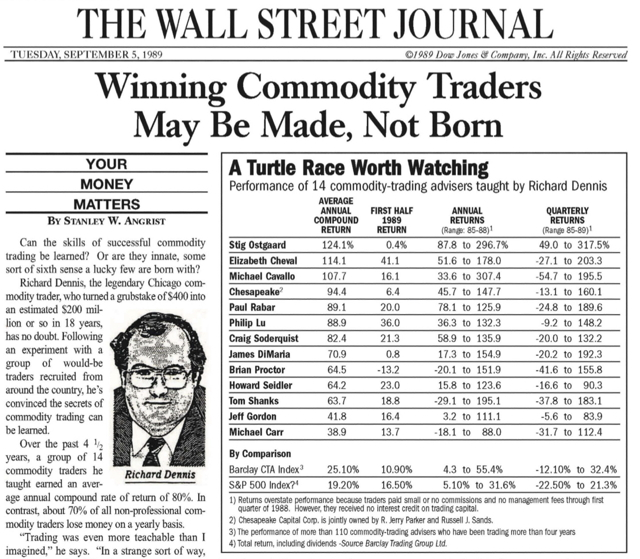
In 18-years, he turned $400 into $200,000,000.
He wanted to prove that trading could be taught to anyone.
So he started the Turtle Traders program.
Over the next 4 years, the Turtles earned a combined profit of over $100,000,000.
The Turtles story:

1) Early Story
Richard Dennis started as a runner in the trading floor, at the age of 17.
He originally borrowed $1,600, and used $1,200 to buy a sit at the MidAmerica Commodity Exchange.
The remaining $400, he used for his personal trading.
Richard Dennis started as a runner in the trading floor, at the age of 17.
He originally borrowed $1,600, and used $1,200 to buy a sit at the MidAmerica Commodity Exchange.
The remaining $400, he used for his personal trading.

VIDEO
He used that money to start trading mini-contracts on his own account.
By the age of 26 he was already a millionaire.
Eventually he would meet his friend and business partner, William Eckhardt.
Eckhardt had a background in mathematics and philosophy.
By the age of 26 he was already a millionaire.
Eventually he would meet his friend and business partner, William Eckhardt.
Eckhardt had a background in mathematics and philosophy.
2) "Experience is not necessary"
Richard had a deep philosophical debate with Eckhardt.
While Eckhardt argued that trading was an inherent ability, Dennis believed that it could be taught.
So he placed an advertisement looking for trainees to join his experiment.
Richard had a deep philosophical debate with Eckhardt.
While Eckhardt argued that trading was an inherent ability, Dennis believed that it could be taught.
So he placed an advertisement looking for trainees to join his experiment.

VIDEO
3) The Turtles
From 100's of applicants, he selected a small group.
Turtles was a nickname that Dennis coined, based on a turtle farm in Singapore.
In that farm, he noticed that the farmers grew turtles quickly, and efficiently.
He wanted to do the same with traders.
From 100's of applicants, he selected a small group.
Turtles was a nickname that Dennis coined, based on a turtle farm in Singapore.
In that farm, he noticed that the farmers grew turtles quickly, and efficiently.
He wanted to do the same with traders.
4) Turtles Successes
The Turtle Traders reportedly earned over $100 million during that period.
By the end of the experiment, Richard said:
"Trading was teachable beyond my wildest dreams."
Their success validated Richard's hypothesis that yes, trading can be taught.
The Turtle Traders reportedly earned over $100 million during that period.
By the end of the experiment, Richard said:
"Trading was teachable beyond my wildest dreams."
Their success validated Richard's hypothesis that yes, trading can be taught.

VIDEO
To this day there's still a Turtle Trader that has continued to achieve significant success in trading.
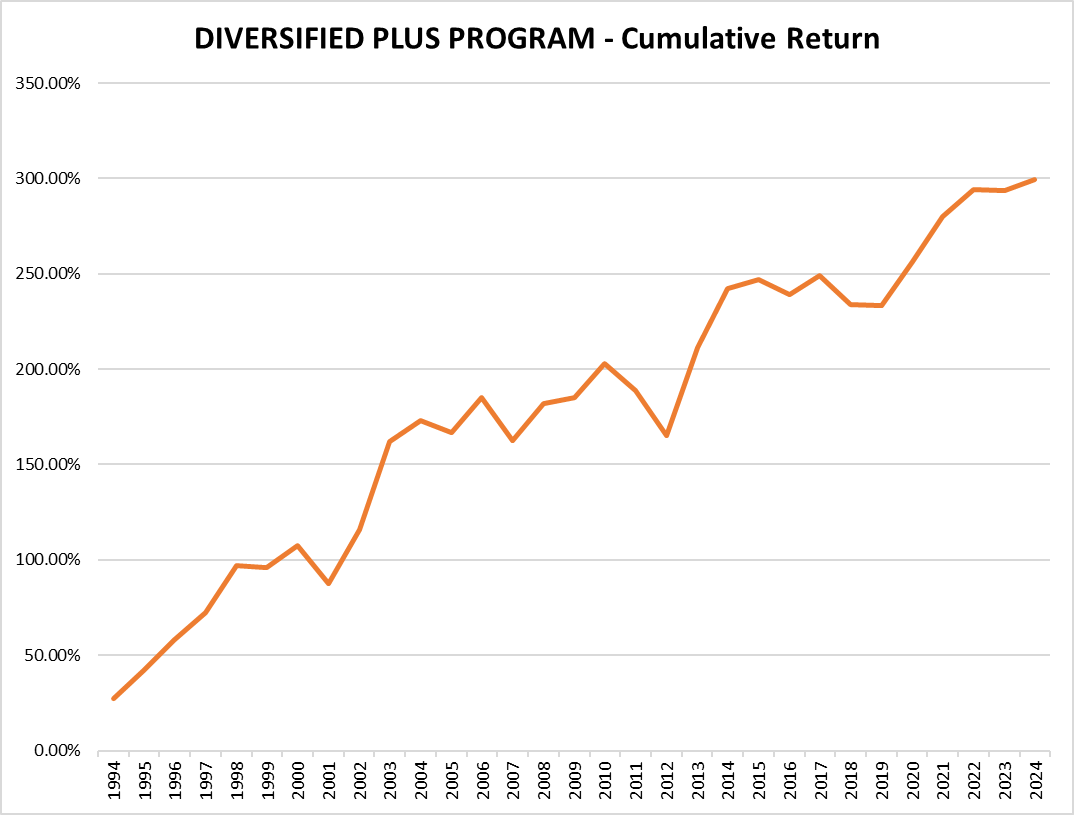
Jerry Parker , one of the original Turtles, founded Chesapeake Capital Corporation in 1988.
These are the returns of Chesapeake's Diversified Plus Program since 1994.
Jerry Parker , one of the original Turtles, founded Chesapeake Capital Corporation in 1988.
These are the returns of Chesapeake's Diversified Plus Program since 1994.
5) The Trading System
a) Position Sizing
The Turtles used a concept called "N", which represented the volatility of a market.
This "N" was measured using the ATR of the last 20 days.
The idea was to risk a small percentage of equity on each trade, around 1-2%.
a) Position Sizing
The Turtles used a concept called "N", which represented the volatility of a market.
This "N" was measured using the ATR of the last 20 days.
The idea was to risk a small percentage of equity on each trade, around 1-2%.

VIDEO
By looking at the ATR of each asset they traded, they ensured that all positions had equal risk, regardless of the asset's volatility.
Example:
You have an account with $10,000 and you want to risk 1% of that account.
The maximum dollar risk of that trade is $100.
Example:
You have an account with $10,000 and you want to risk 1% of that account.
The maximum dollar risk of that trade is $100.
Let's assume that N (volatility measure) is $2, and we wanted to use 2N as a stop loss.
The position size will be:
100 / (2 * 2) = 25 shares
This way if the stop loss is hit, you only lost the $100 previously set as maximum loss.
The position size will be:
100 / (2 * 2) = 25 shares
This way if the stop loss is hit, you only lost the $100 previously set as maximum loss.
b) Adjusting Account Size
Turtles would also adjust their position size based on their current drawdowns.
If the drawdown was over 10%, then they would trade with an account as if the drawdown was 20%.
This way, they exponentially decreased their positions on the way down.
Turtles would also adjust their position size based on their current drawdowns.
If the drawdown was over 10%, then they would trade with an account as if the drawdown was 20%.
This way, they exponentially decreased their positions on the way down.

VIDEO
c) Entry Criteria
They had 2 systems that they could choose from:
i) System 1: A 20-day breakout
ii) System 2: A 50-day breakout
One of the things about this breakout system, is that they did not wait for the close to enter a position.
They entered as price broke through.
They had 2 systems that they could choose from:
i) System 1: A 20-day breakout
ii) System 2: A 50-day breakout
One of the things about this breakout system, is that they did not wait for the close to enter a position.
They entered as price broke through.

VIDEO
d) Pyramiding
After they've entered their positions, they would add more as prices moved higher.
This ensured that they had more capital behind strong trends, and less capital on weaker ones.
I do see the validity of this method, considering the amount of fake breakouts I get.
After they've entered their positions, they would add more as prices moved higher.
This ensured that they had more capital behind strong trends, and less capital on weaker ones.
I do see the validity of this method, considering the amount of fake breakouts I get.

e) Risk Management
As we've discussed above, the maximum risk per trade was 2% (or 2N) of equity.
So as they added more capital into their positions, their stops would also rise.
This made sure that even if stopped out, they would only lose 2%.
As we've discussed above, the maximum risk per trade was 2% (or 2N) of equity.
So as they added more capital into their positions, their stops would also rise.
This made sure that even if stopped out, they would only lose 2%.
f) Exit Criteria
The exits were the opposite of the entry rules.
They used shorter windows for the exit.
i) System 1: A 10-day breakout
ii) System 2: A 20-day breakout
The goal was to be in the trend, until that trend was invalidated.
And the exit rules must NEVER be broken.
The exits were the opposite of the entry rules.
They used shorter windows for the exit.
i) System 1: A 10-day breakout
ii) System 2: A 20-day breakout
The goal was to be in the trend, until that trend was invalidated.
And the exit rules must NEVER be broken.

VIDEO
These are the rules of the system that was used back then.
Markets have matured and the shorter-term system is no longer as effective as it was back then.
From what I've read, this system can still be applied, but on larger timeframes.
A test to do at a later date!
Markets have matured and the shorter-term system is no longer as effective as it was back then.
From what I've read, this system can still be applied, but on larger timeframes.
A test to do at a later date!
6) Conclusion
The Turtle Traders is one of the most famous experiments in the industry.
Richard took a group of unexperienced people and turned them into successful traders.
A story of risk management, patience and solid principles behind trading.
Hope you've enjoyed it!
The Turtle Traders is one of the most famous experiments in the industry.
Richard took a group of unexperienced people and turned them into successful traders.
A story of risk management, patience and solid principles behind trading.
Hope you've enjoyed it!
Generated by Thread Navigator
Press ⌘ + S to quick-export