Over the past 6 years, I've watched and read 1000's of hours of trading content.
And the truth is, >98% of them are complete waste of time.
Here's a logical concept that completely changed how I think: 🧵


During World War II, the statistician Abraham Wald, was assigned the task of reducing bomber losses to enemy fire.
So he examined the damage done to the aircrafts, that had returned from missions.
So he examined the damage done to the aircrafts, that had returned from missions.

VIDEO
The goal was to reinforce the areas where most damage had occurred.
But keep in mind, that adding too much armor, might hinder the aircraft's ability to maneuver.
They had to be really specific on where to add armor.
But keep in mind, that adding too much armor, might hinder the aircraft's ability to maneuver.
They had to be really specific on where to add armor.

VIDEO
The obvious answer is to look at where the red dots, that represent bullets, are hitting the most...
... and reinforce those areas.
But, as with any real life application of theoretical concepts, it isn't as straightforward, and the answer isn't that obvious.
Why?
... and reinforce those areas.
But, as with any real life application of theoretical concepts, it isn't as straightforward, and the answer isn't that obvious.
Why?

VIDEO
Statistical analysis is useless if the dataset is biased.
Why is the cockpit never hit?
Why are the engines never hit?
Aren't those vital parts of the aircraft?
The reason is, the airplanes that did get hit there, never came back.
The data sample is biased to the survivors.
Why is the cockpit never hit?
Why are the engines never hit?
Aren't those vital parts of the aircraft?
The reason is, the airplanes that did get hit there, never came back.
The data sample is biased to the survivors.

VIDEO
This is what's called survivorship bias.
Even though you're analyzing data correctly, the data sample is incomplete.
There's all sorts of biases when looking at data, and in order to detect them, field expertise is a must.
Let's see how this applies to trading:
Even though you're analyzing data correctly, the data sample is incomplete.
There's all sorts of biases when looking at data, and in order to detect them, field expertise is a must.
Let's see how this applies to trading:

VIDEO
1) U.S. Investing Championship
How does survivorship bias apply here?
There are multiple traders that returned >100% in 2023.
To achieve abnormal returns, it's required to take on abnormal risk.
We are looking at the survivors of taking that risk.
How many 1000's blew up?
How does survivorship bias apply here?
There are multiple traders that returned >100% in 2023.
To achieve abnormal returns, it's required to take on abnormal risk.
We are looking at the survivors of taking that risk.
How many 1000's blew up?

I am not saying that there aren't good traders there, and all of them are lucky.
I am also not saying the opposite.
A robust sample of performance is built through years and decades.
I've watched many super star traders come and go.
People always forget those.
I am also not saying the opposite.
A robust sample of performance is built through years and decades.
I've watched many super star traders come and go.
People always forget those.
2) Building strategies on survivorship bias free datasets
Let's say you want to build a trend-following model.
You use a data provider to pull stock's data, and you start testing your system.
Does your data contain all the companies that went bankrupt 5, 10, 20, 50 years ago?
Let's say you want to build a trend-following model.
You use a data provider to pull stock's data, and you start testing your system.
Does your data contain all the companies that went bankrupt 5, 10, 20, 50 years ago?
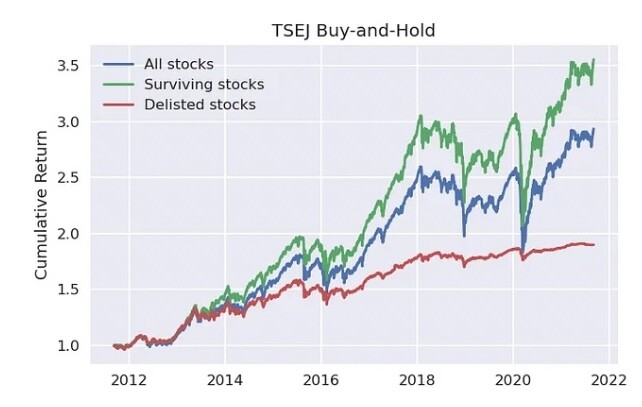
If not, we are going back to our plane example.
You are looking at the companies that survived.
If you're using a system based on momentum and trend, your model's performance will be inflated by the obvious survivors.
Don't forget those that didn't survive.
You are looking at the companies that survived.
If you're using a system based on momentum and trend, your model's performance will be inflated by the obvious survivors.
Don't forget those that didn't survive.
3) Mutual funds performance
Survivorship bias skews the apparent performance of mutual funds over time.
This occurs when funds that perform poorly are closed or merged, and their performances are excluded from studies.
Inflating the sector's performance by the surviving funds.
Survivorship bias skews the apparent performance of mutual funds over time.
This occurs when funds that perform poorly are closed or merged, and their performances are excluded from studies.
Inflating the sector's performance by the surviving funds.
4) Trading success stories
There's tons of stories out there, especially in crypto, of people that turned small amounts of money into fortunes.
You are looking at a small sample of people, that survived taking on enormous risk.
Odds are, it's not based on skill, but luck.
There's tons of stories out there, especially in crypto, of people that turned small amounts of money into fortunes.
You are looking at a small sample of people, that survived taking on enormous risk.
Odds are, it's not based on skill, but luck.
View Tweet
The trading world is completely filled with all kinds of survivorship bias.
Your job as a researcher, is to gain enough field experience to distinguish between what can add value, and what's purely luck.
I hope you've enjoyed this!
Your job as a researcher, is to gain enough field experience to distinguish between what can add value, and what's purely luck.
I hope you've enjoyed this!
Generated by Thread Navigator
Press ⌘ + S to quick-export