I've helped clients liquidate millions in stock options over the years.
Most of them were aware they were powerful tools to build wealth, but never fully understood how to plan for them until working with an advisor.
Here is a rundown of the nonqualified stock option:

What even is equity compensation.
Mostly, it's a way for the company to keep its employees motivated in the growth of the company -- a "skin in the game" type of deal.
In most publicly traded companies this looks like
-- ESPPs
-- RSUs
-- Stock Options
Mostly, it's a way for the company to keep its employees motivated in the growth of the company -- a "skin in the game" type of deal.
In most publicly traded companies this looks like
-- ESPPs
-- RSUs
-- Stock Options
As you climb the ladder part of your compensation is going to granted in the form of equity.
And in many cases you may be given the choice in how you want to split your compensation
Typically its a question of how much do you want to be paid in RSUs compared to options
And in many cases you may be given the choice in how you want to split your compensation
Typically its a question of how much do you want to be paid in RSUs compared to options
Stock options are one of two types:
1. Qualified (otherwise known as Incentive Stock Options)
2. Non Qualified
1. Qualified (otherwise known as Incentive Stock Options)
2. Non Qualified
There are some very significant tax differences between the two types.
If you're at a large publicly traded company, you're more likely to be awarded Non Qualified Stock Options.
If you're at a large publicly traded company, you're more likely to be awarded Non Qualified Stock Options.
Below are the key terms:

Why is Grant Date important?
It's the day you're going to learn a few key items:
First: Exercise Price
This is typically the market value of the stock on the date of the grant and is how much you will need to pay to exercise your options.
It's the day you're going to learn a few key items:
First: Exercise Price
This is typically the market value of the stock on the date of the grant and is how much you will need to pay to exercise your options.
Second: Expiration Date
Typically this will be a long time in the future -- think 10 years, though it can be less.
If you fail to act and your options mature, your options will be forfeited.
This is how you can give up millions in upside by doing nothing.
Typically this will be a long time in the future -- think 10 years, though it can be less.
If you fail to act and your options mature, your options will be forfeited.
This is how you can give up millions in upside by doing nothing.
Third: Vesting Date
The date which options first available to exercise.
Example: Today you're granted 10,000 options. They will vest 20% at the end of March each year. Here is how that looks:
The date which options first available to exercise.
Example: Today you're granted 10,000 options. They will vest 20% at the end of March each year. Here is how that looks:
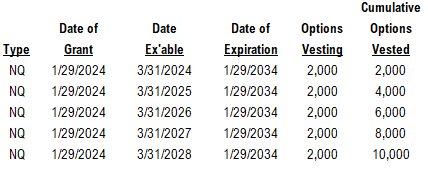
When your options vest, you can now think about exercising.
Just like with investing regularly, the key to options is remaining patient.
Most value is earned over the long-term.
Just like with investing regularly, the key to options is remaining patient.
Most value is earned over the long-term.
The decision to exercise will be dictated by the market value of the stock at that time.
When you do finally exercise you have a decision to make, and this decision will also be dictated by what is available to you in your company's Equity Plan.
When you do finally exercise you have a decision to make, and this decision will also be dictated by what is available to you in your company's Equity Plan.
This plan is a legal document and outlines what happens to your options in almost every circumstance:
1. Death
2. Disability
3. You are fired/leave the company on your own will
4. You are amicably terminated/laid-off
1. Death
2. Disability
3. You are fired/leave the company on your own will
4. You are amicably terminated/laid-off
Additionally you will learn what is available to you for exercise purposes. The key term you will want to be aware of is "cashless exercise".
Back to the basics of an option.
Options simply give you the right to buy a stock at a certain price.
That price is the "exercise cost" or "strike price".
Options simply give you the right to buy a stock at a certain price.
That price is the "exercise cost" or "strike price".
Back to our example, let's assume you fully vested into all of your options.
When you were granted your options the stock price was $50/share. So what is the exercise cost for all 10,000 options?
$500,000.
When you were granted your options the stock price was $50/share. So what is the exercise cost for all 10,000 options?
$500,000.
Most people don't have $500,000 laying around, which is where a cashless exercise comes into play.
In this scenario you're essentially receiving a short term loan from a brokerage to exercise, then immediately selling enough exercised shares to cover the loan, plus transaction costs, plus some taxes.
In this scenario you're essentially receiving a short term loan from a brokerage to exercise, then immediately selling enough exercised shares to cover the loan, plus transaction costs, plus some taxes.
What are the tax implications of nonqualified stock options:
1. Ordinary income. A lot of it.
Remember that this is still compensation and is taxed like it.
Your liability is roughly going to be the difference between the market price of the stock and the exercise cost multiplied by the number of shares you own.
1. Ordinary income. A lot of it.
Remember that this is still compensation and is taxed like it.
Your liability is roughly going to be the difference between the market price of the stock and the exercise cost multiplied by the number of shares you own.
How do we prepare for this liability?
Understand that upon exercise there will be amount withheld by your employer.
For Federal purposes this will either be 22% (if your total supplemental income is <$1M, or 37% if it's above it).
Understand that upon exercise there will be amount withheld by your employer.
For Federal purposes this will either be 22% (if your total supplemental income is <$1M, or 37% if it's above it).
State will always depend.
However, in most instances you are not going to be withholding enough for tax purposes and you should probably put aside an appropriate amount in an interest bearing security for April 15th.
However, in most instances you are not going to be withholding enough for tax purposes and you should probably put aside an appropriate amount in an interest bearing security for April 15th.
Now that you've exercised and withheld some options, now what?
You probably still hold a ton of company stock. The good news is your basis in this stock is the market value of it on the day you exercised.
The most prudent thing is typically to sell all of it and reduce your exposure.
You probably still hold a ton of company stock. The good news is your basis in this stock is the market value of it on the day you exercised.
The most prudent thing is typically to sell all of it and reduce your exposure.
Generated by Thread Navigator
Press ⌘ + S to quick-export