How to fail miserably buying a business...
• Don't analyze customer lists
• Don't review 3-6 years of financials
• Don't get equipment lists & valuations
• Don't learn who the key employees are
How to win at buying a business:

Due diligence is investigating a business before making the decision to buy.
You live or die by DD.
There's no such thing as eliminating risk in an investment...
But here's the process you use to lower it:
You live or die by DD.
There's no such thing as eliminating risk in an investment...
But here's the process you use to lower it:
1. Determine if the sales listing fits your deal box at a high level
2. Ask for some initial financial docs
3. If that looks good, ask for full DD
4. Send the seller an LOI
5. Start negotiations
2. Ask for some initial financial docs
3. If that looks good, ask for full DD
4. Send the seller an LOI
5. Start negotiations

High-level, you want to answer:
Red Flag Finders:
• Are the books correct?
• Are the assets properly valued?
• Is there high employee turnover?
Red Flag Finders:
• Are the books correct?
• Are the assets properly valued?
• Is there high employee turnover?
Potential upside finders:
• Could you add tech to improve margins?
• Could you up prices w/o losing clients?
• Where does your expertise allow you to add value? (marketing, sales, etc)
• Could you add tech to improve margins?
• Could you up prices w/o losing clients?
• Where does your expertise allow you to add value? (marketing, sales, etc)
The first documents you should ask for:
• 3-6 years of financials
• Expenses broken down by month & year
• Revenue broken down by month & year
• Asset/equipment list & valuations
• Photos, if a physical location
• 3-6 years of financials
• Expenses broken down by month & year
• Revenue broken down by month & year
• Asset/equipment list & valuations
• Photos, if a physical location
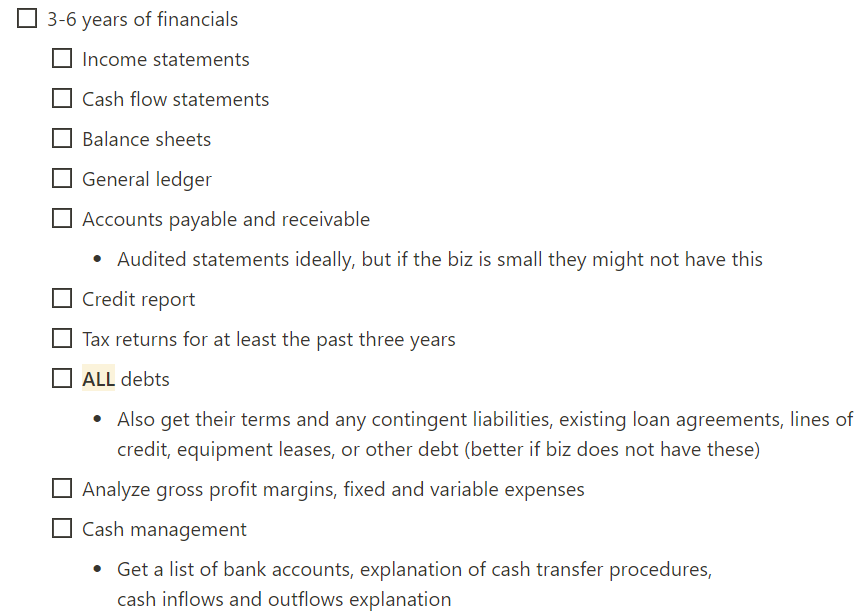
If the numbers sing, it's time for a deep dive:
Your aim is to unearth every artifact:
• debt
• prices
• reports
• forecasts
• employees
• competitors
Your aim is to unearth every artifact:
• debt
• prices
• reports
• forecasts
• employees
• competitors
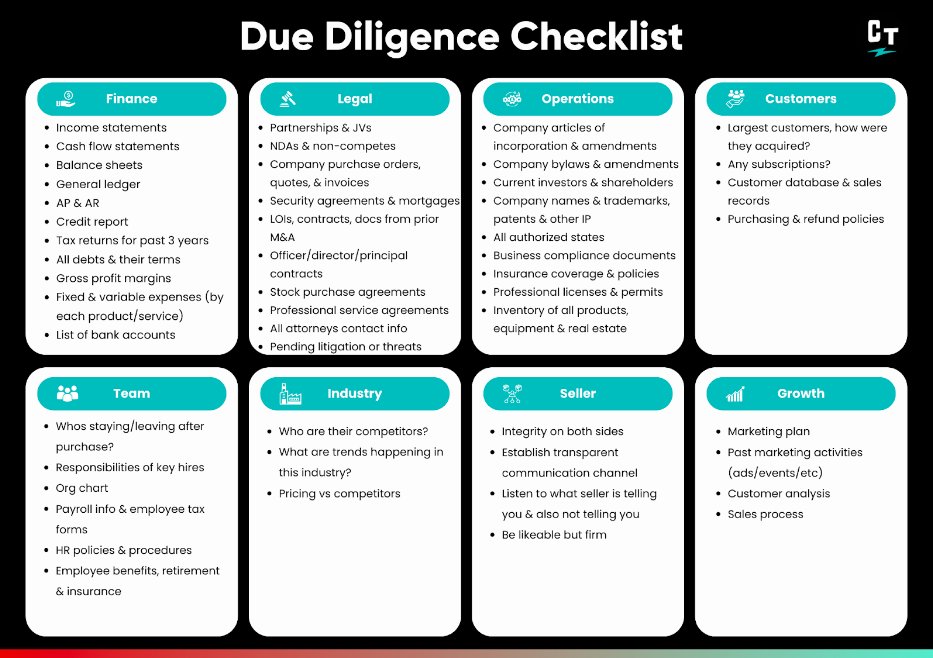
From finance, legal, and ops to customers, teams, and industry itself...
The list will be a lot.
But, the smaller the business, the less complex your DD will be.
The list will be a lot.
But, the smaller the business, the less complex your DD will be.
Throughout the process, keep the seller front of mind:
• Why are they selling?
• Keep integrity on both sides
• Establish transparent communication
• Listen to what they’re telling you and NOT telling you
Establish rapport, but be firm.
• Why are they selling?
• Keep integrity on both sides
• Establish transparent communication
• Listen to what they’re telling you and NOT telling you
Establish rapport, but be firm.
This just skims the surface.
We give a full checklist to members in our community.
It has:
• 80+ due diligence questions
• How to build an airtight DD team
• Lessons navigating partners
• Tips to negotiate terms
You can get the whole thing here:
contrarianthinking.biz/3GfMpiQ
We give a full checklist to members in our community.
It has:
• 80+ due diligence questions
• How to build an airtight DD team
• Lessons navigating partners
• Tips to negotiate terms
You can get the whole thing here:
contrarianthinking.biz/3GfMpiQ
Due diligence isn't just a checklist – it's a chessboard. Choose your move wisely.
Follow me @Codie_Sanchez for more like this, and repost here to help others:
Follow me @Codie_Sanchez for more like this, and repost here to help others:
View Tweet
Generated by Thread Navigator
Press ⌘ + S to quick-export