
A brief introduction to Impressionism:

The story of art is not one of linear progress but one of change, imitation, and reaction.
So to understand Impressionism, which emerged in the middle of the 19th century in France, you've got to know what it was reacting to: the Académie des Beaux-Arts.
So to understand Impressionism, which emerged in the middle of the 19th century in France, you've got to know what it was reacting to: the Académie des Beaux-Arts.

The Académie des Beaux-Arts was a French fine arts school which not only taught young artists but also set the aesthetic standards of the age.
And they prioritised a very particular style of painting based on the ideas of the Renaissance, usually called Academicism.
And they prioritised a very particular style of painting based on the ideas of the Renaissance, usually called Academicism.
Academicism as a style was about strong outlines, clear composition, accurate shading, modelling... it was both realistic and idealised.
So, picture yourself in the middle of the 19th century. This is the sort of work being taught, promoted, and celebrated by the Academy:
So, picture yourself in the middle of the 19th century. This is the sort of work being taught, promoted, and celebrated by the Academy:


There had already been some rebels against this neoclassical, Academic style.
One of them was Gustave Courbet, who portrayed ordinary people with an uncompromising and wholly unidealised realism.
One of them was Gustave Courbet, who portrayed ordinary people with an uncompromising and wholly unidealised realism.

But the greatest rebellion started in the 1860s, among a group of young artists who had met while studying at the Academy together.
They were Claude Monet, Pierre-Auguste Renoir, Alfred Sisley, and Frederic Bazille; and their leader was the slightly older Edouard Manet...
They were Claude Monet, Pierre-Auguste Renoir, Alfred Sisley, and Frederic Bazille; and their leader was the slightly older Edouard Manet...
The first and most striking thing about them was their preference for colour over outline. Rather than making a perfect sketch and filling it with colour later, colour always came first.
Their paintings were much brighter and more vivid than those of the Academic style.
Their paintings were much brighter and more vivid than those of the Academic style.

In this way, Monet and his contemporaries weren't quite revolutionaries.
Rather, their preference for colour over drawing was directly inspired by a similar divergence in 16th century Italy, during the Renaissance.
Rather, their preference for colour over drawing was directly inspired by a similar divergence in 16th century Italy, during the Renaissance.
Whereas the great Florentine artists — Leonardo, Michelangelo, Raphael — had prioritised lines, contours, and forms, the Venetian painters of the same era — foremost among them Titian — had placed far more importance on colour:

It is somehow fitting that the Impressionists later came to paint Venice with such brilliance, as the ancestral home of their artistic modus operandi.
As in these two paintings of the Grand Canal, by Monet and Manet respectively:
As in these two paintings of the Grand Canal, by Monet and Manet respectively:


The Impressionists were also inspired by Japanese ukiyo-e prints, which had recently started coming into Europe.
These highly stylised prints featured ordinary subjects, bold colours, unusual angles, and compositions that would have been heresy in the Academy:
These highly stylised prints featured ordinary subjects, bold colours, unusual angles, and compositions that would have been heresy in the Academy:


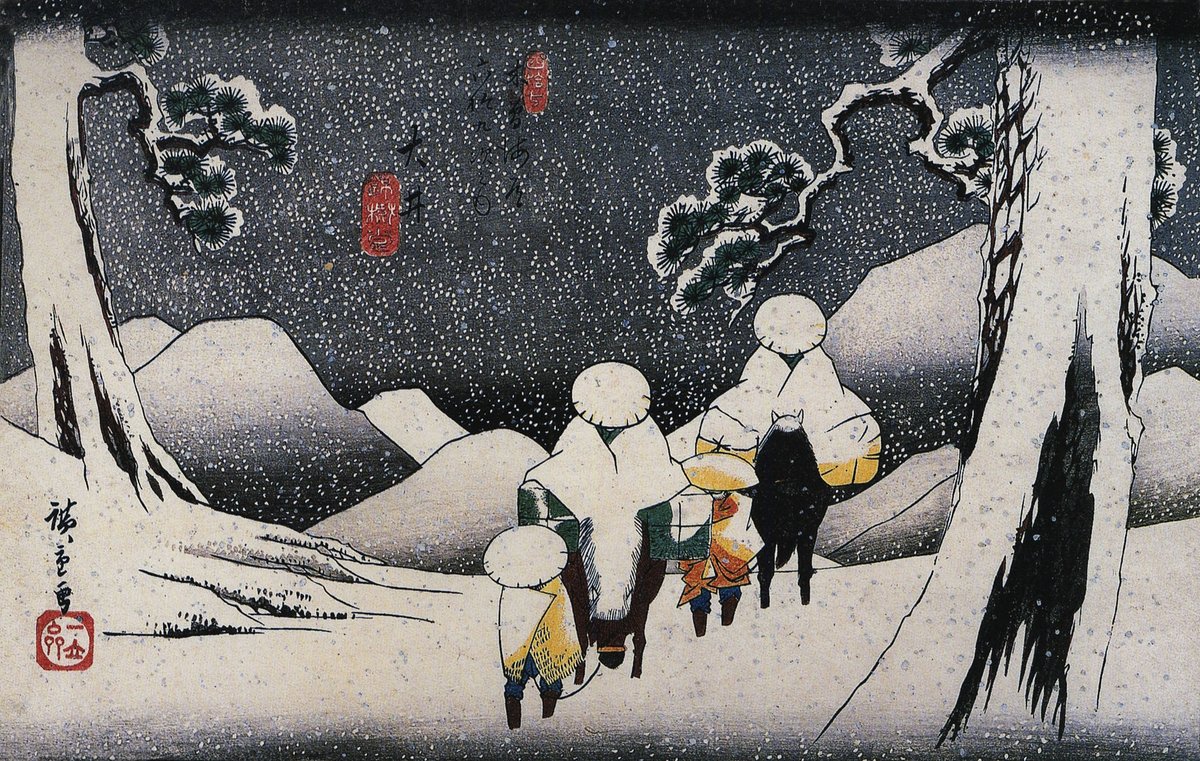
However, the Impressionists — like the Academy — were still trying to depict things in a realistic way; there's nothing abstract about their work.
But Academicism was all about *studio* painting, with carefully orchestrated lighting and placement of models.
But Academicism was all about *studio* painting, with carefully orchestrated lighting and placement of models.

The Impressionists knew that *real life* rarely looks like it does in a studio.
Constant movement; we glimpse things briefly; there is mist, smoke, and haze; perspective is sometimes flattened; brightness, shadows.. the light is literally always changing, and so are the colours.
Constant movement; we glimpse things briefly; there is mist, smoke, and haze; perspective is sometimes flattened; brightness, shadows.. the light is literally always changing, and so are the colours.

There is nothing "unrealistic" about Monet's famous paintings of the lilies and the bridge at his garden in Giverny.
Rather, they somehow feel *more real* than a photorealistic painting or an actual photograph ever could.
Rather, they somehow feel *more real* than a photorealistic painting or an actual photograph ever could.

And so the Impressionists started painting on the fly, outdoors, out and about, with their easels and bundles of brushes.
This explains the brightness of their work; they painted what they saw, including bright blue skies and sunlight reflected on water or dappled by leaves...
This explains the brightness of their work; they painted what they saw, including bright blue skies and sunlight reflected on water or dappled by leaves...

The practice of painting outside, in uncontrolled conditions, and with emphasis on movement and colour and the *real* impression of light, naturally brought with it different techniques.
Their brushstrokes became much looser, and were often clearly visible.
Their brushstrokes became much looser, and were often clearly visible.


And so the methods and appearance of Impressionist art was totally at odds with that of the Academy, where outlines were clear, strokes carefully concealed, and colours separated.
You can see why the Impressionists caused such a stir when this is what people had come to expect:
You can see why the Impressionists caused such a stir when this is what people had come to expect:


But it wasn't only a difference of method and style — it was also a difference of subject matter.
Academicism had been all about Classical and Biblical themes, and scenes drawn from Judeo-Christian history or Greco-Roman mythology.
Academicism had been all about Classical and Biblical themes, and scenes drawn from Judeo-Christian history or Greco-Roman mythology.

The Impressionists, meanwhile, were far more interested in every day subjects, whether the hustle and bustle of Pissarro's Boulevard Montmartre or the steam and soot-stained glass of Monet's Gare Saint-Lazare:


Where does the term "Impressionism" come from?
Just like Gothic, Mannerist, and Baroque, it was originally intended to be a criticism. When Monet's "Impression, Sunrise" was exhibited in Paris in 1874, an art critic called Louis Leroy coined the term pejoratively.
Just like Gothic, Mannerist, and Baroque, it was originally intended to be a criticism. When Monet's "Impression, Sunrise" was exhibited in Paris in 1874, an art critic called Louis Leroy coined the term pejoratively.

Generated by Thread Navigator
Press ⌘ + S to quick-export