JJK through the lens of Marleau-Ponty
The embodied mind or the minded body.
The mind-body problem is addressed within the series multiple times. Are the mind and body separate or inseparable?

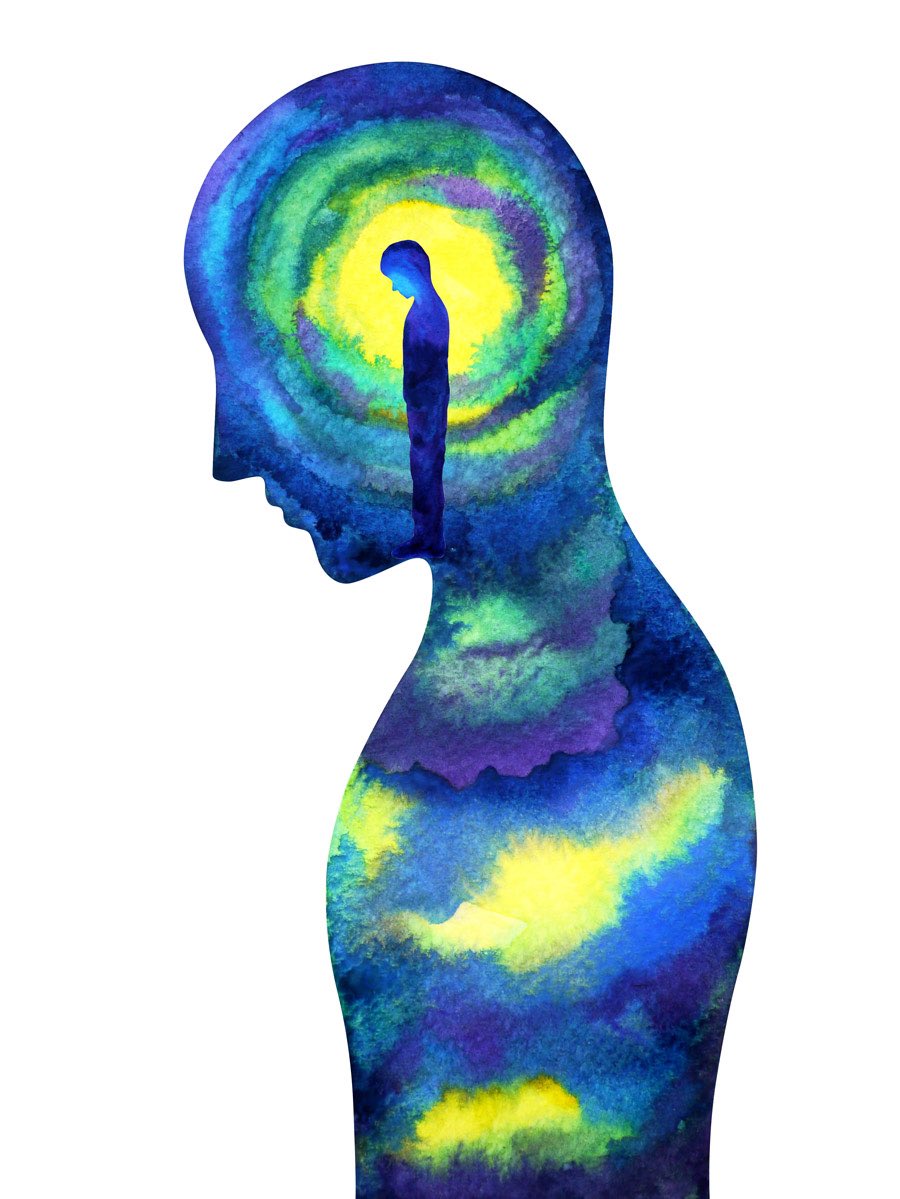
To understand MP’s theory, we first have to look at the opposite; dualism of body and soul/mind which holds that the two are distinct and separable. Mahito alludes to the soul being first and the body attaching itself to the already established soul, meaning that they are -

separable, indicating dualism. In Plato and Descartes’ philosophy they saw perception as separate and the body as “doing” the perception. I want to focus on the first scenario; the soul dwelling in the body, or in other words the body and soul as intertwined and inseparable.
MP believes the opposite of dualism. The body is inseparable from the mind, the living body is one with the soul and this does not mean that there are only 2 layers, the self has many layers and to know yourself you have to know the outer body to the most inner self.
The body is what allows the power of perception. Only through our body, we are in the world. MP follows that something such as a thought or an intention from the mind/soul detaches itself and becomes an outwardly expression visible through the body.
Take for example, a swimmer, whose body has been streamlined through their repetitive actions - turning into a relic of an essential part of the soul’s existence. Even lack of outwardly physical details, is an expression of the soul. The same way that body language speaks out -
what is present in our mind. At the same time, our bodies may even so express thoughts in our minds that the mind itself is not conscious of (yet).
Does the body change to fit the shape of the soul? Or are the body and the soul one, meaning that any change to the soul is a change to the body?

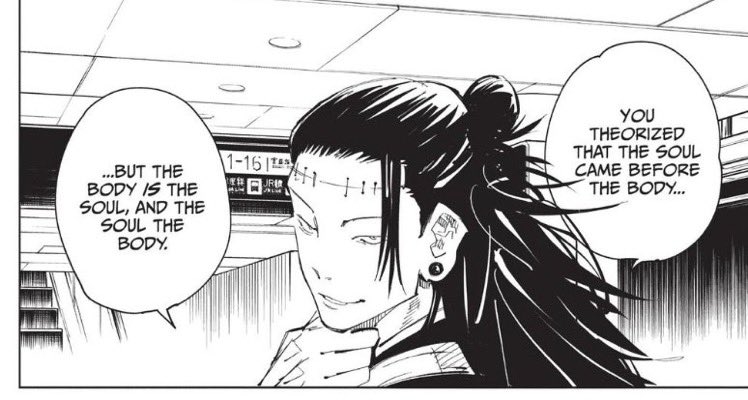
Essentially, in chapter 91, Kenjaku is reiterating these points to Mahito, in their conversation on the body and the soul. “… the body is the soul and the soul is the body” — or in other words the embodied mind or the minded body.
The interaction between the self and the world is a dynamic one, in which we pour our own values and meaning into the world which creates a subjective experience. It could be said that the world we experience is created by our minds thus it is always within our consciousness.
Rather than to see the time-space world as primary and ourselves as secondary “within” it, our consciousness is primary and the subjective world is secondary. MP goes against theories such as Freud’s unconsciousness as a supreme entity essentially, the criticism of MP recognizes
that such theories cannot even exist without the physical lived experience as its foundation. The body is the original knowing subject, and from this lived experience all other knowledge is derived.
To understand this, the concept of the existence of a rigid and objective world needs to be let go of. Then we can recognize that the world and the self are intertwined so that the self perceiving the world isn’t just “viewing”, it includes interaction and reciprocation.
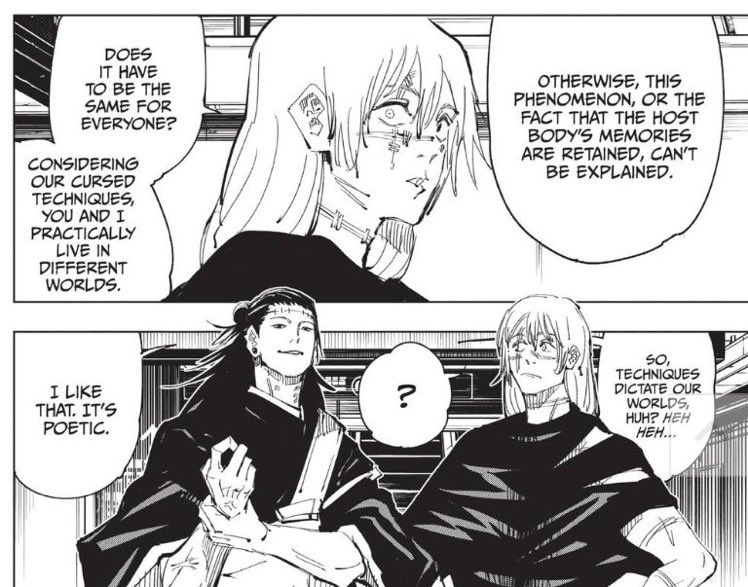
The dynamic of imbuing the world with the self’s meanings and views and in turn experiencing an objective world, is what Mahito refers to. A cursed technique is an essential part of the self, affecting all layers of mind-body, in turn shaping the subjective world one experiences
This is where innate domains and DE fit in. Everyone has an innate domain, but with CE this innate domain can be expanded outside the body. A subjective world that takes shape through our interaction with it from our position as a unity of mind and body.
Essentially, the existence of the Other (another person) confirms that of my own. The same way that I recognize that my body is existed in parts in such a way that it makes up my body, I see the Other and recognize it as a part of the world as a whole.
From here stems the idea that the Other is a requirement for subjectiveness. We cannot see ourselves as distinct first, but rather start by seeing ourselves as part of a unity that we form with all Others, from which we later on can separate ourselves as distinct individuals.
This can also indicate that the world we experience is a big mirror or a window into our self. The key to understanding ourselves so, is by focusing on how we perceive the world around us. Mahito as a character being a mirror for humanity, fits this notion perfectly, but at the
same time humanity functions as a mirror to himself. He is both object and subject. A similar notion is found in the instance of Toji’s soul overwriting his hosts’ body but when Toji’s soul leaves, the body retorts back to it’s original state.

This is another indication of the soul and body being one and inseparable so if the soul leaves, the body goes with it. The same way that Kenjaku cannot simply possess a body with his soul alone, but his brain physically has to be transplanted into the new body, and even then -

Generated by Thread Navigator
Press ⌘ + S to quick-export