
I’m going to contend tonight that autism is a growth disorder whose prevalence increases with advancing average birth weight and height and which explodes in frequency when weight and height can increase no further, resulting in a kind of "spillover" of growth into the brain.
Another point to emphasize is that the increase in growth is ultimately responsible for generation gaps in personality. The mental dimension which separates autistics from non-autistics also separates millennials from boomers and boomers from their parents.
The number of autistics in a cohort is a dramatic representation of even the average person’s personality, their nerdiness, their facility with abstract thinking and making “references” to ideas and events outside of their immediate experience.
I'm a little bit miffed that out of the millions of people who complain about Millennial/Z over-sensitivity nobody ever had the thought that maybe this was related to the explosion of autistic children who upend their classrooms when their routine is changed slightly.
The idea that autism is a growth disorder may sound strange, but it’s not that much of a reach. The most consequential empirical finding in the autism literature is that autistics experience accelerated brain growth in the first 2-5 years of life. sci-hub.se/https://jamane…
IN 2011 Eric Courchesne and co. managed to microscopically inspect the brains of autistics who had died early and found them to have prefrontal cortices that were extraordinarily dense with cells, 67% more than expected by their ages: web.math.princeton.edu/~sswang/develo…
A question to ask yourself is: do you think this brain overgrowth at the same regardless of how nutrition the developing child was receiving? The body’s growth slows down when malnourished; is the brain an exception to this rule?
Studies on young autistics sometimes find them to have elevated levels of growth factors like IGF-1/ IGF-2 and growth hormone binding protein. You may know of IGF-1 as the protein that becomes elevated by dairy consumption and can produce acne. citeseerx.ist.psu.edu/viewdoc/downlo…
As of 2021 only a very small percentage of autism’s genetic risk can be accounted for by named genes, but an unusual number of risk genes overlap with growth and cancer promoting pathways like mTOR, IGF, and PTEN. sciencedirect.com/science/articl…
MTOR hyperactivation seems to be the primary cause of tuberous sclerosis, a condition in autism co-exists at a frequency of 25-50%. TS patients have large growths on their skin that are paralleled by growths in their brains (tubers) en.wikipedia.org/wiki/Tuberous_…
Interestingly, one of the minor physical abnormalities more common in autistics than controls is a high number of moles, which invites an obvious comparison to TS. Autistics have a tendency to produce growths everywhere.
These same genetic pathways interestingly also stimulate aerobic glycolysis, converting glucose to lactate (which is high in autistics) regardless of oxygen status, producing very little energy at high metabolic cost: molecularbrain.biomedcentral.com/articles/10.11…
Although the above paper does not focus on this, aerobic glycolysis (the Warburg effect) stimulates the growth of tumors. Its role in autism would help to explain why a number of autistics seem to improve under a ketogenic diet or when they fast. sciencedirect.com/science/articl…
Glycolysis is also important in that I think it can demonstrated that differences in metabolism underlie the physical and athletic differences between generations.
One of the striking differences between present- day faces and those born before the WWII is just how soft, doughly, and unmuscular old faces were. If you think you this composite from Dienekes Pontikos is unrepresentative, look at pictures of your great-grandma:
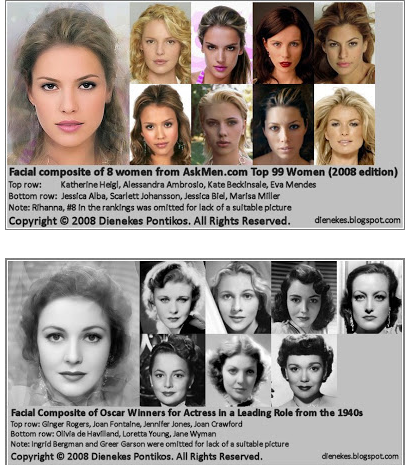
The general trend as far as looks go is that present day women are vastly more beautiful and athletic looking on average than those in the past, whereas in the change is more ambiguous (I think they’re a little less handsome).
Many people don't like the idea, but older generations were not just shorter, but weaker than those in the present day. The physical gap between the Boomers and their parents was so large than the old timers themselves admitted it: youtube.com/watch?v=FZo2hh…
A weird experience a lot of people have when watching old movies is seeing a stunningly handsome 50’s actor take off his shirt to reveal an ugly, flabby, emaciated body: youtube.com/watch?v=__vqb7…
There are a lot of 12 year olds who watch basketball or soccer from the 80’s and mock the slowness of the athletes, while their wise elders instruct that either 1. Those guys didn’t have fancy weightlifting/nutrition or 2. The old guys were actually better. Neither is true.
While heights have stopped growing, every upcoming cohort of young people is more athletic than the last, even while their hands and fine motor skills are weaker. There were not janitors in 1975 with the athleticism of Zion or Lebron waiting for NBA salaries to go up.
Generated by Thread Navigator
Press ⌘ + S to quick-export