1/ Hedge Fund Market Wizards (Jack Schwager)
Thread with quotes from the book
"This volume is part of my continuing effort to meet with exceptional traders to better understand the elements underlying their success."
amazon.com/Hedge-Fund-Mar…

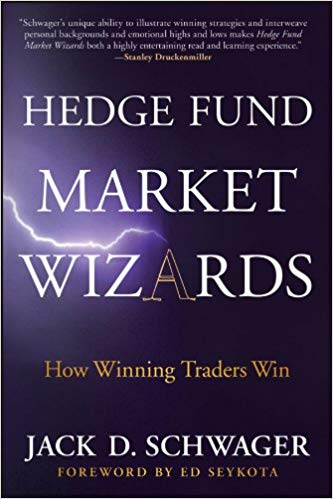
2/ "How you package your work > what you have actually done. There is massive herding in economic forecasting. By staying near the benchmark / prevailing range, you get all the upside of being right without the downside. Once I understood the rules, I became quite cynical." (p.5)
3/ "In order to make problems tractable, you need assumptions, which then become axiomatic for the entire subject—not because they are true, but because they are necessary for a solution.... The problem is that markets aren't efficient, but that is conveniently ignored." (p. 9)
4/ "Markets matter more than policy: real fundamentals, not what policy makers want to happen. The willing disbelief of people can carry on for a long time, but eventually, it is overwhelmed by the market.
"The genius of Soros was recognizing the turning point." (p. 12)
"The genius of Soros was recognizing the turning point." (p. 12)
5/ "As long as no one cares, there is no trend. Would you be short Nasdaq in 1999? You can't be short just because you think something is fundamentally overpriced....
"Even though something might be a good idea, you need to wait for and recognize the right time." (p. 12)
"Even though something might be a good idea, you need to wait for and recognize the right time." (p. 12)
6/ "Risk premium was too low in everything (2006-7). Credit was trading at ludicrous spreads, and no one cared about quality.
"But you can't be short because you lose carry, and at the same time, the spreads get lower.... You just have to make money going the other way." (p. 13)
"But you can't be short because you lose carry, and at the same time, the spreads get lower.... You just have to make money going the other way." (p. 13)
7/ "We were happy to be part of the bubble but in positions that were highly liquid so we could exit quickly.
"Markets look liquid during a bubble; it's the liquidity afterward that matters. We did a lot of trades through options where positive carry paid for the option." (p.14)
"Markets look liquid during a bubble; it's the liquidity afterward that matters. We did a lot of trades through options where positive carry paid for the option." (p.14)
8/ "By being long options... you are never short that horrible tail.
"One of the aspects of risk premiums being very low was that option prices were generally too cheap. It was a low-volatility bubble, which meant that options worked. That's not always the case." (p. 15)
"One of the aspects of risk premiums being very low was that option prices were generally too cheap. It was a low-volatility bubble, which meant that options worked. That's not always the case." (p. 15)
9/ "During the entire Fed hiking cycle of 2005-6, the futures market kept being priced on the premise that it was about to stop... so you had a great risk/reward that in six months, they would still be hiking. As the months rolled on, you could keep repeating the trade." (p. 15)
10/ "There are very few market forces to make macro markets priced efficiently. For tech stocks, then sure, hedge funds are huge. But for FX or Treasuries, hedge funds are tiny compared to PIMCO or the Chinese. I am a small fish swimming in a sea of real money." (p. 16)
11/ On LTCM: "T-bond futures were going up limit every day. That told me there was something going on. I didn't need to know why. Once you realize something is happening, you can trade accordingly.
"If you wait until you can find out the reason, it can be too late." (p. 17)
"If you wait until you can find out the reason, it can be too late." (p. 17)
12/ "After a bull market goes on for years, who is managing most of the money? The bears are all unemployed; you have a few very flexible people, but they run relatively small amounts of money.
"You shouldn't expect a big bull market to end in any rational fashion." (p. 19)
"You shouldn't expect a big bull market to end in any rational fashion." (p. 19)
13/ "Because the bulls control most of the money, expect the transition to a bear market to be quite slow, but then for the move to be enormous when the turn does happen. Then the bulls will say, 'This makes no sense. [The housing bubble] was unforeseeable.' " (p. 19)
14/ "In a world where everyone assumes that everything goes up forever, big price changes occur when market participants are forced to reevaluate their prejudices. The world didn't change that much in 2008; it was just that people finally noticed there was a problem." (p. 20)
15/ "You can notice when things have changed. Most people, though, don't. When Nasdaq is at 4,000 after having been at 5,000, there are a lot of people buying it because it is 'cheap.' People are poorly attuned to making decisions when there is uncertainty." (p. 21)
16/ "Implementation is the key in everything: more important than the trade idea behind it. Having a beautiful idea doesn't get you very far if you don't do it the right way.
"I tried to do the trade in such a way that my timing didn't have to be perfect." (p. 23)
"I tried to do the trade in such a way that my timing didn't have to be perfect." (p. 23)
17/ "People were acting on the premise that Bear Stearns and the banking system were solvent.
"You can't fix a solvency problem by adding more liquidity. If you have a house worth $100K with a $200K mortgage, I can lend you another $100K, but it won't solve the problem." (p. 25)
"You can't fix a solvency problem by adding more liquidity. If you have a house worth $100K with a $200K mortgage, I can lend you another $100K, but it won't solve the problem." (p. 25)
18/ "To make sure our business was as safe as possible, we avoided counterparty exposure to Lehman. We simplified the book. We reduced leverage a lot during 2008. We restricted our trading to highly liquid positions, avoiding OTC trades with lots of counterparties." (p. 26)
19/ "Storytelling is only 10% of what is important in macro. The rest is implementation and flexibility: implement a trade in a way that limits your losses when you are wrong, and be able to recognize when you are wrong." (p. 28)
20/ "Even though Soros will sometimes play up to his public image as a guru who knows what is going on, it is in no sense what he does as a manager. He has no emotional attachment to an idea. When a trade is wrong, he will just cut it, move on, and do something else." (p. 28)
Generated by Thread Navigator
Press ⌘ + S to quick-export