Following Mises or Following the Evidence? What the Research Says About Banks, Money, and Inflation

Spend enough time in libertarian economics circles and you'll hear the same explanation repeated with remarkable confidence. The Federal Reserve lowers interest rates. Banks receive cheap money from the central bank. Lending expands. The money supply grows. Prices rise. Every inflationary episode eventually traces back to central bankers creating too much money.

It is a simple story. It is internally consistent, easy to explain, and fits neatly within the broader Austrian criticism of central banking. It is also presented so often that many people accept it without ever asking whether it accurately describes how modern banking systems actually operate.
Much of this thinking traces back to Ludwig von Mises and the Austrian tradition he helped establish. There is no question that Mises was one of the most influential economists of the twentieth century. His work on money, credit, and the business cycle continues to shape economic debates today. Influence, however, is not the same as infallibility. Economics is not built on authority. It is built on evidence. Every economist, whether Mises, Keynes, Friedman, or anyone else, should have their ideas judged against the best evidence available.
That is the standard I want to apply throughout this article.
Rather than arguing from ideology, I want to compare several of the most common Austrian claims about banking and monetary policy with the academic literature. My focus is not on opinion pieces, podcasts, or social media debates. Instead, I will rely primarily on research published by the Bank of England, the Bank for International Settlements, Federal Reserve economists, and peer-reviewed journals. These institutions often disagree over policy, but they are remarkably consistent when describing the mechanics of modern commercial banking.
That distinction is important because this article is not an argument that central banks are always right. They are not. Central banks have made policy mistakes, misjudged inflation, responded too slowly to financial crises, and at times created problems of their own. None of that is in dispute. The question I am asking is much narrower.
Do commercial banks actually lend reserves supplied by the central bank?
Does lowering interest rates mechanically increase bank lending?
Did quantitative easing place trillions of dollars of new spending power into the hands of households and businesses?
Is inflation simply the result of central banks creating too much money?
These questions sit at the center of many Austrian arguments about the monetary system. If the underlying description of banking is correct, then many of the conclusions that follow are perfectly reasonable. If the description is wrong, then the explanation of interest rates, quantitative easing, and inflation also needs to be reconsidered.
Everything therefore begins with a much simpler question.
When a commercial bank approves a mortgage, a business loan, or a line of credit, where does the money actually come from?
Answering that question turns out to be the key to understanding every chapter that follows.
Do Banks Actually Lend Reserves?
The claim that commercial banks lend reserves sits at the heart of many Austrian explanations of monetary policy. If that claim is wrong, then the entire chain of reasoning connecting Federal Reserve policy to bank lending and inflation becomes much more complicated than it is often presented. Before discussing interest rates, quantitative easing, or inflation, it makes sense to answer a simpler question. What actually happens when a commercial bank approves a loan?
One of the clearest explanations comes from Michael McLeay, Amar Radia, and Ryland Thomas in the Bank of England's 2014 paper Money Creation in the Modern Economy. Their description is remarkably direct.
"Whenever a bank makes a loan, it simultaneously creates a matching deposit in the borrower's bank account, thereby creating new money."
That single sentence overturns one of the most common stories told about banking. If the deposit is created when the loan is made, then banks are not taking existing deposits or reserves and passing them on to borrowers. The loan itself creates a new bank deposit.
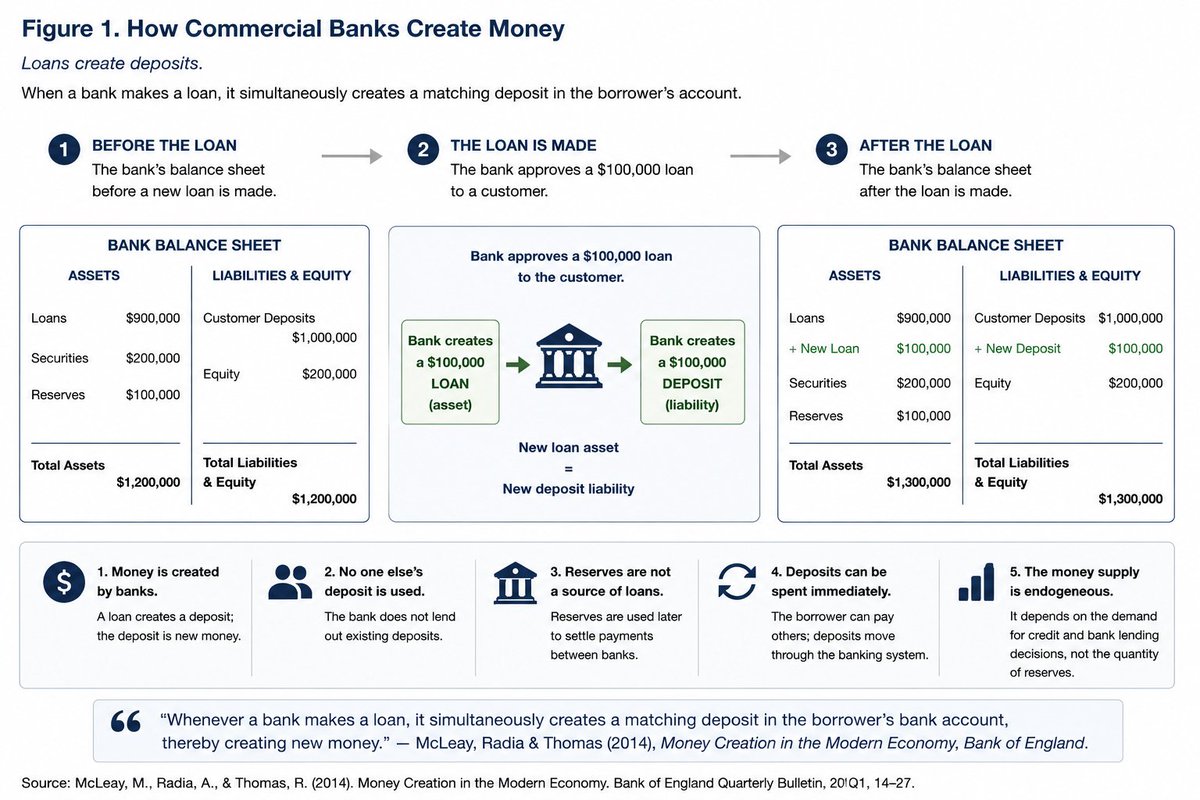
The accounting is surprisingly straightforward. When a bank approves a $500,000 mortgage, it records the mortgage as an asset because the borrower now owes the bank money. At exactly the same moment, it records a new $500,000 deposit in the borrower's account as a liability because the bank now owes that money to its customer. Both sides of the balance sheet expand together. No existing customer's deposit has been reduced. No pile of reserves has been handed to the borrower. The bank has expanded its balance sheet by creating both the loan and the matching deposit.
This is why commercial banks are often described as creators of money rather than simple financial intermediaries. The money appears through the act of lending itself.
That naturally raises another question. If banks are creating deposits when they lend, where do reserves fit into the picture?
Reserve balances are frequently misunderstood. They are not the money households use to buy groceries or businesses use to pay wages. Reserve balances are deposits that commercial banks hold at the central bank. Their primary purpose is to settle payments between banks and to meet any reserve requirements that may exist. They remain inside the banking system.
Imagine a customer at Bank A takes out a loan and immediately uses the money to purchase a car from someone who banks with Bank B. Bank A now owes Bank B the funds associated with that payment. That settlement is completed using reserve balances held at the central bank. The reserves move after the loan has already been created. They facilitate settlement between banks, not the creation of the loan itself.
The Bank of England makes this distinction explicitly. In the same paper, the authors reject the traditional reserve multiplier model found in many introductory textbooks. Rather than describing reserves as the raw material from which loans are made, they argue that banks first decide whether to extend credit and later obtain the reserves necessary to settle payments. In practice, the central bank supplies reserves as needed to keep the payments system functioning and to maintain its target interest rate.
This is not simply the opinion of one central bank.
Claudio Borio and Piti Disyatat at the Bank for International Settlements reached much the same conclusion. In their 2011 paper Global Imbalances and the Financial Crisis: Link or No Link?, and in later work on monetary operations, they argue that the common description of banks as reserve-constrained institutions is misleading. Banks do not sit waiting for reserves before making loans. Instead, lending decisions depend primarily on expected profitability, borrower creditworthiness, available capital, and risk management. Once a loan has been approved, any additional reserves required for settlement can be obtained through money markets or directly from the central bank.
Federal Reserve economists have reached similar conclusions. Seth Carpenter and Selva Demiralp examined whether increases in reserve balances lead to greater bank lending. Their findings provide little support for the idea that simply increasing reserves causes banks to expand credit. The quantity of reserves and the quantity of loans do not move together in the simple mechanical way implied by the money multiplier model.
The period following the Global Financial Crisis provides perhaps the strongest real-world test of these competing views. Beginning in late 2008, the Federal Reserve dramatically increased reserve balances through several rounds of quantitative easing. If reserves were the primary constraint on bank lending, commercial lending should have accelerated at a comparable pace. Instead, reserve balances increased by several trillion dollars while bank lending recovered only gradually over the following years. The relationship predicted by the traditional money multiplier simply did not appear.
That outcome should not have been surprising if the modern banking literature is correct. Banks do not make loans because they have excess reserves sitting idle. They make loans because they expect those loans to be profitable, because borrowers are willing and able to take on debt, and because they have sufficient capital to absorb the associated risks. Reserves support the payments system. They are not the fuel that powers credit creation.
This distinction matters because it changes the way monetary policy should be understood. If reserves are not the limiting factor on lending, then lowering the Federal Reserve's policy rate cannot be described as simply giving banks more money to lend. Interest rates clearly influence the economy, but they do so through channels that are more subtle than the popular Austrian narrative suggests.
That leaves the next question. If banks are not constrained by reserves, then how do lower interest rates influence lending decisions in the first place? That is where the research turns from the mechanics of banking to the economics of credit, expectations, profitability, and risk.
If Banks Don't Lend Reserves, What Do Interest Rates Actually Do?
Rejecting the reserve multiplier does not mean the Federal Reserve is powerless. It means the mechanism is different.
One of the most common criticisms I hear is that if banks are not reserve constrained, then interest rates should not matter. That conclusion does not follow from the evidence. Interest rates matter enormously. They simply do not matter because banks suddenly receive more money to lend. They matter because they change the incentives facing borrowers, lenders, and investors throughout the economy.
The first point worth making is that the Federal Reserve does not tell banks how much to lend. It sets a target for the federal funds rate, the overnight interest rate at which banks borrow and lend reserve balances to one another. That policy rate influences a wide range of other interest rates across the financial system, but it does not determine how many mortgages, business loans, or credit lines commercial banks will approve.
Whether a bank approves a loan depends on a series of commercial decisions. Is the borrower likely to repay? Does the expected return justify the risk? Does the bank have sufficient capital to support additional lending? Is there enough demand for new borrowing? None of those questions can be answered simply by looking at the federal funds rate.
The historical relationship between the federal funds rate and commercial bank lending illustrates this point. Similar rates of commercial bank credit growth have occurred under very different interest-rate regimes. During much of the 1990s, loan growth remained robust despite policy rates above five percent. Two decades later, commercial bank lending often expanded at comparable rates even while the federal funds rate remained close to zero. Interest rates clearly matter, but they do not by themselves determine the pace of bank lending. Borrower demand, expected profitability, bank capital, credit risk, and broader economic conditions all influence whether new loans are created.
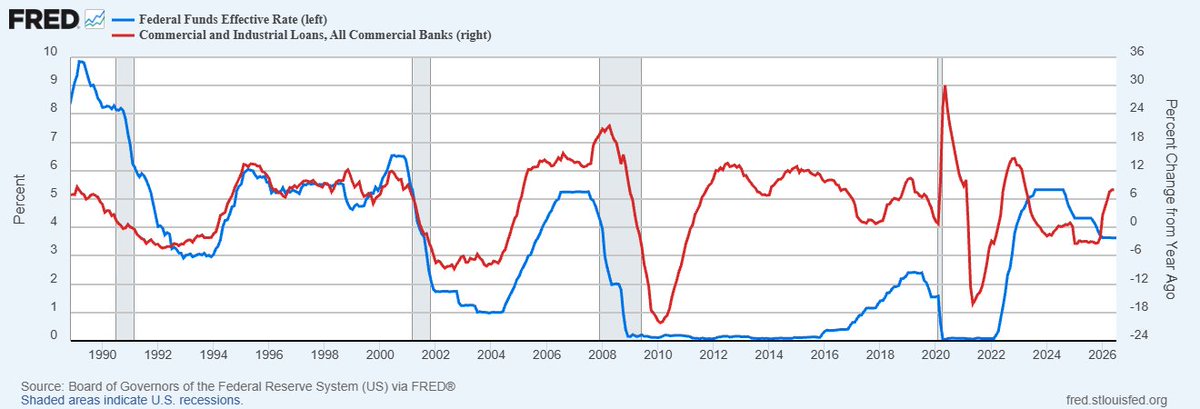
Figure 3 illustrates why it is difficult to explain bank lending using the policy interest rate alone. During much of the 1990s, commercial and industrial loan growth remained similar to the rates observed during the low-interest-rate environment that followed the Global Financial Crisis. The relationship between interest rates and lending is clearly more complex than a simple rule in which lower rates automatically produce faster credit growth. Something else is influencing banks' willingness to lend and borrowers' willingness to borrow.
Ben Bernanke and Mark Gertler explored this issue in their influential 1995 paper, Inside the Black Box: The Credit Channel of Monetary Policy Transmission. They argued that monetary policy works through more than the traditional interest rate channel. Changes in policy also affect balance sheets, collateral values, cash flow, and the availability of external finance. Monetary policy influences the financial position of borrowers, which in turn changes their ability to obtain credit.
This distinction is important because it shifts the focus away from the quantity of reserves and towards the financial condition of households and businesses. A lower policy rate may reduce mortgage repayments, improve business cash flow, increase the value of collateral, and encourage firms to undertake investment that previously appeared uneconomic. Banks may then choose to extend more credit because the loans have become more attractive, not because they suddenly possess more reserves.
The same conclusion appears in research by Anil Kashyap and Jeremy Stein. Their work on the bank lending channel shows that monetary policy affects banks differently depending on their balance sheets and funding structures. Some banks respond more strongly than others. Capital levels, liquidity positions, access to wholesale funding, and the composition of assets all influence lending decisions. There is no single mechanical relationship between policy rates and credit creation.
Evidence from Europe tells a similar story. Óscar Jiménez and his co-authors examined millions of individual loan applications using Spanish banking data. Their research found that lower interest rates generally encouraged lending, but not because banks suddenly acquired new reserves. Banks continued to screen borrowers carefully. Creditworthy borrowers found it easier to obtain loans, while riskier borrowers continued to face tighter standards. Monetary policy changed lending behavior through risk-taking and borrower demand rather than through the availability of reserve balances.
This is consistent with everyday banking practice. A commercial bank does not receive instructions from the central bank telling it to approve more mortgages after an interest rate cut. Loan officers continue evaluating applications using income, collateral, credit history, debt servicing capacity, and expected profitability. A borrower with poor credit does not become an attractive customer simply because the policy rate has fallen by twenty-five basis points.
Demand matters just as much as supply.
Even if every commercial bank wanted to expand lending tomorrow morning, they would still need households and businesses willing to borrow. During recessions, firms often postpone investment because they expect weak sales rather than because borrowing costs are too high. Households may delay purchasing homes because employment appears uncertain. Banks cannot create loans without borrowers willing to sign loan agreements.
This point has long been emphasised by Post-Keynesian economists such as Basil Moore and Marc Lavoie. Credit creation is driven jointly by the willingness of banks to lend and the willingness of the private sector to borrow. Money is therefore endogenous. It expands and contracts with the demand for credit inside the economy rather than according to an externally fixed quantity determined by the central bank.
The experience following the Global Financial Crisis illustrates this particularly well. Policy interest rates in the United States remained exceptionally low for many years. If interest rates alone determined lending, credit growth should have returned rapidly to pre-crisis levels. Instead, households spent years reducing debt, banks tightened lending standards, regulators imposed higher capital requirements, and businesses remained cautious about investment. Lending recovered slowly because the financial conditions affecting borrowers and lenders had changed dramatically.
The opposite pattern can also be observed. There have been periods when borrowing continued expanding despite rising interest rates. Strong income growth, optimistic expectations, rising property prices, and favorable labor markets encouraged households and businesses to continue taking on debt even as financing costs increased. Once again, the relationship proved more complicated than a simple story in which lower rates automatically generate more lending.
This does not mean the Federal Reserve lacks influence over credit conditions. It clearly does. Changing policy rates alters borrowing costs, affects asset prices, influences exchange rates, shapes expectations, changes debt servicing burdens, and affects financial market conditions more broadly. All of these channels influence lending behavior. The important point is that none of them requires banks to receive reserves before they can create loans.
The distinction may seem technical, but it changes how monetary policy should be understood. The Federal Reserve influences the price of credit rather than directly controlling its quantity. Commercial banks decide whether to create loans. Households and businesses decide whether they wish to borrow. Those decisions emerge from expectations about the future, profitability, income, employment, and financial stability. Monetary policy influences those decisions, but it does not dictate them.
This also explains why economists often describe modern monetary policy as operating through transmission channels rather than through a simple money multiplier. The effects of an interest rate change spread throughout the economy by influencing countless individual decisions rather than by mechanically increasing the quantity of money available for banks to lend.
Once the mechanics of bank lending are understood, another question naturally follows. If commercial banks are not reserve constrained, what exactly did the Federal Reserve create during quantitative easing? The answer requires looking more closely at the central bank's own balance sheet.
Did the Fed Print Trillions of Dollars?
One of the most common criticisms of the Federal Reserve is that it "printed trillions of dollars" after the Global Financial Crisis and again during the pandemic. The phrase appears everywhere. Politicians use it. Financial commentators repeat it. It dominates social media discussions whenever inflation is mentioned. The implication is usually straightforward. The Federal Reserve created trillions of dollars, flooded the economy with new money, banks lent that money into the economy, and inflation became inevitable.
There is no dispute that the Federal Reserve's balance sheet expanded dramatically. The first question is simply: what happened?

Figure 3 shows the enormous expansion of the Federal Reserve's balance sheet following the Global Financial Crisis and during the COVID-19 pandemic. This chart is often presented as proof that the Federal Reserve "printed trillions of dollars." In one sense, that statement is correct. The Federal Reserve did create trillions of dollars in new reserve balances. The more important question is whether those reserve balances are the same thing as the money households and businesses use every day.
To answer that, it helps to understand what actually happens when the Federal Reserve conducts quantitative easing.
Suppose the Federal Reserve purchases $100 million of Treasury securities from a commercial bank. Before the transaction, the commercial bank owns a Treasury bond as an asset. After the transaction, the Treasury bond disappears from the bank's balance sheet and is replaced by $100 million in reserve balances held at the Federal Reserve.
From the bank's perspective, one asset has simply been exchanged for another.
The Federal Reserve's balance sheet expands because it now owns the Treasury security while simultaneously creating a matching reserve liability for the commercial bank. No taxpayer writes a cheque. No printing press begins producing stacks of banknotes. The transaction exists almost entirely as electronic accounting entries between the central bank and the commercial banking system.
This process is known as Quantitative Easing, or QE.
Calling QE "money printing" is not entirely wrong, but it is incomplete in a way that often leads people to misunderstand what actually happened. The Federal Reserve did create new reserve balances. Those reserves did not become household bank deposits simply because they existed. They remained deposits belonging to commercial banks at the Federal Reserve.
That distinction matters because reserve balances cannot be spent in the wider economy. Households cannot use reserve balances to buy groceries. Businesses cannot use them to pay employees. Reserve balances never leave the banking system. They exist to settle payments between banks and to support the implementation of monetary policy.
The Bank of England makes exactly this point in Money Creation in the Modern Economy. Reserve balances are fundamentally different from bank deposits held by households and firms. They serve different purposes and circulate within different parts of the financial system.
The Bank for International Settlements reaches the same conclusion. Claudio Borio and Piti Disyatat describe reserve balances as settlement assets used within the banking system rather than the direct source of lending to the private sector. Commercial banks cannot simply take reserve balances and lend them to customers. Lending creates deposits. Reserves facilitate settlement after those deposits begin moving between banks.
The behavior of bank lending after 2008 provides a useful test of these competing explanations.
Between 2008 and the middle of the following decade, reserve balances held by commercial banks increased by several trillion dollars. If reserves directly determined lending, commercial bank credit should have increased at a similar pace. That is not what happened.
Commercial lending recovered slowly. Mortgage lending remained subdued for years. Businesses reduced borrowing as investment opportunities collapsed during the recession. Households focused on paying down debt rather than taking on more of it. Banks became more cautious, regulators imposed tighter capital standards, and borrowers became less willing to borrow.
The dramatic increase in reserve balances did not produce an equally dramatic increase in lending because reserves were never the binding constraint on lending in the first place.
This point has been examined by Federal Reserve economists Seth Carpenter and Selva Demiralp. Their research found little evidence that increases in reserve balances mechanically translate into increases in bank lending. Banks lend when profitable lending opportunities exist. Simply increasing reserve balances does not create those opportunities.
That helps explain why inflation remained below the Federal Reserve's two percent target for much of the decade following the financial crisis despite the largest expansion of the Federal Reserve's balance sheet in its history. If creating reserve balances automatically produced inflation, the years immediately after 2008 should have experienced persistent and accelerating price increases. Instead, policymakers spent much of the following decade worrying that inflation was too low.
The pandemic created a very different environment.
This time, quantitative easing occurred alongside unprecedented fiscal transfers, disrupted global supply chains, labor shortages, energy price shocks, and a rapid recovery in household spending as economies reopened. Unlike the years after 2008, household incomes were directly supported through government spending while productive capacity remained constrained by public health measures and supply disruptions.
In other words, the balance sheet expansion of the Federal Reserve was only one part of a much larger macroeconomic story.
Reducing the inflation of 2021 and 2022 to "the Fed printed money" ignores the interaction between fiscal policy, supply constraints, energy markets, labor shortages, private credit, and consumer demand. Modern inflation emerged from several forces acting simultaneously rather than from a single accounting operation inside the Federal Reserve.
None of this means quantitative easing had no economic effects. It clearly did. By purchasing long-term government securities and other financial assets, the Federal Reserve lowered long-term interest rates, supported financial markets, encouraged investors to rebalance their portfolios, and improved financial conditions more broadly. These channels influenced investment, asset prices, borrowing costs, and economic activity.
Those effects are very different from the popular image of the Federal Reserve creating trillions of dollars that banks simply passed on to households and businesses.
Understanding that distinction is essential because it changes the debate entirely. The question is no longer whether the Federal Reserve created reserve balances. It unquestionably did. The real question is whether reserve creation is the same thing as creating spendable money for the private sector.
The evidence suggests it is not.
Once that distinction is understood, another question naturally follows. If quantitative easing did not directly place trillions of dollars of new spending power into the hands of households and businesses, why did inflation remain subdued after the Global Financial Crisis but accelerate so sharply after the pandemic? The answer lies in recognizing that inflation is shaped by many interacting forces, not by central bank reserve creation alone.
Is Inflation Just Money Printing?
By this point, two important conclusions have emerged. Commercial banks do not lend reserves, and quantitative easing did not place trillions of dollars into household bank accounts. Yet many Austrian economists still arrive at the same conclusion. If the Federal Reserve expands its balance sheet or governments run large deficits, inflation must inevitably follow because there is simply too much money in circulation.
The problem with that explanation is not that money is irrelevant. Money clearly matters. The problem is that it attempts to explain one of the most complex processes in economics with a single variable.
Inflation is a rise in the general price level, but prices do not all move for the same reason or at the same time. Oil prices respond to global energy markets. Housing costs respond to land availability, construction, mortgage credit, and local planning restrictions. Food prices respond to weather, transport costs, fertilizer prices, and international trade. Wages respond to labor market conditions, bargaining power, and productivity. Exchange rates affect the prices of imported goods. Businesses change prices when costs change, when demand changes, or when they believe the market will accept higher prices.
Reducing all of those forces to the phrase "the Fed printed money" asks one explanation to carry far more weight than the evidence allows.
The years following the Global Financial Crisis provide a useful example. Between 2008 and 2019 the Federal Reserve expanded its balance sheet several times through quantitative easing. If reserve creation alone determined inflation, the United States should have experienced persistent high inflation throughout the decade.
That did not happen.
Inflation remained below the Federal Reserve's two percent target for much of that period. In fact, policymakers repeatedly expressed concern that inflation was too low rather than too high.
The pandemic produced a very different outcome, but the economic environment was also very different.
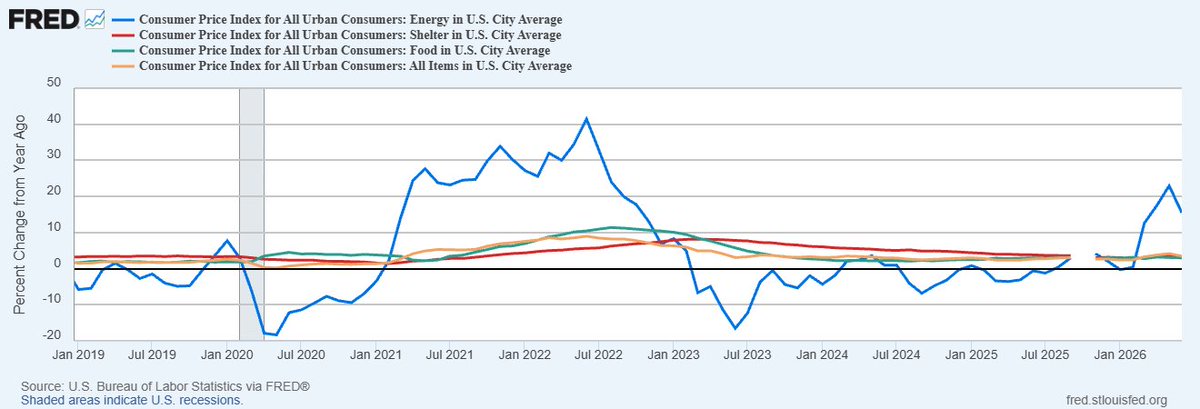
Figure 4 illustrates why inflation cannot be understood as a single process driven by one variable. Energy prices surged rapidly before falling back as global commodity markets stabilized. Shelter inflation rose more gradually and remained elevated for longer. Food prices followed yet another pattern. These differences reflect the fact that prices respond to different supply and demand conditions across the economy rather than moving uniformly because of a single increase in the money supply.
This broader interpretation appears throughout the recent academic literature.
The International Monetary Fund concluded that the post-pandemic inflation surge reflected a combination of strong demand, supply disruptions, and commodity price shocks rather than a single monetary cause. The Bank for International Settlements similarly argued that inflation emerged from the interaction between demand recovery and constrained productive capacity following the pandemic.
Olivier Blanchard has argued that inflation after the pandemic reflected several overlapping forces rather than a repeat of the inflationary episodes of the 1970s. Isabella Weber has highlighted the role of sector-specific supply bottlenecks and strategic pricing in industries facing severe disruptions. While economists continue debating the relative importance of each factor, there is remarkably little support for the idea that one variable alone explains everything that occurred.
This should not be surprising. Modern economies are extraordinarily complex systems. Prices emerge from millions of decisions made by households, businesses, governments, financial institutions, and international markets. Every day firms respond to changes in wages, rents, transport costs, interest expenses, exchange rates, taxes, competition, and expected demand. Inflation is the result of those countless interactions, not the output of a single printing press.
This is also where I think many Austrian explanations become too narrow. Monetary policy certainly influences inflation. Lower interest rates encourage borrowing, support asset prices, and stimulate spending under the right conditions. Fiscal policy can increase household incomes and aggregate demand. Private credit expansion can fuel property booms and financial speculation. Energy shocks can raise production costs across almost every industry. Supply disruptions can reduce output while demand remains strong. Each of these mechanisms can contribute to higher prices, and they often reinforce one another.
Ignoring that complexity produces explanations that fit political narratives better than they fit the evidence.
Perhaps the clearest illustration comes from housing. Home prices have risen dramatically in many advanced economies over recent decades despite very different monetary environments. Interest rates matter, but so do zoning restrictions, land availability, population growth, mortgage lending standards, construction costs, tax policy, investor behavior, and expectations of future price appreciation. Explaining housing inflation by pointing only to central bank money creation leaves much of the story untold.
The same observation applies more broadly to the economy. Inflation cannot be understood by isolating one institution while ignoring the behavior of banks, firms, workers, governments, and consumers. Monetary policy influences all of them, but it does not control them.
None of this means central banks should escape criticism. They have made policy mistakes, underestimated inflationary pressures, and at times responded too slowly to changing economic conditions. My argument is not that the Federal Reserve is always right. It is that criticism should begin with an accurate description of how the monetary system actually works.
If the mechanism is misunderstood, the diagnosis will also be wrong.
By this stage, the evidence points to a consistent conclusion. Commercial banks create money through lending. Reserve balances support the payments system rather than finance private credit. Interest rates influence lending through expectations, profitability, and financial conditions rather than by supplying banks with loanable reserves. Quantitative easing changes the composition of financial assets rather than mechanically injecting spendable money into the private sector. Inflation emerges from the interaction of monetary policy, fiscal policy, private credit, supply conditions, market structure, and expectations.
That is a far more complicated explanation than the slogans often repeated online.
It also happens to be the one most consistent with the modern banking literature.
Following the Evidence
By this point, I hope one thing has become clear. This article was never really about the Federal Reserve.
The Federal Reserve can make mistakes. It has made mistakes. It kept interest rates too low at times, raised them too slowly at others, underestimated inflation after the pandemic, and has repeatedly found itself reacting to events rather than anticipating them. None of that is controversial.
What I have questioned is something much more specific. I have questioned whether the story so often told in Austrian economics accurately describes the way modern banking systems actually work.
The evidence presented throughout this article points in a remarkably consistent direction.
Commercial banks create deposits when they extend loans. They do not lend out reserve balances held at the central bank. Reserve balances exist to settle payments between banks and to support the implementation of monetary policy. Lower policy interest rates influence borrowing, investment, expectations, asset prices, and financial conditions, but they do not mechanically cause banks to multiply reserves into loans. Quantitative easing changes the composition of financial assets held by the private sector rather than dropping spendable money into household bank accounts. Inflation emerges from the interaction of many forces operating throughout the economy rather than from a single institution creating reserves.
None of these conclusions came from one paper.
The Bank of England describes commercial banking this way.
Researchers at the Bank for International Settlements describe commercial banking this way.
Federal Reserve economists describe commercial banking this way.
Academic researchers working in monetary economics describe commercial banking this way.
Some of those economists are New Keynesians. Some are Post-Keynesians. Some work for central banks. Some do not. They disagree over inflation targets, financial regulation, fiscal policy, and many other questions. Yet they repeatedly describe the mechanics of banking in broadly similar terms.
That consistency matters.
Economics advances by testing ideas against evidence. Models survive because they continue explaining the world better than competing models, not because the people who first proposed them become untouchable. Every generation inherits theories from the last. It also inherits the responsibility to test them.
This brings me back to Ludwig von Mises.
I have no interest in dismissing Mises or pretending his work has no value. His contributions to debates about entrepreneurship, market coordination, and economic calculation continue to be studied today. But Mises wrote in a very different monetary world. He wrote before quantitative easing, before interest on reserve balances, before Basel capital standards, before modern electronic payment systems, and before the enormous body of empirical banking research produced over the last half century.
Economics did not stop in 1949.
If new evidence contradicts an older explanation, then the evidence deserves to take priority. That should not be a controversial statement. It is the standard we apply throughout science. Physicists do not reject Einstein because they admire Newton. They recognise that scientific knowledge evolves as better evidence becomes available. Economics should be no different.
That is why I opened this article with the image of Mises walking across a field.
Every school of thought has followers. There is nothing wrong with respecting influential thinkers. The problem begins when followers stop looking around. The shepherd changes direction, and everyone follows without asking whether the path still leads where it once did.
I see that happening far too often in modern discussions of money and banking. The same claims are repeated year after year. Banks lend reserves. The Federal Reserve prints money into the economy. Inflation is always and everywhere the result of central bank money creation. These ideas circulate constantly despite decades of research describing a far more complex system.
Following evidence is harder than following economists.
Evidence forces us to abandon ideas that no longer fit the facts. It forces us to revise theories, question assumptions, and sometimes admit that we were wrong. That process is uncomfortable, but it is also how knowledge advances.
I have no doubt that this article will be criticized. Some readers will accuse me of defending central banks. Others will argue that I have ignored Austrian theory or misunderstood monetary economics. I welcome that discussion. If there are papers I have overlooked or evidence that contradicts the conclusions presented here, I would genuinely like to read them.
What I am less interested in are quotations treated as substitutes for evidence.
Economics should never become a competition over who can quote Mises, Keynes, Friedman, or Marx most often. The only question that ultimately matters is whether our explanations describe the world as it actually exists.
That is the standard I have tried to apply throughout this article.
It is also the standard I believe every school of economics should be willing to accept.
The goal of economics should never be to defend a school of thought. It should be to understand how the economy actually works, even when the evidence forces us to abandon ideas we once accepted.