How to achieve financial independence with AI

I once asked how to get rich and received a meticulous plan for saving money: max out tax-advantaged accounts, automate the transfers, buy low-fee funds, and wait. Every line was sound. Together they answered a different question.

The plan could divide my paycheck, but it could never enlarge it. If I earned $5,000 a month, I might cut $1,500 from my spending and invest the difference. Once the cuts reached rent, food, and the other costs of being alive, that lever stopped. I had asked about income and been given better ways to arrange a fixed sum.

The question gets uglier when you are between jobs and spending too much time on X. Your feed fills with people saying the same things about discipline, speed, and an appetite for discomfort. They post revenue screenshots; your own day contains nothing that could plausibly be multiplied into one. The moral arrives before the mechanism: if the number is not moving, you must not want it badly enough.
Around the same time, I wanted to make $100,000 a month. I opened a spreadsheet and tried to work backward. There was my salary, a possible raise, and the money I could save. Then the rows went blank. Nothing available to me could be turned up ten or twenty times. There was no chain of events leading from an action I could take that day to the number at the top of the sheet.

I kept treating the blank rows as a flaw in myself. Perhaps I lacked nerve, discipline, or the instinct for business. That diagnosis felt serious while telling me nothing. The simpler answer was that the path required pieces I did not have: something that could hold an offer in the market, collect a response, and remain there long enough to change.
You cannot work your way toward a large goal when each day of work leaves you with the same machinery you had yesterday. Before the number becomes a path, something has to exist that can carry a possible path. The relevant question about agents is whether they make these pieces much cheaper to create and maintain.
The $100,000 target functions here as a probe. It exposes a deeper difference: one person can translate the number into variables and feedback, while another receives only pressure. The difference lies partly in the structures around them.
The goal is a configuration
Take three people who each decide to make $100,000 a month. The first earns a salary. He can improve his work, ask for a promotion, or move to a better employer. Those actions affect income within the narrow range of a salary market. A four-percent raise does not contain a hidden route to twelve times his pay.
A trader can increase position size before lunch. Profit may rise; losses can rise faster. She might never reach the target without going broke, but the number exists inside the range of variables she controls. Capital, size, risk, and return give her a dangerous problem she can actually search.

The third person owns several small businesses. He can change a price, replace an offer, try another sales channel, shut down a weak unit, and move cash toward one that is working. None of those decisions guarantees $100,000. Together they give him many possible configurations and a way to compare them.
We tend to describe the difference through character: the trader tolerates risk, the owner thinks big, the employee lacks ambition. Look at the controls and a plainer explanation appears. The employee’s levers stop early. The trader has one lever with terrifying range. The owner has several structures capable of holding different combinations of buyer, offer, price, channel, and delivery method.

That combination is what an income goal actually points toward. Somewhere there may be a buyer who will pay this price for this result, reached through this channel, at a cost that leaves a margin. Most settings produce nothing. A few fit together well enough to support the number.
No display of effort reveals the right settings in advance. They have to meet the world. The work is a search across configurations, and the payoff is usually lopsided: silence across most of the field, then a response that can repay many failed attempts.

A friend of mine found one unusually good configuration in a specialized tax report he sells for about $900. A traditional firm needed weeks to prepare the old version and charged thousands; his software produces it in seconds on a server that costs roughly $5 a month. With gross margin close to 99 percent, a few orders a day take annual revenue near seven figures.
“Tax software” is too broad to explain the result. The money appears at one exact intersection: an urgent buyer finds a trusted report through the right channel, accepts the price, and buys after production has become almost free. Move the buyer, offer, channel, price, or method and the economics may disappear.

A configuration needs somewhere to live
A configuration cannot remain a thought. A price must be posted somewhere. An offer needs a surface where another person can encounter it. Fulfillment has to occur through some repeatable arrangement. The result of each encounter has to leave a mark.
Companies have always done this. So have trading accounts, storefronts, software products, audiences, and bodies of contractual relationships. They preserve a particular arrangement while people sleep, forget, change their minds, or turn their attention elsewhere. Work enters them and changes what will happen next.

This is easy to miss because we attribute the achievement to the person and treat the surrounding machinery as scenery. Yet the machinery remembers the customer, keeps the product available, enforces the price, carries the reputation, and retains the money. It allows yesterday’s judgment to alter today’s choices.
Without something persistent, effort remains a sequence of performances. A person can work with extraordinary intensity and still begin every morning with the same range of action. Nothing has been added to the world that can preserve a correction or keep a promising configuration in place.
The missing object in my spreadsheet was therefore larger than an income lever. I lacked a place where a possible income configuration could live, receive evidence, and become different because the evidence arrived. Until that place existed, every plan came back to me as another thought.

Intelligence needs a body and memory
This is where agents become more interesting than task automation. A model can write copy, inspect a market, produce software, answer a customer, or recommend a price. Intelligence by itself still has no continuing position in the world. A model call ends. Its attention disappears. Nothing guarantees that the next call inherits the same commitments or remembers what reality just said.
An agent acquires continuity from things outside the model: an identity, permissions, tools, accounts, files, databases, code, and a history of actions and results. These form a body of sorts. The model may supply judgment, but the surrounding container holds the configuration between moments of judgment.

External state matters more as models become more capable, not less. A smarter mind can propose better moves, but it still needs to know which move was tried, what changed, who responded, what the response cost, and which facts must remain fixed. More intelligence applied to unstable or imaginary state only produces more persuasive confusion.
The word “autonomous” is often taken to mean an agent operating without human supervision. A more useful meaning is continuity: the result of one action changes the conditions of the next without a person having to reconstruct the entire situation from memory. The loop can continue because its state survives each individual act of reasoning.
Such a loop has a simple philosophical shape. A configuration is held in the world. An action changes part of it. Something outside the agent responds. The response is retained. A later action begins from the altered state. That is how a sequence of model calls becomes a continuing process instead of a pile of disconnected outputs.

The claim has a clear boundary. We do not yet know whether autonomous agents can reliably discover and operate durable businesses, or whether their mistakes will cancel their lower costs. Demand remains external. Markets adapt. A loop can optimize noise as easily as it can find value.
The narrower claim is enough: agents reduce the cost of maintaining and revising candidate configurations in the world. They can keep more possibilities alive, carry forward more state, and shorten the distance between an idea and a real response. That changes who can afford to search, even if it does not guarantee what the search will find.
From a heroic bet to a field of possibilities
Business search was historically expensive because one configuration arrived bundled with most of a company. Testing an offer could require designers, engineers, salespeople, support, legal work, and enough cash to keep them around while you waited for an answer. One fact from the market might cost a founder several years and much of their savings.
Investors escaped this limit with portfolios. Traders could open a position, measure it, resize it, and close it without building a firm around every thesis. Most people had no equivalent way to hold several business configurations at once, so they received only a few attempts and were told to make each one count.

If agents make each persistent configuration cheaper, the natural unit of ambition may change. Instead of one identity-consuming bet, a person might be able to keep several small possibilities in contact with the world. Most would remain quiet. A few might return enough evidence to deserve more attention.
This remains a thought experiment rather than a proven recipe. Its value is that it relocates the source of agency. The decisive advantage would come from owning more intelligence only insofar as that intelligence can inhabit durable structures, preserve separate histories, and remain answerable to signals it does not control.

The comparison returns us to the person staring at the blank spreadsheet. The absence of a path says little about the depth of their ambition. It says that their present world contains no durable configuration through which the number can answer them. Agents matter to this argument only insofar as they widen the set of structures an individual might be able to inhabit.
Ambition is downstream of structure
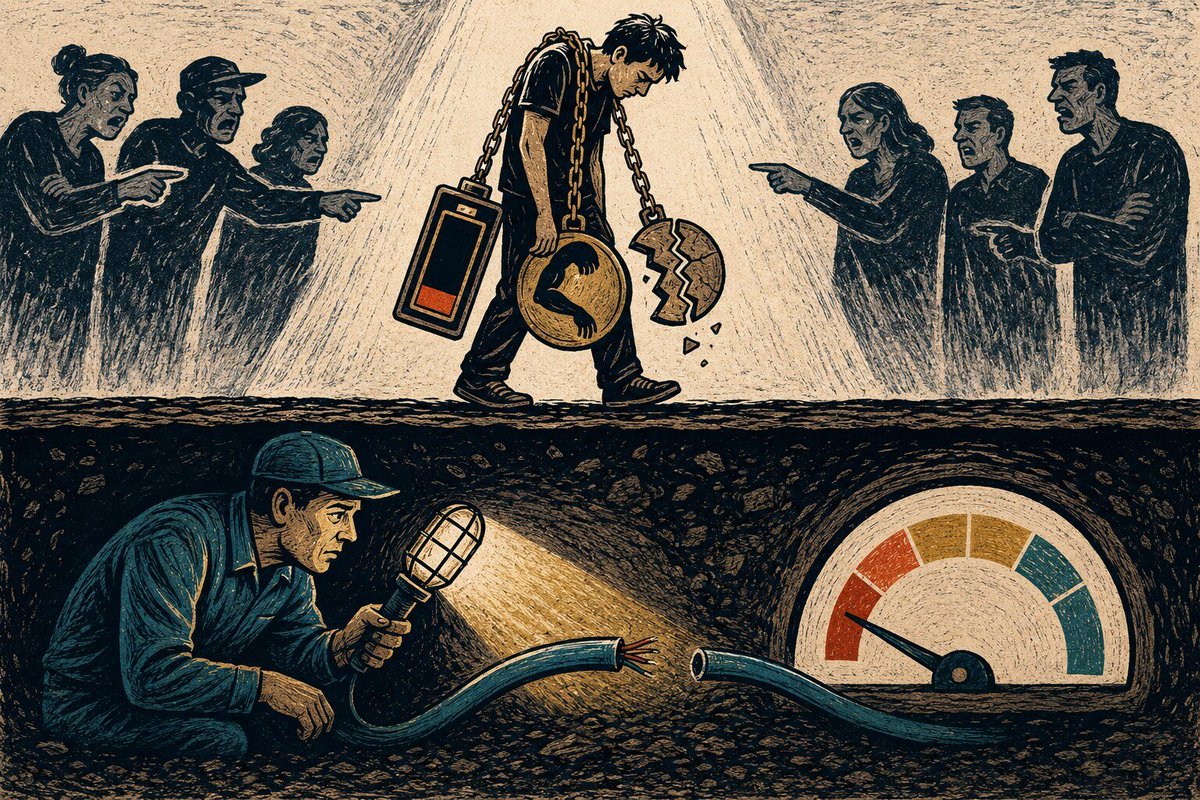
The thought experiment changes the object being explained. An income goal with no structure behind it cannot generate useful corrections. It can intensify desire, shame, envy, or resolve, but those feelings still have no variable to act upon.
From the outside, ambition looks like a property of the person. From inside a working system, it is also a property of the available machinery: somewhere a configuration can live, somewhere reality can answer it, and somewhere the answer can remain. A distant goal can therefore be read as a description of missing structure rather than a demand for a more heroic self.

I know how easy it is to confuse a description of machinery with machinery itself. I spent two years building frameworks nobody had asked for. The diagrams improved, the language sharpened, and the architecture grew more impressive. There was no checkout page, no user waiting, and no stranger who could reject the work. Every signal still came from me.
A design starts producing knowledge when it meets something the designer cannot control. A persistent structure gives that encounter somewhere to happen and gives the result somewhere to stay. Intelligence can then return to a world that is different because the previous attempt occurred.

The path to $100,000 a month does not begin with $100,000 worth of effort. It begins when possible paths have somewhere to live. Until then, the number can only judge you. Once a structure can hold a configuration, accept a response, and change without forgetting, ambition becomes a search the world can answer.