From $340 a month to $5 a month: four local GPU setups that kill your entire AI subscription stack
Last month I paid seven different companies $340 for the privilege of using AI. Claude Pro, ChatGPT Plus, Cursor, Perplexity, Granola, Midjourney, a meeting transcriber whose name I cannot remember, and three other line items I genuinely could not identify on the credit card statement.
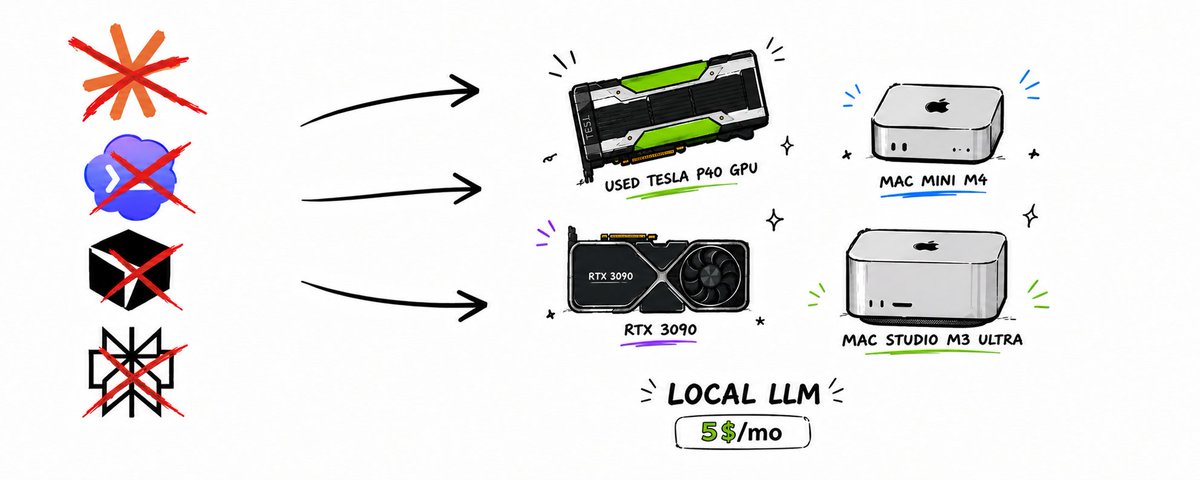
So I did the boring exercise nobody actually does. I opened a note and wrote next to every subscription the last time I touched it for a real piece of work. Not opened. Used.
Half of them had not been opened in over a month. Two were duplicates of tools I already replaced and forgot to cancel. One I have no memory of signing up for.
I cancelled six this morning. Saved $140 a month. Nothing in my workflow changed.
That was the moment the bigger thing clicked. The remaining $200 was Claude Pro, ChatGPT Plus, and Cursor, and the only reason I was paying any of it is that somewhere on the internet a GPU was running a model I could not run myself.
In 2026 that is no longer true.
What changed and why this article exists now
Three things converged in the last eighteen months. Open weight models got dramatically smarter at the 7B to 70B range. Apple's M4 chip and AMD's Strix Halo brought unified memory to consumer prices. The runtime stack (Ollama, Open WebUI) became a single Docker command instead of a weekend of compiling.
The result is that the same class of models people pay subscription fees to access now run on hardware that costs less than two months of a single Pro subscription. Electricity sits around $3 to $10 a month depending on the device. The math has not been close for over a year.
I spent a weekend pricing every option that actually works and ended up with four devices that cover every realistic budget, from "I have $200 in a savings account" to "I want the strongest local setup money can buy."
The cost picture:
Monthly subscription stack (typical heavy user)
Claude Pro                    $20
ChatGPT Plus                  $20
Cursor Pro                    $20
Claude Code Max               $200
Perplexity Pro                $20
Random tools you forgot       $60
Total                         $340/month, $4,080/year

Local hardware path
Hardware (one time)           $180 to $4,199
Electricity                   $3 to $12/month
Optional: keep ONE sub        $20/month
Total year 1                  $216 to $4,343
Total year 2+                 $36 to $144/year
By year two, even the most expensive device on this list has paid for itself five times over against the old subscription bill
Tesla P40 GPU. $180

he cheapest serious entry into local AI by a wide margin, and the option almost nobody writing about local AI mentions.
The Tesla P40 is a 24GB datacenter card that NVIDIA shipped in 2016 for $5,700. Cloud providers retired them when A100s landed, and they have been quietly draining out of the used market ever since. eBay listings in 2026 sit at $150 to $250.
The number that matters: 24GB of VRAM. That is the same memory capacity as a used RTX 3090 and a brand new RTX 5090. It is enough to run Qwen 3.6 27B comfortably, the open model that beats Claude 4.5 Opus on vision benchmarks.
A $180 card running a model that outperforms a $200 a month subscription. That is the trade.
Three things to know before buying:
Total cost out the door: around $220 including adapters. Electricity at $0.15/kWh and 24/7 uptime adds about $7 a month. The whole thing pays back against a single month of Claude Pro.
This is the device for someone who already owns a desktop PC with a spare PCIe slot and wants local AI for the cost of a nice dinner.
Mac mini M4. $599.

The reason every local AI account on the internet keeps recommending the Mac mini is not hype. It is one specific hardware design choice.
On a normal PC the model has to copy data between system RAM and discrete GPU VRAM. That copy step is slow, and you are hard capped at whatever VRAM your card has. On Apple Silicon the CPU and GPU share a single memory pool. The model loads once. Both processors read from the same place.
The practical effect is that a $599 box with 16GB of unified memory runs 7B and 8B models faster than Windows machines costing twice as much. The $799 model with 32GB runs 14B models. The $1,399 M4 Pro with 48GB runs Llama 3.3 70B, the closest open weight model to GPT-4 that fits on a desk.
Power draw is 10 to 30W. The fan is silent under most loads. It can sit on a shelf next to a router and you will not hear it running. Electricity comes out to about $3 to $5 a month.
The pitch is not raw speed. It is that you get a silent, low-power 24/7 server that replaces a $20 ChatGPT Plus subscription in three months while giving you access to models that no subscription tier offers.
Used RTX 3090. $700.

For local AI, VRAM matters more than GPU generation. The RTX 5090 has 32GB and costs $3,800 new. The RTX 4090 has 24GB and trades at $2,000 used. The five-year-old RTX 3090 has the same 24GB as the 4090 and sells for $650 to $750 on eBay.x
The same memory. The same usable model size. About 70 to 80 percent of the speed of a 4090. One third of the price.
The combination that makes this device dangerous: a used 3090, an existing gaming PC, an 850W power supply if yours is undersized. Total spend lands around $850. The result runs Qwen 3.6 27B at roughly 25 to 30 tokens per second. That is faster than ChatGPT Plus on a good day, and it never throttles.
Two warnings when buying used. Stick to eBay sellers with 98 percent or higher feedback. Avoid any listing that mentions mining, because constant high-temperature operation degrades the memory chips over time. Cards that came from gaming PCs are fine.
This is the buy for someone who already owns a desktop PC and wants the best memory per dollar that exists right now.
Mac Studio M3 Ultra. $4,199.

If the budget is not the limiting factor and you want one device that replaces every subscription including the $200 a month frontier tiers, this is the buy.
The base Mac Studio with M3 Ultra ships with 96GB of unified memory. The maxed configuration goes to 192GB. There is no consumer device above this. The next price tier up is a server rack with H100s and a six-figure price tag.
192GB of unified memory is the unlock. That is enough to load Llama 4 Maverick, the full DeepSeek V3, or Qwen3 235B locally without any quantization tricks at all. These are frontier-class models. They are the same weight class as whatever is sitting behind your $200 Claude Code Max or ChatGPT Pro subscription today.
Electricity on a Mac Studio running flat out 24/7 is about $12 a month. Break even versus a single $200 a month subscription hits at month 21. After that the device generates roughly $2,400 a year in pure savings, every year, for as long as the machine survives. Mac Studios typically last seven to ten years before they retire.
Two people should buy this. The developer running combined Claude Code Max plus ChatGPT Pro plus Cursor plus API costs at $400 to $600 a month. And the professional whose work cannot legally leave their device. Lawyers, doctors, financial analysts, journalists working with sources. For them the privacy story alone is worth the spend, before the savings even start.
The software stack is the same on every device
This is the strongest signal that local AI is no longer experimental. The same three commands work on a $180 Tesla P40 and a $4,199 Mac Studio.
# Install the runtime
curl -fsSL https://ollama.com/install.sh | sh

# Pull a model
ollama pull qwen3.6:27b

# Point Claude Code at your local model
ANTHROPIC_BASE_URL=http://localhost:11434/v1 claude
That is it. Ollama is free, open source, and runs every major open weight model. It exposes an OpenAI-compatible API on localhost, which means every tool already wired up for OpenAI just works pointed at a local URL.
For a private ChatGPT-style browser interface, install Open WebUI in one Docker command:
docker run -d -p 3000:8080 \
  --add-host=host.docker.internal:host-gateway \
  -v open-webui:/app/backend/data \
  ghcr.io/open-webui/open-webui:main
Open localhost:3000 in your browser. You now have a private ChatGPT clone running entirely on your hardware.
Quick decision
Already own a desktop PC, want cheapest local AI possible
→ Tesla P40, $180

Want silent 24/7 server, zero setup, runs everything sane
→ Mac mini M4, $599

Already own a gaming PC, want best raw inference per dollar
→ Used RTX 3090, $700

Pay $400+/month combined Claude + ChatGPT + Cursor
→ Mac Studio M3 Ultra, $4,199

Privacy-critical work (legal, medical, financial, journalism)
→ Any of the above. All local. Nothing leaves your network.
The honest tradeoff
Local AI in 2026 covers roughly 80 to 85 percent of what a heavy user actually needs from a paid subscription. Drafting, summarizing, coding, document analysis, retrieval over your own files, automation pipelines. All of it runs locally, instantly, with no per-token cost.
The remaining 15 to 20 percent is where the frontier still pulls ahead. Multi-hour deep research tasks. Specific multi-step reasoning chains. The brand new model release in the week it ships.
For that work, keeping exactly one $20 a month subscription around is the smart move. Most people I know who run local AI keep one Pro tier active and let the other five expire.
The math, even with one subscription kept:
Old:  $340/month × 12 = $4,080/year

New:  hardware (one time) + $20/month sub + electricity
Tesla P40:    $180 + $240 + $84  = $504    year 1
                                   $324    year 2
Mac mini M4:  $599 + $240 + $48  = $887    year 1
                                   $288    year 2
RTX 3090:     $700 + $240 + $84  = $1,024  year 1
                                   $324    year 2
Mac Studio:   $4,199 + $240 + $144 = $4,583 year 1 (break even month 14)
Even the most expensive option saves money in year two. The cheapest option saves you $3,500 in twelve months.
What to actually do this week
Open the credit card statement. Write next to every AI subscription the last time you used it for real work. Not opened. Used.
The number you get back will surprise you. Most people I have done this with cancel three to six tools in the same sitting and free up $80 to $160 a month immediately, before they even buy hardware.
Then look at the four devices in this article. Pick the one that matches the actual work you do. Order it this weekend. Set it up next weekend. The whole thing takes one Saturday afternoon.
The pattern is not that AI tools are bad. The pattern is that subscriptions made sense when the only place to run good models was someone else's data center. In 2026 you can run them on a box that sits silently on a shelf for the price of a coffee a month.
Stop renting compute that fits on a $180 GPU. The window to do this in 2026 is wide open, and the math has never been more in your favor.