@SolarDTM: Jujutsu Kaisen Chapter 216, Ba...
@SolarDTM
28 views
Jun 23, 2026
Advertisement
1
Jujutsu Kaisen Chapter 216, Bath: Analysis 🧵
Discourse on the Theological Nature of Spiritual Cleansing
Discourse on the Theological Nature of Spiritual Cleansing

2
INTRO
Presently, within Theology and Myth, bathing and submerging one’s body in water have consistently maintained a highly spiritual and divine link, often associated with ritualistic purification or radical acceptance of theological beings.
Presently, within Theology and Myth, bathing and submerging one’s body in water have consistently maintained a highly spiritual and divine link, often associated with ritualistic purification or radical acceptance of theological beings.
3
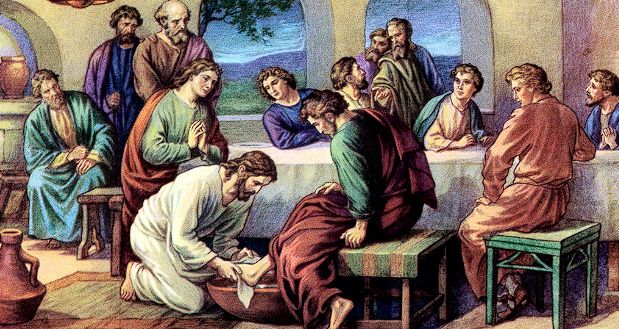
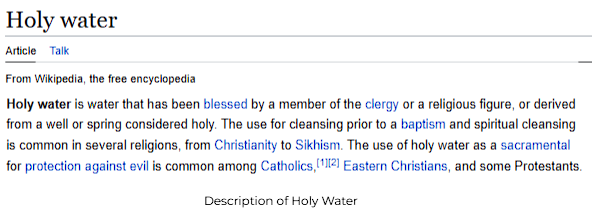
A great example is Christian Baptism, which is considered an invitation within the church and complete acceptance into the religion. Getting baptized is often deemed a rite of passage and a devotion to Christian theology. The general connection to water in Christian thought is often linked to divineness, with sanctified water being referred to as “Holy,” and it can protect against evil.
4
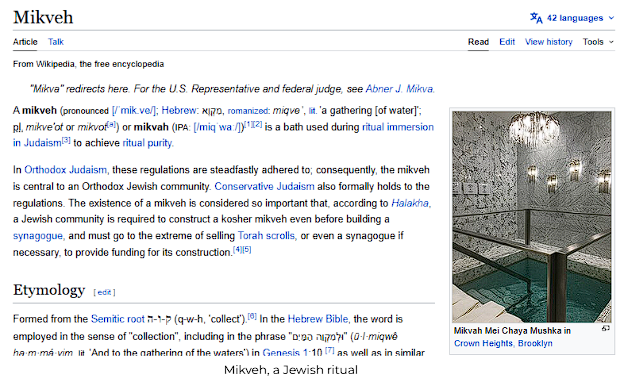
In addition, there's also Mikveh, a ritual bath in Judaism designed for immersion to achieve spiritual purity, and also necessary for the conversion process.
5
Specifically, for Shinto, a religion heavily embedded within Sukuna’s syncretic character, there is a similar concept, which is referred to as Misogi (more broadly referred to as misogiharae when combined with modern tradition)

6
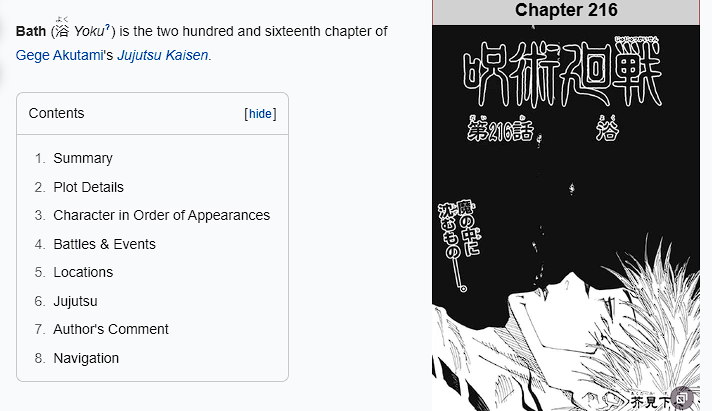
In this discourse, we will explore the significance of this Shinto tradition and how it strengthens Jujutsu Kaisen’s Chapter 216, titled Bath !!
7
I. Explaining Shinto & Buddhist Tradition
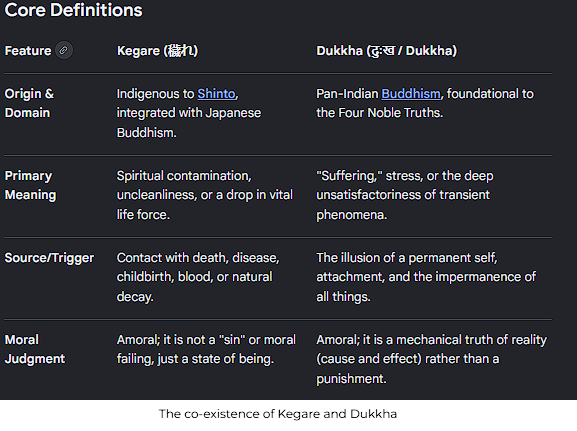
Essentially, there is a concept of pollution referred to as “Kegare,” according to Shinto and Buddhism, it is spiritual impurity, defilement, or a draining of life energy.
In Jujutsu Kaisen, cursed energy, which is humanity's shared negative emotions, is metaphysically representative of Kegare and Buddhist Dukkha. This is because, while Dukkha describes the internal state of suffering, Kegare (spiritual impurity/defilement) describes the contagion it leaves behind.
Essentially, there is a concept of pollution referred to as “Kegare,” according to Shinto and Buddhism, it is spiritual impurity, defilement, or a draining of life energy.
In Jujutsu Kaisen, cursed energy, which is humanity's shared negative emotions, is metaphysically representative of Kegare and Buddhist Dukkha. This is because, while Dukkha describes the internal state of suffering, Kegare (spiritual impurity/defilement) describes the contagion it leaves behind.
8
In Shinto, Kegare is a state of stagnation, or pollution that occurs when death, disease, or intense negativity disrupts the natural flow of life. It’s sticky, it spreads, and it actively corrupts the environment if left unchecked. (Sounds Familiar?)
9
By combining them, Gege Akutami created an intriguing system: Human beings experience Dukkha (existential suffering), which leaks into the physical world as Kegare (spiritual pollution). Jujutsu sorcerers are hazardous waste managers. They aren't curing the existential root (Dukkha); they are just violently scrubbing away the grime (Kegare) before it completely poisons the baseline human world.
It loops back to the perpetual cycle (Samsara) of Jujutsu Kaisen; the pollution can be cleaned, but as long as the engine of human suffering keeps running, the smog will keep coming back.
It loops back to the perpetual cycle (Samsara) of Jujutsu Kaisen; the pollution can be cleaned, but as long as the engine of human suffering keeps running, the smog will keep coming back.
10
II. Expanded Symbolism
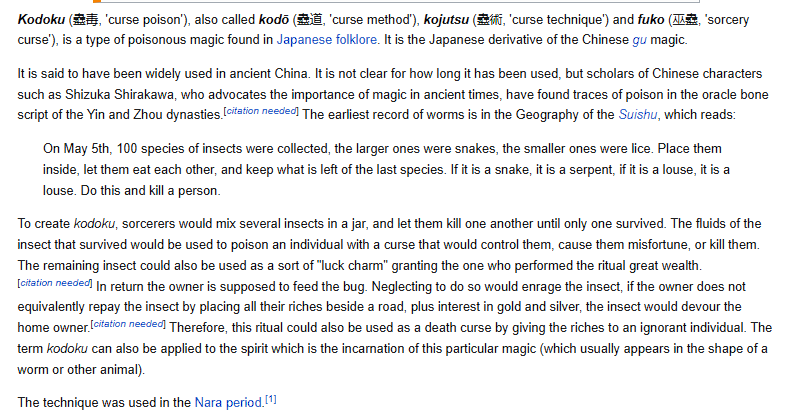
Kenjaku mentions that the bath liquid is created through a process known as Kodoku. Which is a real, ancient ritual from Chinese and Japanese witchcraft (Gu magic), on the Kodoku Wikipedia page, JJK is actually mentioned there !!
Kenjaku mentions that the bath liquid is created through a process known as Kodoku. Which is a real, ancient ritual from Chinese and Japanese witchcraft (Gu magic), on the Kodoku Wikipedia page, JJK is actually mentioned there !!

11
In traditional folklore, a sorcerer would take dozens of venomous creatures: spiders, scorpions, snakes, centipedes, and lock them all inside a single sealed jar. The creatures would violently attack and devour each other out of sheer desperation. The single creature that survived the slaughter was believed to have absorbed the concentrated malice, poison, and spiritual spite of all the ones it killed. Its venom would then be used for lethal curses.
12
Uraume recreated this, but instead of insects, they used cursed spirits trapped in the Zenin clan’s disciplinary pit. (Associated with Dukkha, Mai’s death, and Toji’s Punishment) They forced the curses into a meat grinder of negativity, compressing their suffering into that liquid.
13
Additional Note: Some of the most famous Buddhist parables are representative of water and its functions. The clarity, flow, and ability to reflect are used as metaphors for the mind, purification, and the illusion of reality.
14
III. The Bath
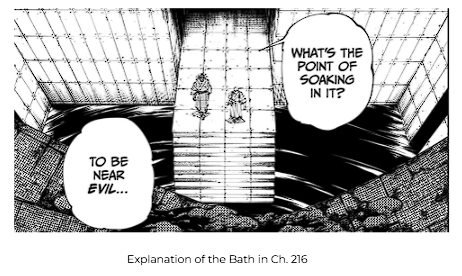
Sukuna and Uraume take the concept of “ spiritual and ego cleansing” in Misogi and invert it. Instead of bathing to wash away impurity (Cursed Energy), Sukuna bathes in it to forcefully defile Megumi’s soul.
- By crushing countless curses into a concentrated liquid, Uraume essentially created a literal tub of pure, condensed spiritual pollution (Kegare).
- Drowning Megumi's soul in it was a twisted anti-baptism meant to crush his moral center so Sukuna could take total control.
Sukuna and Uraume take the concept of “ spiritual and ego cleansing” in Misogi and invert it. Instead of bathing to wash away impurity (Cursed Energy), Sukuna bathes in it to forcefully defile Megumi’s soul.
- By crushing countless curses into a concentrated liquid, Uraume essentially created a literal tub of pure, condensed spiritual pollution (Kegare).
- Drowning Megumi's soul in it was a twisted anti-baptism meant to crush his moral center so Sukuna could take total control.
15
This is one example of how Sukuna takes many concepts within theology and turns them into compromised versions for maliciousness; another one is the concept of being a Bodhisattva and Anti-Buddha/Mara. (Kenjaku does this too, with their name signifying a tool for salvation and breaking the cycle of suffering; they aim to do a corrupted version of that.)

16
In the manga, it's explained that the ritual requires ten months and ten days to complete. In Japanese culture, this is the traditional, poetic length of a human pregnancy.
To accelerate the process, Uraume utilized cursed energy from cursed spirits to create a more potent bile.
The bath is symbolic of a ritual of demonic rebirth. Sukuna uses a process meant to mimic the creation of life to instead "birth" a monster, effectively drowning the last traces of Megumi's humanity.
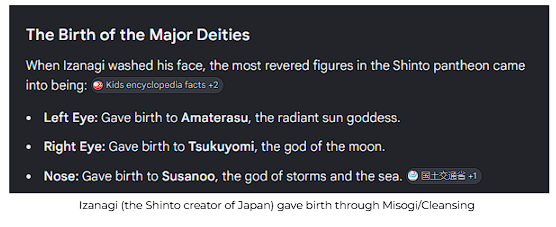
It's worth noting that the bath process represents two forms of birth, human birth and theological birth, with human birth being represented by the time required, and the Shinto myth claiming that Izanagi gave birth through cleansing himself.
To accelerate the process, Uraume utilized cursed energy from cursed spirits to create a more potent bile.
The bath is symbolic of a ritual of demonic rebirth. Sukuna uses a process meant to mimic the creation of life to instead "birth" a monster, effectively drowning the last traces of Megumi's humanity.
It's worth noting that the bath process represents two forms of birth, human birth and theological birth, with human birth being represented by the time required, and the Shinto myth claiming that Izanagi gave birth through cleansing himself.
17
IV. After the Cleanse
After “cleansing” himself within the bath, Sukuna dons a garment stylized after traditional Japanese religious, priestly, and ritual attire.
After “cleansing” himself within the bath, Sukuna dons a garment stylized after traditional Japanese religious, priestly, and ritual attire.

18
The outfit Sukuna puts on isn't just a standard casual kimono; it's a structural nod to ancient Heian-period robes often worn by Shinto priests, Buddhist ascetics, or nobles engaging in spiritual rites:
The High Collar / Neck Wrap is a distinct, tightly wrapped collar and front scarf-like closure, reminiscent of garments worn during serious spiritual ceremonies or by practitioners of ascetic mountain Buddhism (Shugendo).
The High Collar / Neck Wrap is a distinct, tightly wrapped collar and front scarf-like closure, reminiscent of garments worn during serious spiritual ceremonies or by practitioners of ascetic mountain Buddhism (Shugendo).
19
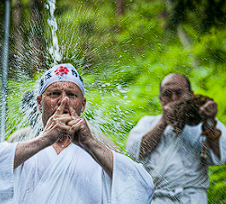
In actual Shinto practice, a practitioner undergoes Misogi (bathing in cold, pure water under a waterfall or in the sea) to wash away spiritual pollution (Kegare) and return to a state of absolute purity. Before the bath, they change into clean, white sacred vestments (Shiro-shōzoku), but Sukuna does it backwards.
By stepping out of the bath, which lasted exactly the traditional duration of a human pregnancy, and donning these sacred-looking clothes, Sukuna is signaling his complete spiritual status. He is dressing like a god or a supreme high priest because, in his mind, he has successfully "purified" the body of Megumi's human morals.
By stepping out of the bath, which lasted exactly the traditional duration of a human pregnancy, and donning these sacred-looking clothes, Sukuna is signaling his complete spiritual status. He is dressing like a god or a supreme high priest because, in his mind, he has successfully "purified" the body of Megumi's human morals.

20
V. Conclusion
The bath is a supreme element of Jujutsu Kaisen’s syncretism, especially for Sukuna; his entire character is a culmination of Buddhism, Shinto, folklore, and More. This ritualistic element adds to the world immensely and solidifies Gege’s mythic brilliance.
The bath is a supreme element of Jujutsu Kaisen’s syncretism, especially for Sukuna; his entire character is a culmination of Buddhism, Shinto, folklore, and More. This ritualistic element adds to the world immensely and solidifies Gege’s mythic brilliance.
21
Heres the link to the document I made for this analysis:
docs.google.com/document/d/1YW…
docs.google.com/document/d/1YW…