@bravosresearch: History is Repeating.Buckle ...
@bravosresearch
12 views
Jun 15, 2026
Advertisement
1
History is Repeating.
Buckle up.
A thread 🧵
Buckle up.
A thread 🧵

2
2/ In December 1928, the Goldman Sachs Trading Corporation was launched.
A historic amount of shares were sold to the public during one of the most euphoric stock market rallies ever recorded.
Just a few months later, the peak of the 1920s stock market was marked by Black Tuesday.
And then the Great Depression began.
A historic amount of shares were sold to the public during one of the most euphoric stock market rallies ever recorded.
Just a few months later, the peak of the 1920s stock market was marked by Black Tuesday.
And then the Great Depression began.

3
3/ In the 1970s Intel went public after multiple decades of economic strength and a historically expensive stock market.
This was shortly followed by a peak in the stock market and a 50% decline.
This was shortly followed by a peak in the stock market and a 50% decline.

4
4/ Then again in April 2000, AT&T's IPO came during one of the most euphoric periods in market history.
And it marked almost the exact peak of the S&P 500 before the dot-com bust led to a 50% decline.
Recently, SpaceX launched its IPO, which came down as the single largest IPO in history.
And it did so amidst one of the strongest and most expensive stock market rallies since the dot com bubble.
In many ways, it seems like history is repeating itself again.
And it marked almost the exact peak of the S&P 500 before the dot-com bust led to a 50% decline.
Recently, SpaceX launched its IPO, which came down as the single largest IPO in history.
And it did so amidst one of the strongest and most expensive stock market rallies since the dot com bubble.
In many ways, it seems like history is repeating itself again.

5
5/ These IPOs that mark historic stock market peaks are neither a coincidence nor a psychological phenomenon.
There is a real mechanical explanation for why this has happened time and time again throughout history.
But in order to understand it, we need to look at what's happening right now more closely.
There is a real mechanical explanation for why this has happened time and time again throughout history.
But in order to understand it, we need to look at what's happening right now more closely.

6
6/ The US stock market recently posted a 16% gain in 2 months, making new all-time highs.
This has has only happened 2 times over the past 100 years:
- 1987 before the Black Monday
- 1929 before the Black Tuesday.
Back then, the euphoria around new tech like electricity, cars, and PCs fueled massive market rallies.
Today, it's AI that has been doing the same.
This has has only happened 2 times over the past 100 years:
- 1987 before the Black Monday
- 1929 before the Black Tuesday.
Back then, the euphoria around new tech like electricity, cars, and PCs fueled massive market rallies.
Today, it's AI that has been doing the same.

7
7/ This is the reason we're currently witnessing the single biggest IPO frenzy in history.
In 2026, companies like OpenAI and Anthropic are expected to raise more than $200 billion through IPOs.
Historically, this is the largest sum of money ever raised even after adjusting for inflation.
So the IPO frenzy today looks similar to the one that took place during the dot-com bubble, right before it burst.
In 2026, companies like OpenAI and Anthropic are expected to raise more than $200 billion through IPOs.
Historically, this is the largest sum of money ever raised even after adjusting for inflation.
So the IPO frenzy today looks similar to the one that took place during the dot-com bubble, right before it burst.

8
8/ When companies raise money through IPOs, money usually comes from one of 2 places:
- Cash on the sidelines.
- Selling other assets.
And for tech IPOs today, investors would most likely sell their other tech stocks in order to gain exposure to the new companies.
- Cash on the sidelines.
- Selling other assets.
And for tech IPOs today, investors would most likely sell their other tech stocks in order to gain exposure to the new companies.

9
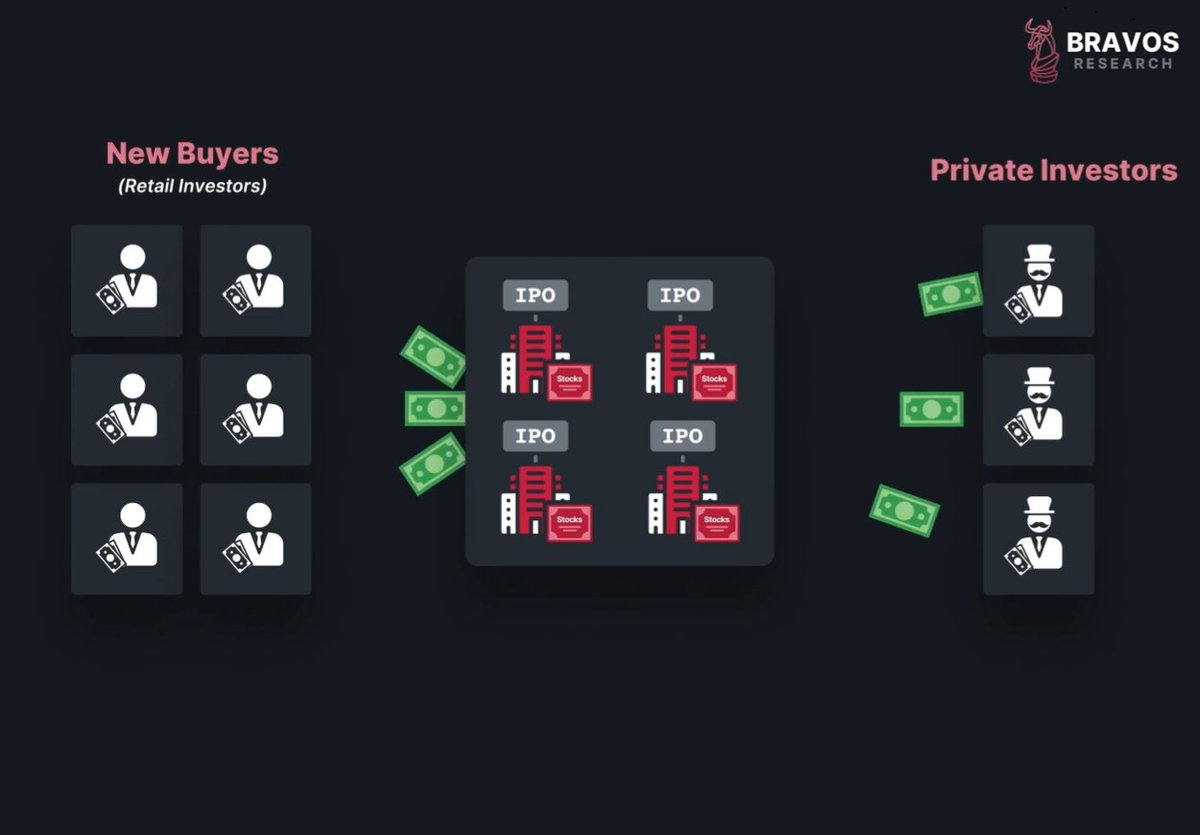
9/ So during an IPO there is a new frenzy of buyers, often retail investors, piling into a handful of companies.
At the same time private investors are cashing out.
This creates a lot of selling pressure on the rest of the market.
It's also why massive IPOs tend to happen when markets are the most expensive and euphoric.
Private investors want to sell when valuations are highest and retail investors are most likely to be buying.
At the same time private investors are cashing out.
This creates a lot of selling pressure on the rest of the market.
It's also why massive IPOs tend to happen when markets are the most expensive and euphoric.
Private investors want to sell when valuations are highest and retail investors are most likely to be buying.
10
10/ In 1999, companies like AT&T, Pets. com, and Linux took advantage of the retail euphoria surrounding tech stocks to go public.
The selling pressure from those large IPOs was likely one of the key reasons the tech boom eventually slowed and reversed.
There simply wasn't enough money on the sidelines to absorb all the new shares being issued.
The selling pressure from those large IPOs was likely one of the key reasons the tech boom eventually slowed and reversed.
There simply wasn't enough money on the sidelines to absorb all the new shares being issued.

11
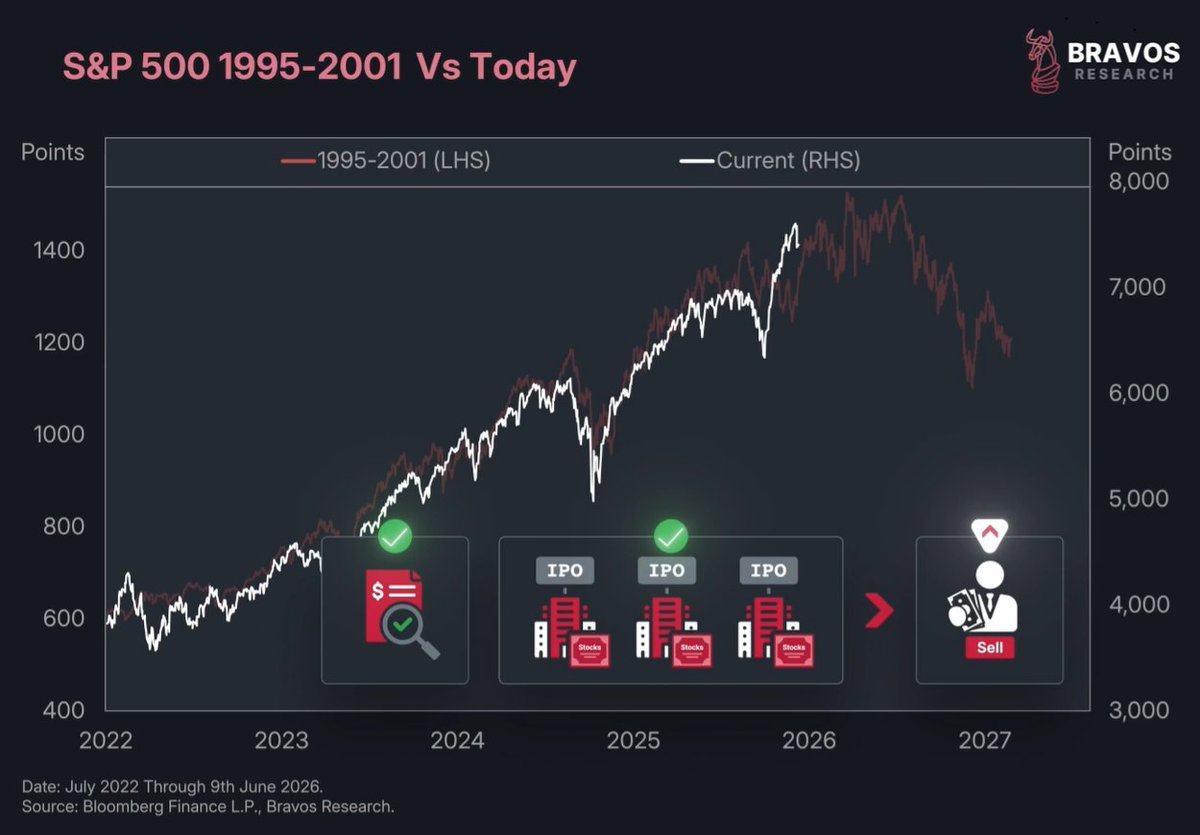
11/ Today, the market is following similar price action to the late 1990s, and valuations are similar as well.
Back then, this setup slowed the bull market and led to its immediate reversal.
Back then, this setup slowed the bull market and led to its immediate reversal.
12
12/ Today, the question is whether we should expect the latest IPOs to lead to a similar outcome?
To answer that, we need to look at the 2 forces that drove the reversal in 2000.
To answer that, we need to look at the 2 forces that drove the reversal in 2000.
13
13/ The 1st force was a lack of cash on the sidelines.
If there isn't enough cash available when massive IPOs take place, investors are forced to sell stocks elsewhere to fund those purchases.
And that's what this chart shows us.
It tells us the amount of cash that is stored on the sidelines at any moment relative to the size of the stock market.
If there isn't enough cash available when massive IPOs take place, investors are forced to sell stocks elsewhere to fund those purchases.
And that's what this chart shows us.
It tells us the amount of cash that is stored on the sidelines at any moment relative to the size of the stock market.

14
14/ In 2000, the cash sitting on the sidelines was at one of the lowest levels ever recorded.
The financial system lacked the dry powder to actually buy the shares that were being issued.
And it caused selling pressure on the rest of the market.
Today, it is sitting at precisely the same level it was back then.
Meaning there is a historically small amount of dry powder available to participate in these IPOs.
The financial system lacked the dry powder to actually buy the shares that were being issued.
And it caused selling pressure on the rest of the market.
Today, it is sitting at precisely the same level it was back then.
Meaning there is a historically small amount of dry powder available to participate in these IPOs.

15
15/ So, it seems unlikely that investors can buy $200 billion worth of new IPO shares without selling other assets.
JPMorgan estimates passive funds will need to sell $95 billion of the 8 largest tech stocks just to make room for these new IPOs.
And we're already seeing signs of it.
Meta, Amazon, Microsoft, and Broadcom all faced selling pressure ahead of the SpaceX IPO.
JPMorgan estimates passive funds will need to sell $95 billion of the 8 largest tech stocks just to make room for these new IPOs.
And we're already seeing signs of it.
Meta, Amazon, Microsoft, and Broadcom all faced selling pressure ahead of the SpaceX IPO.

16
16/ Now, it's impossible to know the exact reason for why investors have been selling these stocks right now.
But it's highly likely that investors are already raising cash in order to buy the new shares.
So the 1st force that we saw in 2000, a lack of cash on the sidelines, is clearly present today.
But it's highly likely that investors are already raising cash in order to buy the new shares.
So the 1st force that we saw in 2000, a lack of cash on the sidelines, is clearly present today.

17
17/ The 2nd key force is tight financial conditions.
If the central bank is providing ample liquidity, odds are that it can offset some of the selling pressure created by IPOs.
But if the Federal Reserve is pulling liquidity out of the system, the situation changes completely.
If the central bank is providing ample liquidity, odds are that it can offset some of the selling pressure created by IPOs.
But if the Federal Reserve is pulling liquidity out of the system, the situation changes completely.

18
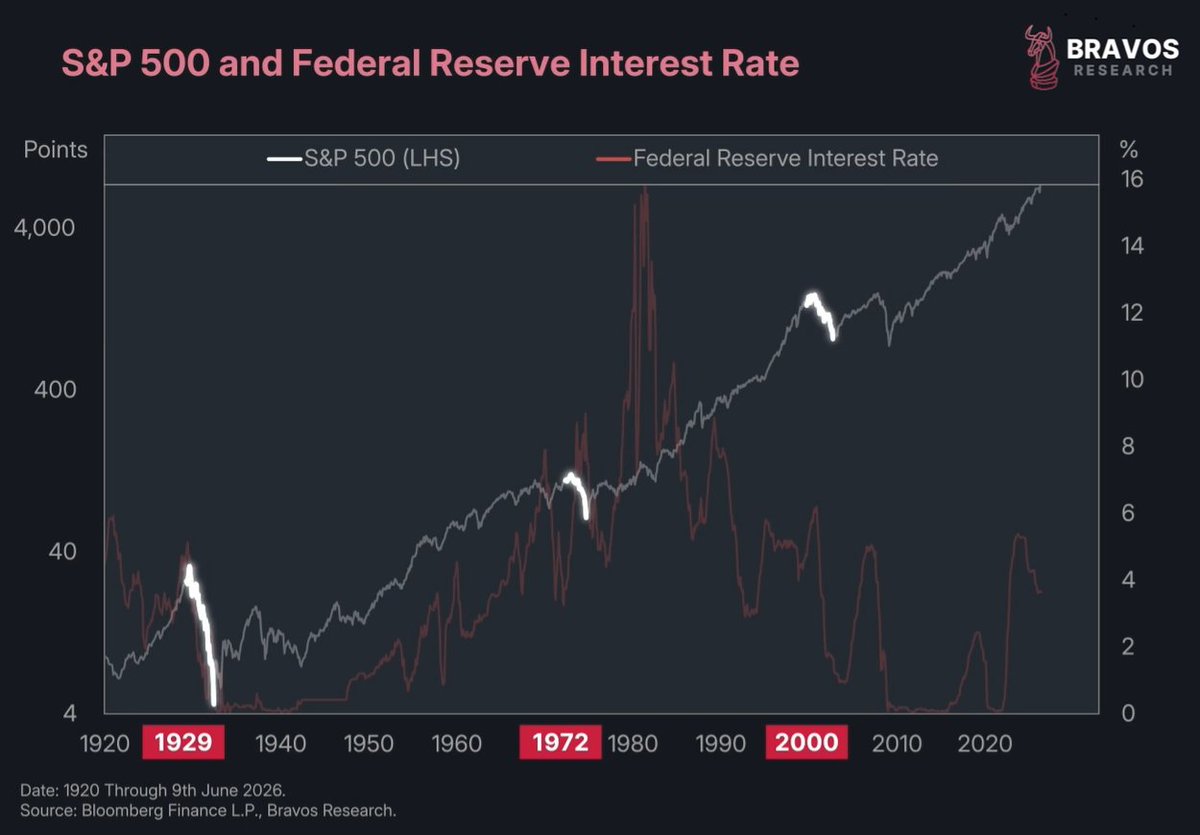
18/ That's exactly what happened in 1929, 1972, and 2000.
In each of these instances, the Fed was raising their interest rates, essentially restricting liquidity in the financial system.
This took place at moments when the market was particularly euphoric and expensive.
So when large IPOs hit the market, they gave investors a reason to sell, resulting in a market decline.
In each of these instances, the Fed was raising their interest rates, essentially restricting liquidity in the financial system.
This took place at moments when the market was particularly euphoric and expensive.
So when large IPOs hit the market, they gave investors a reason to sell, resulting in a market decline.
19
19/ Today, the Fed has not been raising interest rates like it was back then.
For the most part, it has been lowering interest rates and providing looser financial conditions for the stock market.
But this could quickly change.
As the futures markets now suggest the Fed is likely going to raise interest rates by the end of this year.
For the most part, it has been lowering interest rates and providing looser financial conditions for the stock market.
But this could quickly change.
As the futures markets now suggest the Fed is likely going to raise interest rates by the end of this year.

20
20/ So it could be that we are closer to June of 1999, January of 1972, or September of 1927.
These were moments where the stock market was surging.
Major IPOs were already taking place with very little cash on the sidelines.
And the Fed had not begun to actually raise rates and tighten the financial conditions.
These were moments where the stock market was surging.
Major IPOs were already taking place with very little cash on the sidelines.
And the Fed had not begun to actually raise rates and tighten the financial conditions.

21
21/ In all 3 cases, the market still had another 1 to 2 years before reaching its final peak.
Today, if the market is really following a similar path, the chart could end up looking something like this.
Now the SpaceX IPO may not be the exact peak of the market.
But in hindsight it will be remembered as one of the signs that we were getting closer to one.
Today, if the market is really following a similar path, the chart could end up looking something like this.
Now the SpaceX IPO may not be the exact peak of the market.
But in hindsight it will be remembered as one of the signs that we were getting closer to one.

22
22/ However, that does not mean you should sell your stocks and move to cash.
Because the reality is the purchasing power of the US dollar always goes down over time.
And there is also no certainty on when the stock market will actually peak.
History shows that being too heavy in cash is usually a bad idea.
Because the reality is the purchasing power of the US dollar always goes down over time.
And there is also no certainty on when the stock market will actually peak.
History shows that being too heavy in cash is usually a bad idea.

23
23/ That’s because the S&P 500 tends to rise over time because it is priced in US dollars that are losing purchasing power.
And there are good reasons to believe that loss of purchasing power could accelerate in the years ahead.
And there are good reasons to believe that loss of purchasing power could accelerate in the years ahead.

24
24/ We have identified key areas of the market that have the potential to deliver massive returns.
You can see exactly where we think these opportunities are in this FREE video:
go.bravosresearch.com/InvestmentRepo…
You can see exactly where we think these opportunities are in this FREE video:
go.bravosresearch.com/InvestmentRepo…
25
25/ Thanks for reading!
If you enjoyed this thread, please ❤️ and 🔁 the first tweet below
And follow @bravosresearch for more market insights, finance and investment strategies
If you enjoyed this thread, please ❤️ and 🔁 the first tweet below
And follow @bravosresearch for more market insights, finance and investment strategies
View Tweet