@BoxTraderVK: <b>0/</b>A ballroom dancer tou...
0/A ballroom dancer touring the world had no terminal, no real-time quotes, no broker calls, no CNBC.
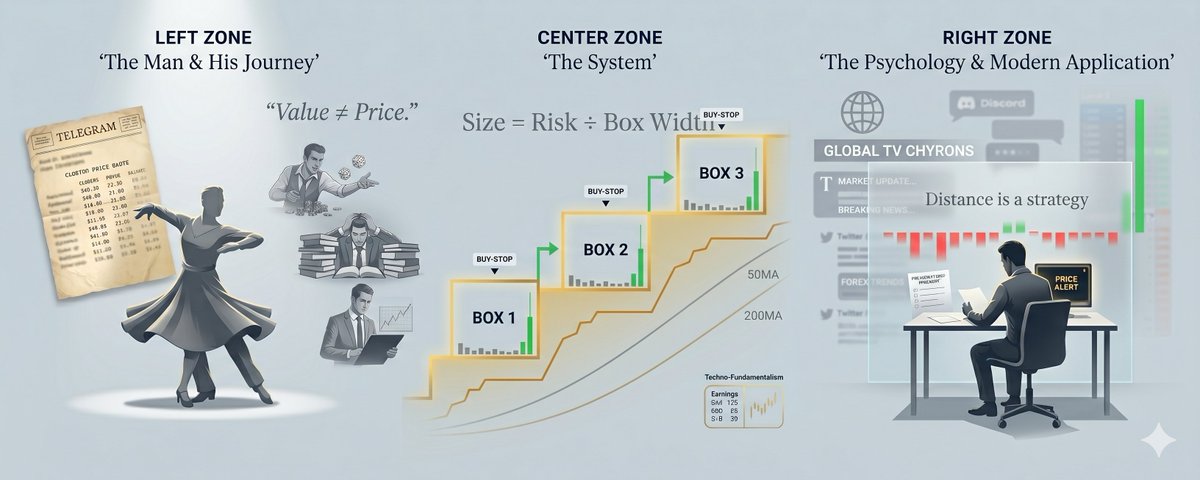
He made $2,000,000 in 18 months.
His weapon was a box. His real edge was silence.
Here's everything. 🧵
PART 1: THE MAN
1/Nicolas Darvas wasn't a trader. He was performing in Tokyo. Istanbul. Paris.
His only market data: → A delayed telegram with closing prices → A weekly Barron's
One number per stock. Per day. That's it.
2/He didn't start a genius.
Phase 1 — the gambler: Tips from waiters. Broker hunches. Rumors.
He chased every one. He lost thousands.
You can't borrow conviction. So he had no spine when price moved against him.
3/Phase 2 — the overcorrection:
He read 200+ books. Studied balance sheets, P/E, dividends.
Found a stock he "proved" was worth far more. Bought it. It dropped. He refused to sell — the numbers say I'm right.
It crushed him.
4/That was the lesson that built the system:
Being right about value ≠ being right about price.
The market doesn't care about your thesis. It only shows you price and volume.
So he threw out everything else.
5/Then a strange thing:
Once touring pulled him away from Wall Street, his results jumped.
Less access. Less noise. More money.
Proximity to noise = proximity to bad decisions. He built a firewall. Telegrams only.
6/Later he moved back near Wall Street.
He kept the firewall anyway. Still telegrams. Still no broker floor.
Distance wasn't forced on him now. He chose it.
That's mastery.
PART 2: THE SYSTEM
7/Core philosophy:
Strong stocks don't go straight up. They consolidate → break out → consolidate → break out.
Each consolidation = a box. Each breakout = your entry.
Steps, not lines. Boxes, not noise.
8/He named his edge: Techno-Fundamentalism.
Fundamentals tell you what can run. Technicals tell you when it's running.
He bought emerging-industry leaders with explosive earnings — but only when price confirmed.
9/Stock selection — before you touch a chart:
✅ New 52-week highs ✅ Strong, accelerating earnings ✅ Emerging, leading industry ✅ High relative strength vs market ✅ Liquid, clean uptrend
Miss any → pass. Full stop.
10/Building the box (exact rule):
→ Stock prints a new high → High holds 3 straight days = BOX TOP → Reaction low in that range = BOX BOTTOM
Price coils inside. Volume dries up inside. Institutions absorbing supply quietly.
11/What a valid box looks like:
📦 Clear uptrend BEFORE the box (none form in downtrends) 📦 Tight, clean range — obvious top and bottom 📦 Volume dead inside 📦 No wild spikes violating the range
Looks messy → it IS messy → skip.
12/Entry — proof, not prediction:
→ Buy stop just above the box top → Only fills if price actually trades there → No guessing. No front-running. No "looks like it's about to go."
Breakout confirms. Then you're in. Not before.
13/Volume is the gatekeeper:
🟢 Surge on breakout = real institutional demand = VALID 🔴 Weak volume on breakout = suspect = pass or small 🔴 Heavy volume on pullback = institutions selling = EXIT warning
Price = what happened. Volume = who did it.
14/Stop loss — non-negotiable:
Initial stop = just below the box bottom.
Price falls back into the box → thesis is dead. No "give it room." No "just a shakeout."
The box IS the room. Respect it.
15/Position sizing from the box:
Risk/share = Entry − Box bottom Size = Account risk ÷ Risk per share
Tight box = bigger size. Wide box = smaller size.
The box sets the bet. Not your gut.
16/Pyramiding — where the real money lives:
→ Break Box 1 → initial position → Box 2 forms & breaks → add → Box 3 forms & breaks → add → Each time → raise stop to the NEW box bottom
Add to winners. Never to losers. Never to hope.
17/The staircase in your head:
Box 1 breaks → buy → stop at Box 1 bottom Box 2 → add → stop to Box 2 bottom Box 3 → add → stop to Box 3 bottom
Trail up every step. Never move a stop down. Winners climb stairs — you climb with them.
18/Exit rules — the hardest part:
❌ No fixed targets ❌ No "up 30%, time to sell" ❌ No "feels extended"
✅ Hold until price breaks the current box bottom
Price decides when you're done. Not your emotions. Not your P&L.
19/ The receiptsThis wasn't theory.
→ Thiokol: rode box after box, banked ~$800K, exited when structure broke → Then pyramided Zenith, Fairchild, Beckman, Litton
Those four tech leaders pushed him past $2M.
Same rules. Every time.
PART 3: THE PSYCHOLOGY
20/His hard rules — written in scar tissue:
🚫 Ignore tips, news, opinions, rumors 🚫 Never average down. Ever. 🚫 Never hope a loser turns around ✅ Take small losses instantly ✅ Trust price and volume only ✅ Let winners run until structure breaks
21/His worst early habit:
Falling in love with a stock. Holding through a structure break "because the story's still good."
The story doesn't move price. Demand moves price. Demand leaves → you leave.
22/He reframed losing:
A small loss isn't failure. It's tuition.
He expected most breakouts to fail. He sized so any single loss barely stung.
You don't avoid being wrong. You make being wrong cheap.
23/The payoff profile most can't stomach:
→ Many small losses from failed breakouts → A FEW giant winners that climb box after box → Win rate often under 50% → Average winner >> average loser
You don't get paid for being right. You get paid for discipline.
24/Modern upgrades that sharpen it:
→ Trade only above rising 50 & 200 MA → Relative strength top decile vs index → ATR buffer above the box top (kills micro fake-outs) → Market regime filter — run this in bull phases only → Skip illiquid names
25/The modern version of what destroyed early Darvas:
📱 Twitter open all day 📺 CNBC in the background 💬 Discord pumping names 📊 15 indicators at once 🔴 Staring at L2 on a swing
You don't need more data. You need less noise.
26/The modern version of what MADE him:
✅ Prep done once, pre-market ✅ Alerts at box breakout levels ✅ Walk away ✅ Stop does the work ✅ Come back when price says something happened
System-based. Not screen-based.
27/The whole thing in one line:
Trend + boxes with volume + non-negotiable stops + pyramid into strength + rare massive winners.
Simplicity IS the edge. Complexity is how you lose.
28/He didn't win because he was smarter. He won because he was further away.
Further from opinions. Further from panic. Further from the noise that makes you override your own rules.
Distance is a strategy.
29/Save this. Build your checklist from it.
Then do the one thing Darvas did that most never will:
Follow your rules when it hurts.
That's where the money is.