@JordanAcademia0: Why the Qur'an does not believ...
@JordanAcademia0
8 views
May 13, 2026
Advertisement
1
Why the Qur'an does not believe in an imminent eschatology or why Muhammad was not a failed apocalyptic prophet: A Thread 🧵
#islamicstudies #islam #quran #religion
#islamicstudies #islam #quran #religion
View Tweet
2
Contents 📚
1. Summarizing @DrJavadTHashmi Article
2. Presenting Other Information (Though Already Mentioned Within The Article)
1. Summarizing @DrJavadTHashmi Article
2. Presenting Other Information (Though Already Mentioned Within The Article)
3
Scholarship That Argues Against Imminent Apocalypticism 📚 (1/2)
Javad T. Hashmi characterizes the Prophet Muḥammad as a "proto-apocalyptic" figure who synthesized traditional prophetic warnings with urgent apocalyptic elements. Most recently, Zishan Ghaffar argues that a close reading of the Qurʾānic text reveals its urgent eschatological discourse to be largely rhetorical in nature.
On his reading, “the early Qurʾan is not at all apoc alyptic,” “does not announce the imminent end of an eon,” and does not portray Judgment Day as temporally near at hand; rather, it aims merely to convey “the cer tainty of its [eventual] fulfilment.” Pointing out that “already in the early Meccan period, the question about the timing of the Hour is rejected (Q 79:42–45),” Ghaffar makes the stronger claim that the Qurʾān is “even programmatically anti-apocalyptic" (Ghaffar 2019a, 211, 254; 2019b, 126–127; 2021, 15). This non- or anti-apocalyptic thesis was already intimated by W. Montgomery Watt in his classic biography of the Prophet, and finds further support in more recent studies by Nicolai Sinai, Klaus Von Stosch, and Andrew O’Connor. Watt 1953 opines that the eschatological language “would seem not to refer to the imminence of the judgement or punishment in the near future but to the reality and certainty of it at some unspecified future time” (65–66); Sinai 2017, 236–238; Von Stosch 2022; O’Connor 2023.
Javad T. Hashmi characterizes the Prophet Muḥammad as a "proto-apocalyptic" figure who synthesized traditional prophetic warnings with urgent apocalyptic elements. Most recently, Zishan Ghaffar argues that a close reading of the Qurʾānic text reveals its urgent eschatological discourse to be largely rhetorical in nature.
On his reading, “the early Qurʾan is not at all apoc alyptic,” “does not announce the imminent end of an eon,” and does not portray Judgment Day as temporally near at hand; rather, it aims merely to convey “the cer tainty of its [eventual] fulfilment.” Pointing out that “already in the early Meccan period, the question about the timing of the Hour is rejected (Q 79:42–45),” Ghaffar makes the stronger claim that the Qurʾān is “even programmatically anti-apocalyptic" (Ghaffar 2019a, 211, 254; 2019b, 126–127; 2021, 15). This non- or anti-apocalyptic thesis was already intimated by W. Montgomery Watt in his classic biography of the Prophet, and finds further support in more recent studies by Nicolai Sinai, Klaus Von Stosch, and Andrew O’Connor. Watt 1953 opines that the eschatological language “would seem not to refer to the imminence of the judgement or punishment in the near future but to the reality and certainty of it at some unspecified future time” (65–66); Sinai 2017, 236–238; Von Stosch 2022; O’Connor 2023.


4
Scholarship That Argues Against Imminent Apocalypticism 📚 (2/2)
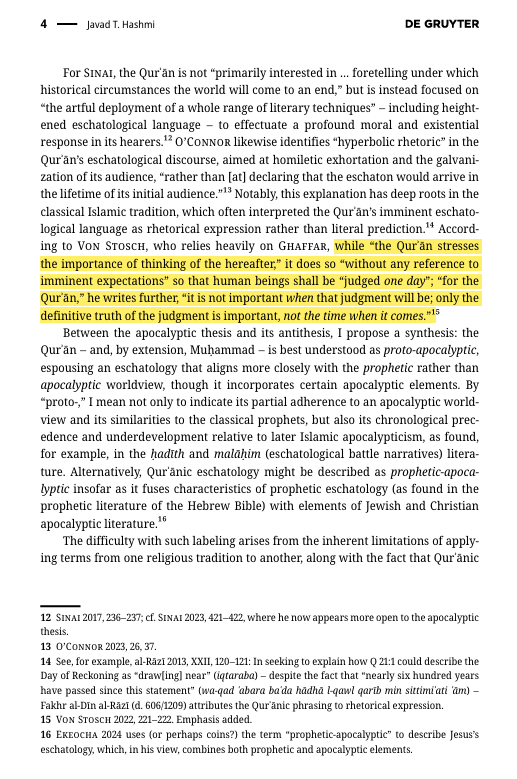
For Sinai, the Qurʾān is not “primarily interested in … foretelling under which historical circumstances the world will come to an end,” but is instead focused on “the artful deployment of a whole range of literary techniques” – including height ened eschatological language – to effectuate a profound moral and existential response in its hearers (Sinai 2017, 236–237; cf. Sinai 2023, 421–422). O’Connor likewise identifies “hyperbolic rhetoric” in the Qurʾān’s eschatological discourse, aimed at homiletic exhortation and the galvani zation of its audience, “rather than [at] declaring that the eschaton would arrive in the lifetime of its initial audience" (O’Connor 2023, 26, 37). Notably, this explanation has deep roots in the classical Islamic tradition, which often interpreted the Qurʾān’s imminent eschatological language as rhetorical expression rather than literal prediction. Accord ing to Von Stosch, who relies heavily on Ghaffar, while “the Qurʾān stresses the importance of thinking of the hereafter,” it does so “without any reference to imminent expectations” so that human beings shall be “judged one day”; “for the Qurʾān,” he writes further, “it is not important when that judgment will be; only the definitive truth of the judgment is important, not the time when it comes" (Von Stosch 2022, 221–222).
For Sinai, the Qurʾān is not “primarily interested in … foretelling under which historical circumstances the world will come to an end,” but is instead focused on “the artful deployment of a whole range of literary techniques” – including height ened eschatological language – to effectuate a profound moral and existential response in its hearers (Sinai 2017, 236–237; cf. Sinai 2023, 421–422). O’Connor likewise identifies “hyperbolic rhetoric” in the Qurʾān’s eschatological discourse, aimed at homiletic exhortation and the galvani zation of its audience, “rather than [at] declaring that the eschaton would arrive in the lifetime of its initial audience" (O’Connor 2023, 26, 37). Notably, this explanation has deep roots in the classical Islamic tradition, which often interpreted the Qurʾān’s imminent eschatological language as rhetorical expression rather than literal prediction. Accord ing to Von Stosch, who relies heavily on Ghaffar, while “the Qurʾān stresses the importance of thinking of the hereafter,” it does so “without any reference to imminent expectations” so that human beings shall be “judged one day”; “for the Qurʾān,” he writes further, “it is not important when that judgment will be; only the definitive truth of the judgment is important, not the time when it comes" (Von Stosch 2022, 221–222).

5
The Imminence of the Hour and the Day of Yahweh
This tradition depicts God as a divine warrior—often using "cloud-rider" imagery inherited from Ancient Near Eastern myths—who descends from the heavens to the terrestrial realm to enact final judgment. the Qurʾān follows the developed Day of the Lord tradition as found in the New Testament, thus primarily warning of an imminent end of the world (“the Hour,” al-sāʿa) and only second arily of a possible localized destruction (“the Punishment,” al-ʿadhāb) of Mecca (Sprenger 1861, 529; Bell 1968, 103; Horovitz 1926, 30–31; Durie 2019, 48–50; Marshall 1999, 50, 65; Saleh 2016, 118). The Punishment Legends (Straflegenden) of the Qurʾān, in which past communities were supernaturally destroyed, serve as typological precursors to the final cataclysmic end, just as the historical Days of Yahweh in the Hebrew Bible prefigure the final, eschatological Day of Yahweh. In places, the Qurʾān threatens either “the Punishment or the Hour” (immā l-ʿadhāba wa-immā l-sāʿata) (Q 19:75; see also Q 12:107 and 22:55), where the former refers to a localized, communal punishment and the latter the cosmic end of the world. However, it should be noted that eschato logical ambiguity remains a central feature of the Qurʾānic rhetoric. Thus, although the Qurʾān dis tinguishes between the Punishment and the Hour in certain verses, in other places the distinction is blurred.
This tradition depicts God as a divine warrior—often using "cloud-rider" imagery inherited from Ancient Near Eastern myths—who descends from the heavens to the terrestrial realm to enact final judgment. the Qurʾān follows the developed Day of the Lord tradition as found in the New Testament, thus primarily warning of an imminent end of the world (“the Hour,” al-sāʿa) and only second arily of a possible localized destruction (“the Punishment,” al-ʿadhāb) of Mecca (Sprenger 1861, 529; Bell 1968, 103; Horovitz 1926, 30–31; Durie 2019, 48–50; Marshall 1999, 50, 65; Saleh 2016, 118). The Punishment Legends (Straflegenden) of the Qurʾān, in which past communities were supernaturally destroyed, serve as typological precursors to the final cataclysmic end, just as the historical Days of Yahweh in the Hebrew Bible prefigure the final, eschatological Day of Yahweh. In places, the Qurʾān threatens either “the Punishment or the Hour” (immā l-ʿadhāba wa-immā l-sāʿata) (Q 19:75; see also Q 12:107 and 22:55), where the former refers to a localized, communal punishment and the latter the cosmic end of the world. However, it should be noted that eschato logical ambiguity remains a central feature of the Qurʾānic rhetoric. Thus, although the Qurʾān dis tinguishes between the Punishment and the Hour in certain verses, in other places the distinction is blurred.


6
The Three-Stage Eschatological Model (1/4)📚
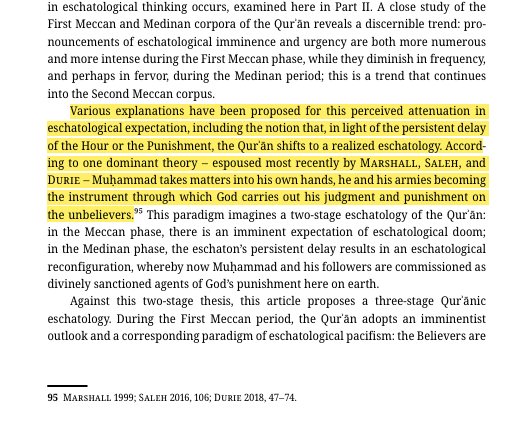
During this stage, the Qur’an emphasizes intense imminentism. Believers are instructed to follow a paradigm of "eschatological pacifism," patiently enduring persecution while awaiting God’s imminent intervention on the "Day of Victory" (yawm al-fatḥ), which mirrors the New Testament's "Day of the Lord". Various explanations have been proposed for this perceived attenuation in eschatological expectation, including the notion that, in light of the persistent delay of the Hour or the Punishment, the Qurʾān shifts to a realized eschatology. Accord ing to one dominant theory – espoused most recently by Marshall, Saleh, and Durie – Muḥammad takes matters into his own hands, he and his armies becoming the instrument through which God carries out his judgment and punishment on the unbelievers (Marshall 1999; Saleh 2016, 106; Durie 2018, 47–74).
During this stage, the Qur’an emphasizes intense imminentism. Believers are instructed to follow a paradigm of "eschatological pacifism," patiently enduring persecution while awaiting God’s imminent intervention on the "Day of Victory" (yawm al-fatḥ), which mirrors the New Testament's "Day of the Lord". Various explanations have been proposed for this perceived attenuation in eschatological expectation, including the notion that, in light of the persistent delay of the Hour or the Punishment, the Qurʾān shifts to a realized eschatology. Accord ing to one dominant theory – espoused most recently by Marshall, Saleh, and Durie – Muḥammad takes matters into his own hands, he and his armies becoming the instrument through which God carries out his judgment and punishment on the unbelievers (Marshall 1999; Saleh 2016, 106; Durie 2018, 47–74).


7
The Three-Stage Eschatological Model (2/4)📚
In the Meccan period, judgment was relegated entirely to God, and the Prophet was viewed only as a "warner". In Medina, a shift occurs where the Believers themselves become the instruments through which God enacts punishment on His enemies. This is most clearly articulated in Q 9:14–15, which instructs the community to fight so that "God will punish them at your hands".
Warfare is not sanctioned to punish "unbelief" (kufr) in a final sense, which remains God's exclusive domain, but is instead a conditional tool to repel religious persecution (fitna), aggression, and treaty violations.
Notably, contrary to the claim that warfare is undertaken as punishment for unbelief (Durie 2018, 60–61; cf. Hashmi 2026), the Qurʾānic pronouncements sanctioning warfare are distinctly defen sive or retaliatory in orientation (Q 22:38–40). Often considered the first Qurʾānic pronouncement to permit warfare, the “permis sion-to-fight” passage provides a distinctly defensive or retaliatory rationale: “Verily, God defends those who believe (inna llāha yudāfiʿu ʿani lladhīna āmanū) … Permission [to fight] is granted to those who are fought, because they have been wronged/oppressed, and God is indeed able to help them (udhina li-lladhīna yuqātalūna bi-annahum ẓulimū wa-inna llāha ʿalā naṣrihim la-qadīr) – those who were driven out from their homes without right, only for saying, ‘Our Lord is God.’ Were it not for God’s repelling people – some by means of others – monasteries, churches, synagogues, and mosques, wherein God’s name is mentioned much, would have been destroyed. And God will surely help those who help Him.” (Q 22:38–40).
In the Meccan period, judgment was relegated entirely to God, and the Prophet was viewed only as a "warner". In Medina, a shift occurs where the Believers themselves become the instruments through which God enacts punishment on His enemies. This is most clearly articulated in Q 9:14–15, which instructs the community to fight so that "God will punish them at your hands".
Warfare is not sanctioned to punish "unbelief" (kufr) in a final sense, which remains God's exclusive domain, but is instead a conditional tool to repel religious persecution (fitna), aggression, and treaty violations.
Notably, contrary to the claim that warfare is undertaken as punishment for unbelief (Durie 2018, 60–61; cf. Hashmi 2026), the Qurʾānic pronouncements sanctioning warfare are distinctly defen sive or retaliatory in orientation (Q 22:38–40). Often considered the first Qurʾānic pronouncement to permit warfare, the “permis sion-to-fight” passage provides a distinctly defensive or retaliatory rationale: “Verily, God defends those who believe (inna llāha yudāfiʿu ʿani lladhīna āmanū) … Permission [to fight] is granted to those who are fought, because they have been wronged/oppressed, and God is indeed able to help them (udhina li-lladhīna yuqātalūna bi-annahum ẓulimū wa-inna llāha ʿalā naṣrihim la-qadīr) – those who were driven out from their homes without right, only for saying, ‘Our Lord is God.’ Were it not for God’s repelling people – some by means of others – monasteries, churches, synagogues, and mosques, wherein God’s name is mentioned much, would have been destroyed. And God will surely help those who help Him.” (Q 22:38–40).
8
The Three-Stage Eschatological Model (3/4)📚
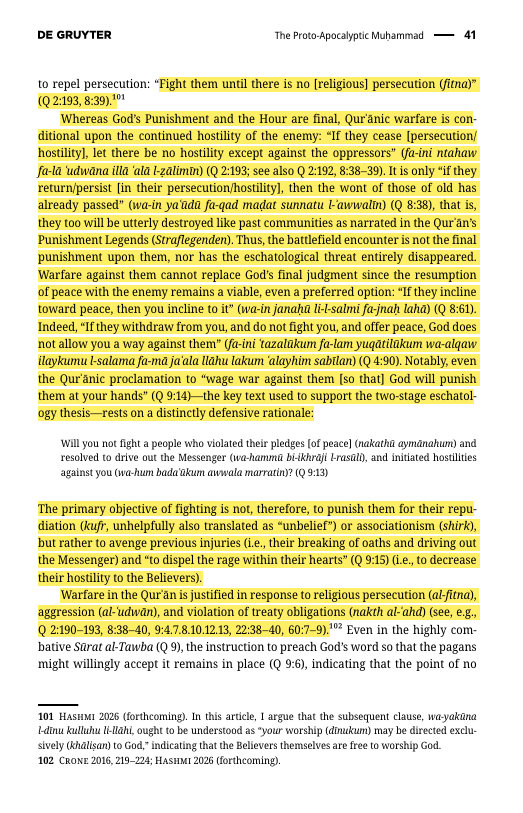
“Fight them until there is no [religious] persecution (fitna)” (Q 2:193, 8:39). Whereas God’s Punishment and the Hour are final, Qurʾānic warfare is con ditional upon the continued hostility of the enemy: “If they cease [persecution/ hostility], let there be no hostility except against the oppressors” (fa-ini ntahaw fa-lā ʿudwāna illā ʿalā l-ẓālimīn) (Q 2:193; see also Q 2:192, 8:38–39). It is only “if they return/persist [in their persecution/hostility], then the wont of those of old has already passed” (wa-in yaʿūdū fa-qad maḍat sunnatu l-ʾawwalīn) (Q 8:38), that is, they too will be utterly destroyed like past communities as narrated in the Qurʾān’s Punishment Legends (Straflegenden). Thus, the battlefield encounter is not the final punishment upon them, nor has the eschatological threat entirely disappeared. Warfare against them cannot replace God’s final judgment since the resumption of peace with the enemy remains a viable, even a preferred option: “If they incline toward peace, then you incline to it” (wa-in janaḥū li-l-salmi fa-jnaḥ lahā) (Q 8:61). Indeed, “If they withdraw from you, and do not fight you, and offer peace, God does not allow you a way against them” (fa-ini ʿtazalūkum fa-lam yuqātilūkum wa-alqaw ilaykumu l-salama fa-mā jaʿala llāhu lakum ʿalayhim sabīlan) (Q 4:90). Notably, even the Qurʾānic proclamation to “wage war against them [so that] God will punish them at your hands” (Q 9:14). The primary objective of fighting is not, therefore, to punish them for their repu diation (kufr, unhelpfully also translated as “unbelief”) or associationism (shirk), but rather to avenge previous injuries (i.e., their breaking of oaths and driving out the Messenger) and “to dispel the rage within their hearts” (Q 9:15) (i.e., to decrease their hostility to the Believers). Warfare in the Qurʾān is justified in response to religious persecution (al-fitna), aggression (al-ʿudwān), and violation of treaty obligations (nakth al-ʿahd) (see, e.g., Q 2:190–193, 8:38–40, 9:4.7.8.10.12.13, 22:38–40, 60:7–9) (Crone 2016, 219–224).
“Fight them until there is no [religious] persecution (fitna)” (Q 2:193, 8:39). Whereas God’s Punishment and the Hour are final, Qurʾānic warfare is con ditional upon the continued hostility of the enemy: “If they cease [persecution/ hostility], let there be no hostility except against the oppressors” (fa-ini ntahaw fa-lā ʿudwāna illā ʿalā l-ẓālimīn) (Q 2:193; see also Q 2:192, 8:38–39). It is only “if they return/persist [in their persecution/hostility], then the wont of those of old has already passed” (wa-in yaʿūdū fa-qad maḍat sunnatu l-ʾawwalīn) (Q 8:38), that is, they too will be utterly destroyed like past communities as narrated in the Qurʾān’s Punishment Legends (Straflegenden). Thus, the battlefield encounter is not the final punishment upon them, nor has the eschatological threat entirely disappeared. Warfare against them cannot replace God’s final judgment since the resumption of peace with the enemy remains a viable, even a preferred option: “If they incline toward peace, then you incline to it” (wa-in janaḥū li-l-salmi fa-jnaḥ lahā) (Q 8:61). Indeed, “If they withdraw from you, and do not fight you, and offer peace, God does not allow you a way against them” (fa-ini ʿtazalūkum fa-lam yuqātilūkum wa-alqaw ilaykumu l-salama fa-mā jaʿala llāhu lakum ʿalayhim sabīlan) (Q 4:90). Notably, even the Qurʾānic proclamation to “wage war against them [so that] God will punish them at your hands” (Q 9:14). The primary objective of fighting is not, therefore, to punish them for their repu diation (kufr, unhelpfully also translated as “unbelief”) or associationism (shirk), but rather to avenge previous injuries (i.e., their breaking of oaths and driving out the Messenger) and “to dispel the rage within their hearts” (Q 9:15) (i.e., to decrease their hostility to the Believers). Warfare in the Qurʾān is justified in response to religious persecution (al-fitna), aggression (al-ʿudwān), and violation of treaty obligations (nakth al-ʿahd) (see, e.g., Q 2:190–193, 8:38–40, 9:4.7.8.10.12.13, 22:38–40, 60:7–9) (Crone 2016, 219–224).


9
The Three-Stage Eschatological Model (4/4)📚
Following the migration to Medina, the eschatology is partially realized through military victory. Warfare is permitted, and victory on the battlefield (fatḥ) is interpreted as a prefiguration of God's theophanic presence.
Elsewhere, the Qurʾān declares of the Ninevites, “They believed, so We granted them enjoyment for a while (fa-mattaʿnāhum ilā ḥīn)” (Q 37:148). The locution “enjoyment for a while” (mattaʿnāhum ilā ḥīn) in the Qurʾān signifies a divine reprieve in this worldly life, with reckoning deferred to the Day of Judgment. “Enjoyment for a while” (wa-matāʿun ilā ḥīn) is used in the well-known Qurʾānic verses refer ring to humanity’s descent from the heavenly garden (Q 2:36, 7:24). The Qurʾān describes “the life of this world as nothing but the enjoyment of delusion (matāʿ al-ghurūr)” (Q 3:185) and refers to it as “a brief [period of] enjoyment” (matāʿ qalīl) (Q 3:197; see also Q 4:77, 9:38, 10:23.70, 13:26, 16:117, 20:131, 28:60.61, 40:39, 42:36, 43:35, 57:20). Notably, the Qurʾān also frames the entirety of human history since the Deluge as a brief period of enjoyment preceding eschatological doom (Q 11:48).
According to this paradigm, the eschatological warner announces a doomsday message to his people, calling on them to repent before it is too late. Crucially, the recipients of this message can avert their fate if they heed his message, repent of their sins, and reform their behavior accordingly. Jonah’s people, the Ninevites, provide the classic illustration: upon repenting, “God changed His mind about the calamity that He had said He would bring upon them; and He did not do it” (Jonah 3:10). This paradigm appears to underlie the mission of many of the classical prophets of the Hebrew Bible (e.g., Ezek 18:21–23; Jer 17:7–8) and may possibly inform the message of Jesus in the New Testament (Luke 13:3).
Following the migration to Medina, the eschatology is partially realized through military victory. Warfare is permitted, and victory on the battlefield (fatḥ) is interpreted as a prefiguration of God's theophanic presence.
Elsewhere, the Qurʾān declares of the Ninevites, “They believed, so We granted them enjoyment for a while (fa-mattaʿnāhum ilā ḥīn)” (Q 37:148). The locution “enjoyment for a while” (mattaʿnāhum ilā ḥīn) in the Qurʾān signifies a divine reprieve in this worldly life, with reckoning deferred to the Day of Judgment. “Enjoyment for a while” (wa-matāʿun ilā ḥīn) is used in the well-known Qurʾānic verses refer ring to humanity’s descent from the heavenly garden (Q 2:36, 7:24). The Qurʾān describes “the life of this world as nothing but the enjoyment of delusion (matāʿ al-ghurūr)” (Q 3:185) and refers to it as “a brief [period of] enjoyment” (matāʿ qalīl) (Q 3:197; see also Q 4:77, 9:38, 10:23.70, 13:26, 16:117, 20:131, 28:60.61, 40:39, 42:36, 43:35, 57:20). Notably, the Qurʾān also frames the entirety of human history since the Deluge as a brief period of enjoyment preceding eschatological doom (Q 11:48).
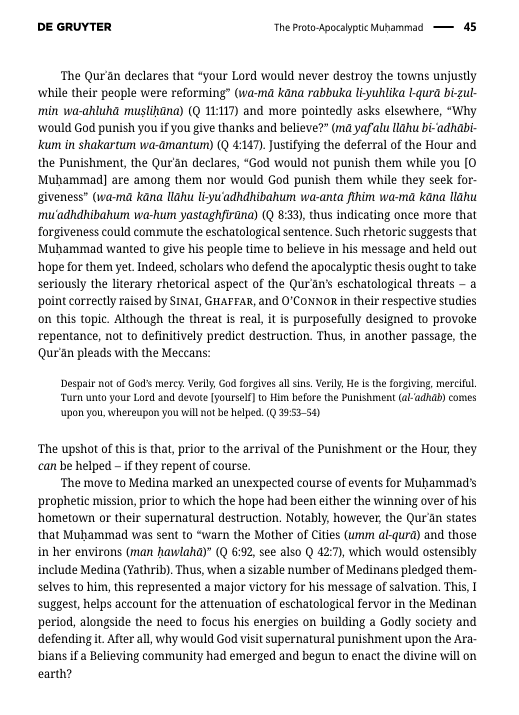
According to this paradigm, the eschatological warner announces a doomsday message to his people, calling on them to repent before it is too late. Crucially, the recipients of this message can avert their fate if they heed his message, repent of their sins, and reform their behavior accordingly. Jonah’s people, the Ninevites, provide the classic illustration: upon repenting, “God changed His mind about the calamity that He had said He would bring upon them; and He did not do it” (Jonah 3:10). This paradigm appears to underlie the mission of many of the classical prophets of the Hebrew Bible (e.g., Ezek 18:21–23; Jer 17:7–8) and may possibly inform the message of Jesus in the New Testament (Luke 13:3).


10
Why The Qur'an Specifically Does Not Have An Imminent Apocalypse (1/3) 📚
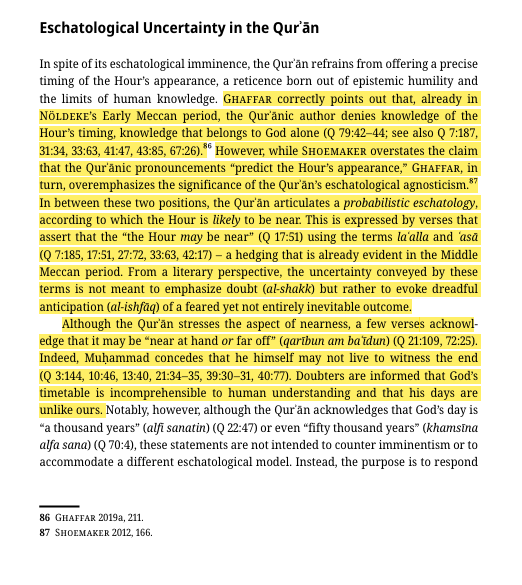
While Muḥammad believed the end was likely, the Qur’an maintains that certain knowledge of its timing belongs to God alone. Ghaffar correctly points out that, already in Nöldeke’s Early Meccan period, the Qurʾānic author denies knowledge of the Hour’s timing, knowledge that belongs to God alone (Q 79:42–44; see also Q 7:187, 31:34, 33:63, 41:47, 43:85, 67:26) (Ghaffar 2019a, 211).
While Muḥammad believed the end was likely, the Qur’an maintains that certain knowledge of its timing belongs to God alone. Ghaffar correctly points out that, already in Nöldeke’s Early Meccan period, the Qurʾānic author denies knowledge of the Hour’s timing, knowledge that belongs to God alone (Q 79:42–44; see also Q 7:187, 31:34, 33:63, 41:47, 43:85, 67:26) (Ghaffar 2019a, 211).


11
Why The Qur'an Specifically Does Not Have An Imminent Apocalypse (2/3) 📚
A central feature of the Qur’an that militates against a deterministic apocalyptic prediction is its consistent rejection of a specific timing for "the Hour".
- Already in the early Meccan period, the Qur'an asserts that certain knowledge of the timing belongs exclusively to God (Q 79:42–45).
- The Prophet is made to declare, "I do not know whether that which you are promised is near at hand or far off" (Q 21:109).
- Qur'an often uses conditional terms like laʿalla and ʿasā ("it may be," "perhaps"), so it's a threat, not an event
Qur’anic eschatology is historically contingent rather than predetermined. This is best exemplified by the "Ninevite paradigm" (the story of Jonah), where the people of Nineveh repented and thereby averted divine destruction.Qur'an frequently mentions that
- God grants "respite" or "enjoyment for a while," deferring punishment to allow for reformation
A central feature of the Qur’an that militates against a deterministic apocalyptic prediction is its consistent rejection of a specific timing for "the Hour".
- Already in the early Meccan period, the Qur'an asserts that certain knowledge of the timing belongs exclusively to God (Q 79:42–45).
- The Prophet is made to declare, "I do not know whether that which you are promised is near at hand or far off" (Q 21:109).
- Qur'an often uses conditional terms like laʿalla and ʿasā ("it may be," "perhaps"), so it's a threat, not an event
Qur’anic eschatology is historically contingent rather than predetermined. This is best exemplified by the "Ninevite paradigm" (the story of Jonah), where the people of Nineveh repented and thereby averted divine destruction.Qur'an frequently mentions that
- God grants "respite" or "enjoyment for a while," deferring punishment to allow for reformation

12
Why The Qur'an Specifically Does Not Have An Imminent Apocalypse (3/3) 📚
the Qur’an lacks several hallmarks of the standard apocalyptic genre . Unlike other apocalypses, the Qur'an:
- Does not depict a predetermined sequence of historical events leading to the end
- Lacks the radical cosmic dualism (a world controlled by the Devil) typical of apocalypticism; instead, God remains in constant, direct control
- Contains no signs to look out for that would delay the end, the "signs" have already arrived
the Qur’an lacks several hallmarks of the standard apocalyptic genre . Unlike other apocalypses, the Qur'an:
- Does not depict a predetermined sequence of historical events leading to the end
- Lacks the radical cosmic dualism (a world controlled by the Devil) typical of apocalypticism; instead, God remains in constant, direct control
- Contains no signs to look out for that would delay the end, the "signs" have already arrived
13
Other Sources On Why There's No Imminent Eschatology In The Qur'an (1/3) 📚
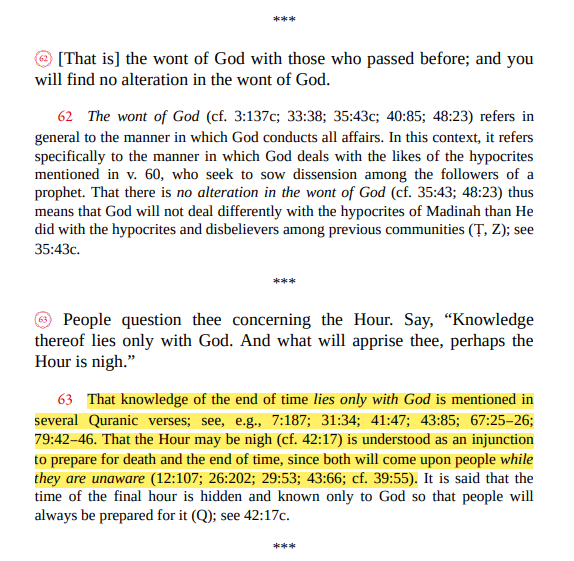
Q79 – It is unclear whether the audience addressed Muhammad because they doubt that the Hour [15] will ever come to pass—as the associators and disbelievers typically do—or whether some of the believers want to learn the precise time of the eschaton in order better to prepare for it. Regardless, God dismisses the question. The Prophet’s role is only to warn about the eschatological hour, not to reveal its time.
Q79 – It is unclear whether the audience addressed Muhammad because they doubt that the Hour [15] will ever come to pass—as the associators and disbelievers typically do—or whether some of the believers want to learn the precise time of the eschaton in order better to prepare for it. Regardless, God dismisses the question. The Prophet’s role is only to warn about the eschatological hour, not to reveal its time.

14
Other Sources On Why There's No Imminent Eschatology In The Qur'an (2/3) 📚
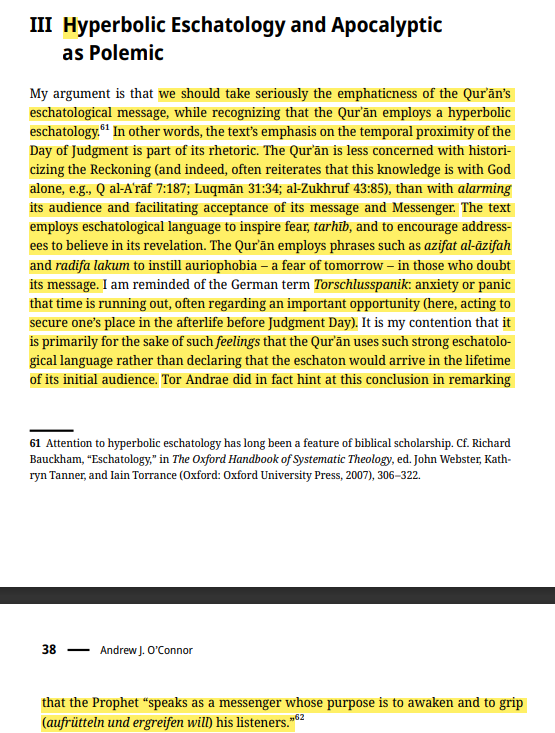
We should take seriously the emphaticness of the Qurʾān’s eschatological message, while recognizing that the Qurʾān employs a hyperbolic eschatology (The Oxford Handbook of Systematic Theology, ed. John Webster, Kathryn Tanner, and Iain Torrance (Oxford: Oxford University Press, 2007), 306–322). In other words, the text’s emphasis on the temporal proximity of the Day of Judgment is part of its rhetoric. The Qurʾān is less concerned with historicizing the Reckoning (and indeed, often reiterates that this knowledge is with God alone, e.g., Q al-Aʿrāf 7:187; Luqmān 31:34; al-Zukhruf 43:85), than with alarming its audience and facilitating acceptance of its message and Messenger. The text employs eschatological language to inspire fear, tarhīb, and to encourage addressees to believe in its revelation. The Qurʾān employs phrases such as azifat al-āzifah and radifa lakum to instill auriophobia – a fear of tomorrow – in those who doubt its message. Torschlusspanik: anxiety or panic that time is running out, often regarding an important opportunity (here, acting to secure one’s place in the afterlife before Judgment Day). It is primarily for the sake of such feelings that the Qurʾān uses such strong eschatological language rather than declaring that the eschaton would arrive in the lifetime of its initial audience.
We should take seriously the emphaticness of the Qurʾān’s eschatological message, while recognizing that the Qurʾān employs a hyperbolic eschatology (The Oxford Handbook of Systematic Theology, ed. John Webster, Kathryn Tanner, and Iain Torrance (Oxford: Oxford University Press, 2007), 306–322). In other words, the text’s emphasis on the temporal proximity of the Day of Judgment is part of its rhetoric. The Qurʾān is less concerned with historicizing the Reckoning (and indeed, often reiterates that this knowledge is with God alone, e.g., Q al-Aʿrāf 7:187; Luqmān 31:34; al-Zukhruf 43:85), than with alarming its audience and facilitating acceptance of its message and Messenger. The text employs eschatological language to inspire fear, tarhīb, and to encourage addressees to believe in its revelation. The Qurʾān employs phrases such as azifat al-āzifah and radifa lakum to instill auriophobia – a fear of tomorrow – in those who doubt its message. Torschlusspanik: anxiety or panic that time is running out, often regarding an important opportunity (here, acting to secure one’s place in the afterlife before Judgment Day). It is primarily for the sake of such feelings that the Qurʾān uses such strong eschatological language rather than declaring that the eschaton would arrive in the lifetime of its initial audience.

15
Other Sources On Why There's No Imminent Eschatology In The Qur'an (3/3) 📚
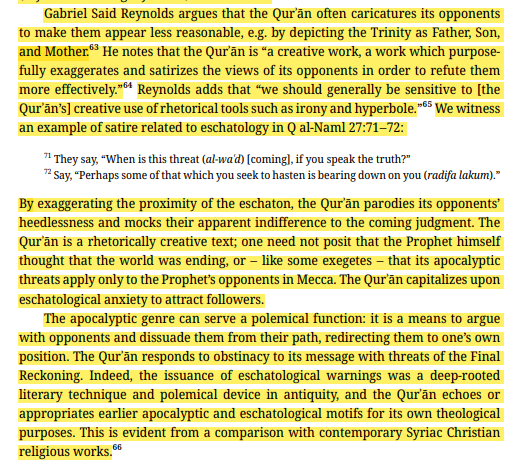
By exaggerating the proximity of the eschaton, the Qurʾān parodies its opponents’ heedlessness and mocks their apparent indifference to the coming judgment. The Qurʾān is a rhetorically creative text; one need not posit that the Prophet himself thought that the world was ending, or – like some exegetes – that its apocalyptic threats apply only to the Prophet’s opponents in Mecca. The Qurʾān capitalizes upon eschatological anxiety to attract followers. The apocalyptic genre can serve a polemical function: it is a means to argue with opponents and dissuade them from their path, redirecting them to one’s own position. The Qurʾān responds to obstinacy to its message with threats of the Final Reckoning. Indeed, the issuance of eschatological warnings was a deep-rooted literary technique and polemical device in antiquity, and the Qurʾān echoes or appropriates earlier apocalyptic and eschatological motifs for its own theological purposes. This is evident from a comparison with contemporary Syriac Christian religious works.
By exaggerating the proximity of the eschaton, the Qurʾān parodies its opponents’ heedlessness and mocks their apparent indifference to the coming judgment. The Qurʾān is a rhetorically creative text; one need not posit that the Prophet himself thought that the world was ending, or – like some exegetes – that its apocalyptic threats apply only to the Prophet’s opponents in Mecca. The Qurʾān capitalizes upon eschatological anxiety to attract followers. The apocalyptic genre can serve a polemical function: it is a means to argue with opponents and dissuade them from their path, redirecting them to one’s own position. The Qurʾān responds to obstinacy to its message with threats of the Final Reckoning. Indeed, the issuance of eschatological warnings was a deep-rooted literary technique and polemical device in antiquity, and the Qurʾān echoes or appropriates earlier apocalyptic and eschatological motifs for its own theological purposes. This is evident from a comparison with contemporary Syriac Christian religious works.

16
Comparison With Other Apocalyptic Sources (1/3)📚
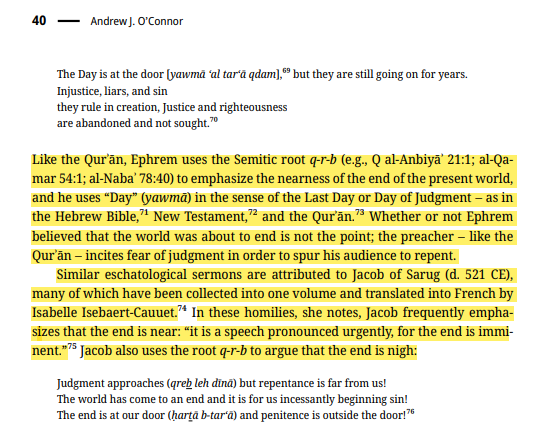
Like the Qurʾān, Ephrem uses the Semitic root q-r-b (e.g., Q al-Anbiyāʾ 21:1; al-Qamar 54:1; al-Nabaʾ 78:40) to emphasize the nearness of the end of the present world, and he uses “Day” (yawmā) in the sense of the Last Day or Day of Judgment – as in the Hebrew Bible (Isa 2:12, 3:7, 4:2, 5:30), New Testament (Rom 2:16; 1 Thess 5:2; Eph 4:30, 6:13; Phil 1:6, 10, 2:16), and Qu’ran (Q al-Aʿrāf 7:53; al-Naḥl 16:111; al-Ṣaffāt 37:33 (“on that day”); 40:17). Whether or not Ephrem believed that the world was about to end is not the point; the preacher – like the Qurʾān – incites fear of judgment in order to spur his audience to repent. Similar eschatological sermons are attributed to Jacob of Sarug (d. 521 CE), many of which have been collected into one volume and translated into French by Isabelle Isebaert-Cauuet (Jacques de Saroug, La Fin du monde : Homélies eschatologiques, ed. and trans. Isabelle Ise baertCauuet (Paris: Migne, 2005). Isebaert-Cauuet collects eight homilies, which correspond with Paul Bedjan’s numbers 31, 32, 67, 68, 192, 193, 194, and 195). In these homilies, she notes, Jacob frequently emphasizes that the end is near: “it is a speech pronounced urgently, for the end is imminent” (Ibid., 198). Jacob also uses the root q-r-b to argue that the end is nigh (Homilies of Mar Jacob of Sarug (Homiliae selectae Mar-Jacobi Sarugensis) vol. 1 (Piscataway, NJ: Gorgias Press, 2006), 510).
In another homily (Bedjan, #192), Jacob of Sarug uses this root three times, stating that the end has drawn near (qerbat ḥartā), that the “coming is near (qarībā),” and that the end has approached (Bedjan, 5:849, 850).
Like the Qurʾān, Ephrem uses the Semitic root q-r-b (e.g., Q al-Anbiyāʾ 21:1; al-Qamar 54:1; al-Nabaʾ 78:40) to emphasize the nearness of the end of the present world, and he uses “Day” (yawmā) in the sense of the Last Day or Day of Judgment – as in the Hebrew Bible (Isa 2:12, 3:7, 4:2, 5:30), New Testament (Rom 2:16; 1 Thess 5:2; Eph 4:30, 6:13; Phil 1:6, 10, 2:16), and Qu’ran (Q al-Aʿrāf 7:53; al-Naḥl 16:111; al-Ṣaffāt 37:33 (“on that day”); 40:17). Whether or not Ephrem believed that the world was about to end is not the point; the preacher – like the Qurʾān – incites fear of judgment in order to spur his audience to repent. Similar eschatological sermons are attributed to Jacob of Sarug (d. 521 CE), many of which have been collected into one volume and translated into French by Isabelle Isebaert-Cauuet (Jacques de Saroug, La Fin du monde : Homélies eschatologiques, ed. and trans. Isabelle Ise baertCauuet (Paris: Migne, 2005). Isebaert-Cauuet collects eight homilies, which correspond with Paul Bedjan’s numbers 31, 32, 67, 68, 192, 193, 194, and 195). In these homilies, she notes, Jacob frequently emphasizes that the end is near: “it is a speech pronounced urgently, for the end is imminent” (Ibid., 198). Jacob also uses the root q-r-b to argue that the end is nigh (Homilies of Mar Jacob of Sarug (Homiliae selectae Mar-Jacobi Sarugensis) vol. 1 (Piscataway, NJ: Gorgias Press, 2006), 510).
In another homily (Bedjan, #192), Jacob of Sarug uses this root three times, stating that the end has drawn near (qerbat ḥartā), that the “coming is near (qarībā),” and that the end has approached (Bedjan, 5:849, 850).
17
Comparison With Other Apocalyptic Sources (2/3)📚
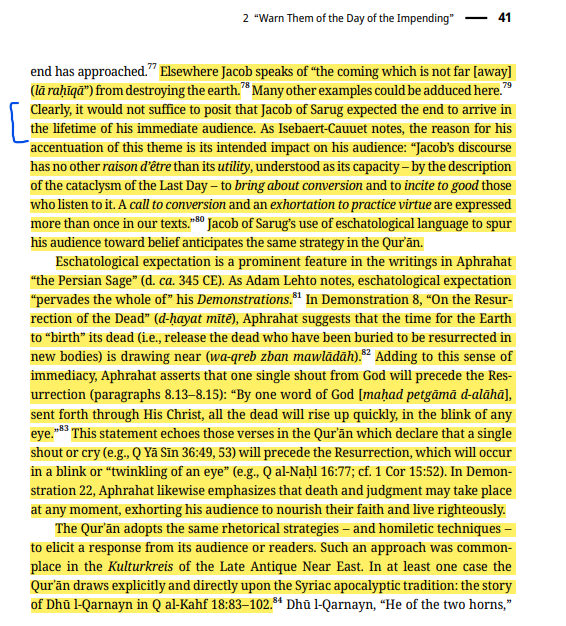
Elsewhere Jacob speaks of “the coming which is not far [away] (lā raḥīqā”) from destroying the earth (Bedjan, 5:887 (French: Jacques de Saroug, La Fin du monde, 181). Many other examples could be adduced here (Jacques de Saroug, La Fin du monde, 198).
Clearly, it would not suffice to posit that Jacob of Sarug expected the end to arrive in the lifetime of his immediate audience. As Isebaert-Cauuet notes, the reason for his accentuation of this theme is its intended impact on his audience: “Jacob’s discourse has no other raison d’être than its utility, understood as its capacity – by the description of the cataclysm of the Last Day – to bring about conversion and to incite to good those who listen to it. A call to conversion and an exhortation to practice virtue are expressed more than once in our texts.” Jacob of Sarug’s use of eschatological language to spur his audience toward belief anticipates the same strategy in the Qurʾān.
Elsewhere Jacob speaks of “the coming which is not far [away] (lā raḥīqā”) from destroying the earth (Bedjan, 5:887 (French: Jacques de Saroug, La Fin du monde, 181). Many other examples could be adduced here (Jacques de Saroug, La Fin du monde, 198).
Clearly, it would not suffice to posit that Jacob of Sarug expected the end to arrive in the lifetime of his immediate audience. As Isebaert-Cauuet notes, the reason for his accentuation of this theme is its intended impact on his audience: “Jacob’s discourse has no other raison d’être than its utility, understood as its capacity – by the description of the cataclysm of the Last Day – to bring about conversion and to incite to good those who listen to it. A call to conversion and an exhortation to practice virtue are expressed more than once in our texts.” Jacob of Sarug’s use of eschatological language to spur his audience toward belief anticipates the same strategy in the Qurʾān.
18
Comparison With Other Apocalyptic Sources (3/3)📚
Eschatological expectation is a prominent feature in the writings in Aphrahat “the Persian Sage” (d. ca. 345 CE). As Adam Lehto notes, eschatological expectation “pervades the whole of” his Demonstrations (Adam Lehto, The Demonstrations of Aphrahat, the Persian Sage (Piscataway, NJ: Gorgias Press, 2010), 46). In Demonstration 8, “On the Resurrection of the Dead” (d-ḥayat mītē), Aphrahat suggests that the time for the Earth to “birth” its dead (i.e., release the dead who have been buried to be resurrected in new bodies) is drawing near (wa-qreb zban mawlādāh) (Ibid., 224. Syriac: Ioannes Parisot, Aphraatis Sapientis Persae Demonstrationes, vol. 1, Patrologia Syriaca 1.1 (Paris: Firmin-Didot, 1894), 371). Adding to this sense of immediacy, Aphrahat asserts that one single shout from God will precede the Resurrection (paragraphs 8.13–8.15): “By one word of God [maḥad petgāmā d-alāhā], sent forth through His Christ, all the dead will rise up quickly, in the blink of any eye” (Lehto, The Demonstrations, 229–230 (Syriac: Parisot, Demonstrationes, 387). This statement echoes those verses in the Qurʾān which declare that a single shout or cry (e.g., Q Yā Sīn 36:49, 53) will precede the Resurrection, which will occur in a blink or “twinkling of an eye” (e.g., Q al-Naḥl 16:77; cf. 1 Cor 15:52). In Demonstration 22, Aphrahat likewise emphasizes that death and judgment may take place at any moment, exhorting his audience to nourish their faith and live righteously. The Qurʾān adopts the same rhetorical strategies – and homiletic techniques – to elicit a response from its audience or readers. Such an approach was commonplace in the Kulturkreis of the Late Antique Near East.
Eschatological expectation is a prominent feature in the writings in Aphrahat “the Persian Sage” (d. ca. 345 CE). As Adam Lehto notes, eschatological expectation “pervades the whole of” his Demonstrations (Adam Lehto, The Demonstrations of Aphrahat, the Persian Sage (Piscataway, NJ: Gorgias Press, 2010), 46). In Demonstration 8, “On the Resurrection of the Dead” (d-ḥayat mītē), Aphrahat suggests that the time for the Earth to “birth” its dead (i.e., release the dead who have been buried to be resurrected in new bodies) is drawing near (wa-qreb zban mawlādāh) (Ibid., 224. Syriac: Ioannes Parisot, Aphraatis Sapientis Persae Demonstrationes, vol. 1, Patrologia Syriaca 1.1 (Paris: Firmin-Didot, 1894), 371). Adding to this sense of immediacy, Aphrahat asserts that one single shout from God will precede the Resurrection (paragraphs 8.13–8.15): “By one word of God [maḥad petgāmā d-alāhā], sent forth through His Christ, all the dead will rise up quickly, in the blink of any eye” (Lehto, The Demonstrations, 229–230 (Syriac: Parisot, Demonstrationes, 387). This statement echoes those verses in the Qurʾān which declare that a single shout or cry (e.g., Q Yā Sīn 36:49, 53) will precede the Resurrection, which will occur in a blink or “twinkling of an eye” (e.g., Q al-Naḥl 16:77; cf. 1 Cor 15:52). In Demonstration 22, Aphrahat likewise emphasizes that death and judgment may take place at any moment, exhorting his audience to nourish their faith and live righteously. The Qurʾān adopts the same rhetorical strategies – and homiletic techniques – to elicit a response from its audience or readers. Such an approach was commonplace in the Kulturkreis of the Late Antique Near East.
19
Mehdy Shaddel on an Imminent Apocalypse (1/1)📚
20
Nicolai Sinai On The Eschatology Of The Qur'an (1/2) 📚
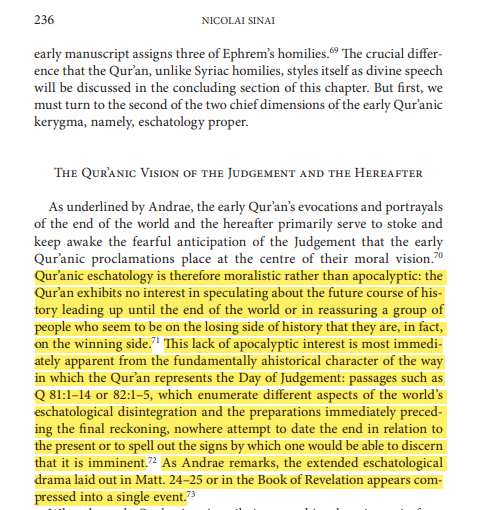
Nicolai Sinai (The eschatological Kerygma of the early Qur’an, p. 236), for example, interprets the eschatology of the Qur'an as a means to motivate its audience to do good and be obedient to God:
As underlined by Andrae, the early Qur’an’s evocations and portrayals of the end of the world and the hereafter primarily serve to stoke and keep awake the fearful anticipation of the Judgement that the early Qur’anic proclamations place at the centre of their moral vision. Qur’anic eschatology is therefore moralistic rather than apocalyptic: the Qur’an exhibits no interest in speculating about the future course of his tory leading up until the end of the world or in reassuring a group of people who seem to be on the losing side of history that they are, in fact, on the winning side. This lack of apocalyptic interest is most immediately apparent from the fundamentally ahistorical character of the way in which the Qur’an represents the Day of Judgement: passages such as Q 81:1–14 or 82:1–5, which enumerate different aspects of the world’s eschatological disintegration and the preparations immediately preceding the final reckoning, nowhere attempt to date the end in relation to the present or to spell out the signs by which one would be able to discern that it is imminent.
Nicolai Sinai (The eschatological Kerygma of the early Qur’an, p. 236), for example, interprets the eschatology of the Qur'an as a means to motivate its audience to do good and be obedient to God:
As underlined by Andrae, the early Qur’an’s evocations and portrayals of the end of the world and the hereafter primarily serve to stoke and keep awake the fearful anticipation of the Judgement that the early Qur’anic proclamations place at the centre of their moral vision. Qur’anic eschatology is therefore moralistic rather than apocalyptic: the Qur’an exhibits no interest in speculating about the future course of his tory leading up until the end of the world or in reassuring a group of people who seem to be on the losing side of history that they are, in fact, on the winning side. This lack of apocalyptic interest is most immediately apparent from the fundamentally ahistorical character of the way in which the Qur’an represents the Day of Judgement: passages such as Q 81:1–14 or 82:1–5, which enumerate different aspects of the world’s eschatological disintegration and the preparations immediately preceding the final reckoning, nowhere attempt to date the end in relation to the present or to spell out the signs by which one would be able to discern that it is imminent.
21
Nicolai Sinai On The Eschatology Of The Qur'an (2/2)📚
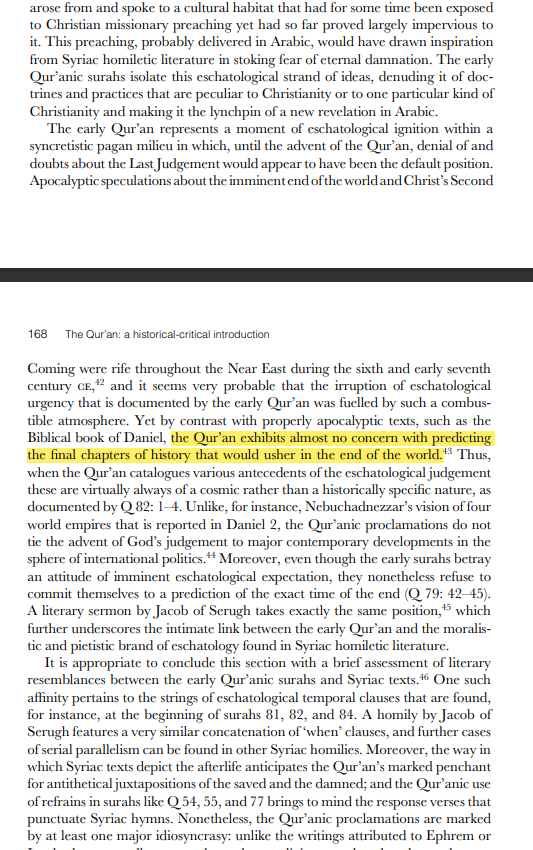
According to Q 79:46, it will appear to the resurrected as if they had spent only a single night in their graves. Later passages speak of a period of ten days (Q 20:103), ‘only an hour’ (Q 10:45, 30:55), and ‘a short while’ (Q 17:52, 23:114). This is NOT the same as an imminent apocalypse. The Qur’an exhibits almost no concern with predicting the final chapters of history that would usher in the end of the world.
According to Q 79:46, it will appear to the resurrected as if they had spent only a single night in their graves. Later passages speak of a period of ten days (Q 20:103), ‘only an hour’ (Q 10:45, 30:55), and ‘a short while’ (Q 17:52, 23:114). This is NOT the same as an imminent apocalypse. The Qur’an exhibits almost no concern with predicting the final chapters of history that would usher in the end of the world.

22
Conclusion📚
If you found this thread insightful, please follow and repost to support more historical research and threads like this.
Join the discussion & access more resources: x.com/i/communities/…
Discord: discord.gg/EG6wJ4zer3
Substack: jordanjournal.substack.com
If you found this thread insightful, please follow and repost to support more historical research and threads like this.
Join the discussion & access more resources: x.com/i/communities/…
Discord: discord.gg/EG6wJ4zer3
Substack: jordanjournal.substack.com