@sairahul1: A full marketing team costs $3...
A full marketing team costs $30,000–$80,000 a month.
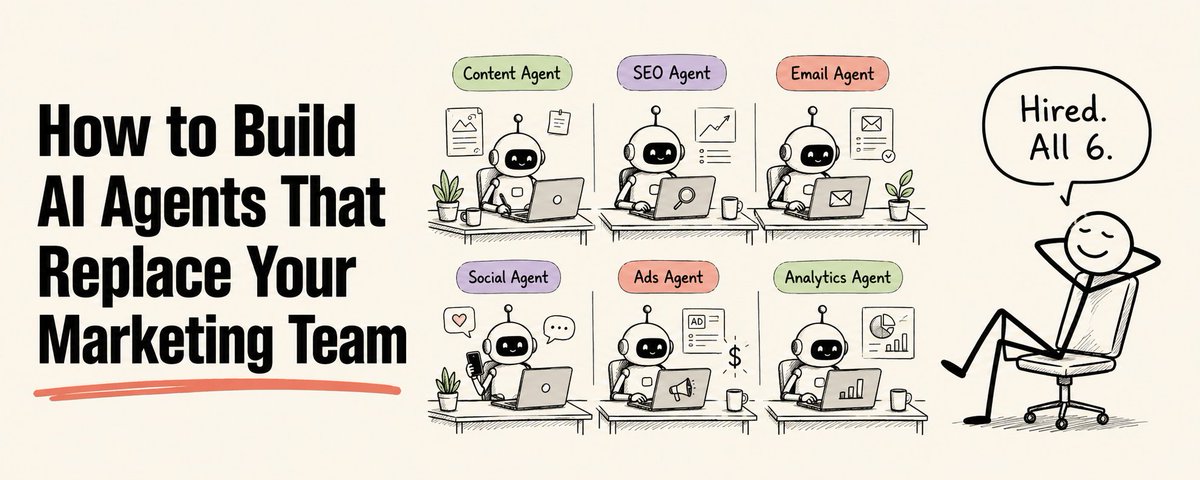
Content writers. SEO strategists. Email marketers. Social media managers. Paid ads specialists. Analytics people. Coordinators to manage them all.
Most founders hire too many, too early. Then wonder why growth is slow and burn is high.
Here's the playbook for replacing your first marketing team with a system of AI agents — and what each agent actually does.
THE SHIFT THAT'S ALREADY HAPPENING
SMBs spending $5,000–$15,000/month on agencies are cutting those costs by 60–80% by running AI agents across social, SEO, email, and paid ads.
Marketing teams using AI agents report 73% faster campaign development. 68% shorter content creation timelines. 30% lower customer acquisition costs.
This isn't hype from a tool vendor. This is what's happening right now at companies you've heard of.
The reason it works: most marketing execution is pattern-repetitive. Write a post. Schedule it. Check performance. Adjust. Write more. AI does all of that. What it can't do is strategy, taste, and genuine creative direction. That's the only part that needs a human.
The teams that win in 2026 run AI agents for execution and one strategic human to direct them.
THE MARKETING TEAM YOU'RE REPLACING
Here are the 6 roles most early-stage teams hire — and the AI agent that replaces each one.
▸ Role 1: Content Writer → Content Agent
▸ Role 2: SEO Strategist → SEO Agent
▸ Role 3: Email Marketer → Email Agent
▸ Role 4: Social Media Manager → Social Agent
▸ Role 5: Paid Ads Specialist → Ads Agent
▸ Role 6: Analytics Manager → Analytics Agent
Let's break down exactly what each one does.
AGENT 1 — THE CONTENT AGENT
Replaces: Content writer ($4,000–$8,000/month)
What it does:
Researches topics using competitor analysis and search intent data. Identifies content gaps — topics your competitors rank for that you don't. Drafts long-form articles optimized for both search and AI search engines (GEO). Matches your brand voice using a trained style guide. Publishes directly to your CMS via MCP integration. Tracks performance and surfaces what to write next.
The full loop: research → draft → optimize → publish → measure → repeat. No human in the loop except for review and approval.
What it can't do: original thought leadership, genuine narrative, contrarian takes that require real experience. Those still need a human.
Tools to build it: Claude or GPT-4.1 as the reasoning layer. Ahrefs or DataForSEO for keyword data. A CMS MCP server (Webflow, WordPress, Ghost). n8n or Make.com or even Claude Cowork/OpenAI Codex to orchestrate the workflow.
AGENT 2 — THE SEO AGENT
Replaces: SEO strategist ($5,000–$10,000/month)
What it does:
Monitors your rankings daily. Tracks competitor movements — when a competitor gains on a keyword you care about, the agent flags it. Audits your site for technical issues (broken links, missing meta, slow pages). Identifies internal linking opportunities across your existing content. Generates keyword clusters for your next content sprint. Reports weekly without being asked.
The old version of this role was expensive because the knowledge was rare. That knowledge is now a prompt.
What it can't do: build actual backlinks, develop genuine relationships, or make judgment calls on brand positioning. Those still need humans.
Tools to build it: DataForSEO or Ahrefs API. A site crawler (Screaming Frog or a custom one). Claude for analysis and recommendations. A Slack or email MCP to push weekly reports automatically.
AGENT 3 — THE EMAIL AGENT
Replaces: Email marketer ($4,000–$7,000/month)
What it does:
Segments your list dynamically based on behavior — who opened what, who clicked what, who bought what. Writes personalized sequences for each segment. Tests subject lines automatically. Monitors deliverability and flags issues before they tank your sender score. Sends campaigns at the optimal time per subscriber. Updates flows when product changes happen.
The key unlock: behavioral segmentation at scale. A human email marketer can manage maybe 4–6 segments. An AI agent manages hundreds — each getting a version tailored to exactly where they are in the journey.
What it can't do: write emails that sound genuinely personal to an individual, handle complex emotional situations, or manage relationship-driven enterprise email.
Tools to build it: Klaviyo, Loops, or ActiveCampaign for the email layer. Claude for copy generation. n8n for the orchestration and trigger logic.
AGENT 4 — THE SOCIAL AGENT
Replaces: Social media manager ($3,500–$6,000/month)
What it does:
Monitors your brand mentions across platforms. Drafts posts in your voice for each platform — not the same post copy-pasted everywhere. Schedules content across the week based on peak engagement times. Repurposes long-form content into threads, carousels, and short clips. Engages with comments using pre-approved response templates. Tracks what performed and adjusts the content mix.
The volume problem: most teams can't post consistently because it takes too much time. An AI social agent produces 30+ pieces of content per week without anyone burning out.
What it can't do: go viral on command, build genuine community relationships, or handle nuanced PR situations.
Tools to build it: Claude for content generation. Buffer or Typefully for scheduling. Make.com to connect content creation to publishing. A web search tool for trend monitoring.
AGENT 5 — THE ADS AGENT
Replaces: Paid ads specialist ($5,000–$12,000/month)
What it does:
Monitors campaign performance in real time. Pauses underperforming ad sets before they drain budget. Generates new ad copy variations for split testing. Identifies the best-performing audiences and scales spend toward them. Alerts you when CAC spikes or ROAS drops below threshold. Produces weekly performance summaries with plain-English recommendations.
The speed advantage: a human ads manager checks performance once or twice a day. An AI agent checks every hour and acts immediately. Budget wastage on a bad day goes from thousands to hundreds.
What it can't do: develop brand-level creative strategy, make judgment calls on sensitive messaging, or build platform relationships with ad reps.
Tools to build it: Google Ads API or Meta Marketing API. Claude for copy generation and analysis. A spreadsheet or dashboard MCP for reporting. n8n to run the monitoring loop on a schedule.
AGENT 6 — THE ANALYTICS AGENT
Replaces: Marketing analyst ($5,000–$9,000/month)
What it does:
Pulls data from every channel into one view. Spots anomalies — traffic drop, conversion rate spike, email unsubscribe surge — and investigates before you notice. Writes the weekly marketing report in plain English, not a spreadsheet. Answers questions in natural language: "Why did CAC go up 30% last month?" Attributes revenue across touchpoints. Forecasts performance based on current trends.
The biggest win: no more waiting for someone to pull a report. The agent delivers insights before you ask.
What it can't do: replace the human judgment needed to act on those insights, run qualitative research, or interview customers.
Tools to build it: Segment or Rudderstack for data pipelines. BigQuery or Postgres as the warehouse. Claude with a database tool for natural language queries. A Slack MCP to push daily digests.
HOW TO WIRE THEM TOGETHER
Individual agents are powerful. Connected agents are a different category.
The winning architecture:
Analytics Agent feeds performance data to every other agent. When content performance drops, the Content Agent is triggered to produce more of what works. When email open rates fall, the Email Agent tests new subject line patterns. When ad ROAS dips, the Ads Agent pauses spend and generates new creative. The SEO Agent surfaces what the Content Agent should write next.
They share context. They react to each other. You get a marketing system that compounds — not just a collection of automated tasks.
The orchestration layer: n8n, Make.com, Cowork, Codex, or a custom agent framework (LangGraph, CrewAI) connects all of them. A shared memory layer (Mem0) means every agent knows what the others have learned.
One human (you, or a growth lead) sets strategy, approves major decisions, and handles anything that requires taste or relationships.
THE 30-DAY TRANSITION PLAN
Don't replace everything at once. You'll overwhelm yourself with review tasks and lose all the efficiency you were trying to gain.
Week 1 — Social Agent + Analytics Agent
Lowest risk. Fastest proof of value. Social content is easy to review. Analytics gives you visibility into everything else from day one.
Week 2 — Content Agent + SEO Agent
Connect them. SEO Agent identifies what to write. Content Agent writes it. Human reviews before publish.
Week 3 — Email Agent
Map your existing segments. Let the agent draft sequences. Review once, then let it run.
Week 4 — Ads Agent
Connect to your ad accounts in read-only mode first. Let it monitor and report. Only enable autonomous budget actions after you trust its judgment.
By Day 30: six agents running, one human directing. You have more marketing output than a team of six, at a fraction of the cost.
WHAT THIS ACTUALLY COSTS
Human marketing team (6 people): $30,000–$50,000/month
Agency alternative: $8,000–$20,000/month
AI agent stack:
Claude/GPT API: $200–$500/month
n8n or Make.com: $50–$200/month
Data tools (Ahrefs, DataForSEO): $100–$400/month
Scheduling + email tools: $100–$300/month
Memory layer (Mem0): $19–$99/month
Vector database: $0–$100/month
Total: $500–$1,600/month
One strategic human to direct it: $5,000–$10,000/month (or your own time).
All-in cost: $6,000–$12,000/month.
Same output as a $40,000/month team.
The gap is the moat.
THE ONE THING THAT MAKES OR BREAKS IT
Most teams fail at this because they treat AI agents like better tools.
They're not tools. They're systems. And systems need:
A clear brief — every agent needs to know exactly what good looks like.
Brand voice training — give it examples of your best content, not just a style guide.
A feedback loop — tell it what performed, not just what was produced.
Human checkpoints — approval before publish, not after.
The teams winning with this aren't the ones with the best AI tools. They're the ones who built the best system around those tools.
Your competitors are still hiring for these roles.
You could have an AI agent in the seat by next week.
The gap between "we're testing AI" and "AI runs our marketing" is execution.
Start with one agent. Master it. Add the next.
Follow for more playbooks on building AI-powered businesses.