@Jay_49erTikTok: @JaiNDoC_RL (credit)...
@JaiNDoC_RL (credit)

— CLAIM
“Alif Lam Mim… that kebab has no oil in it.”
Yes, that’s a real possible reading of the Qur’an.
And it exposes a massive problem with early Qur’anic manuscripts.
— THE VISUAL PROOF

Early Qur’anic text = rasm
— WHAT THE TEXT ALLOWS
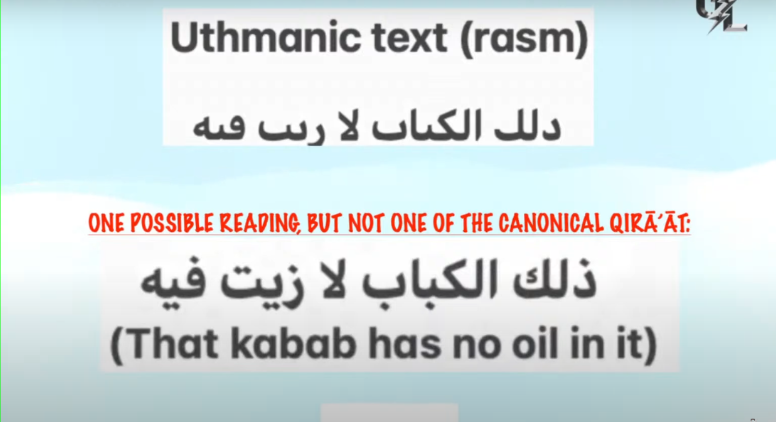
The same skeletal text:
ذلك الكتاب لا ريب فيه
Can be read as:
And as shown here:
“That kabab has no oil in it”
This is not a canonical qirāʾah - but it is still a valid reading from the same letter skeleton.
Same letters.
Different dots.
Completely different meaning.
— THIS IS NOT THEORY
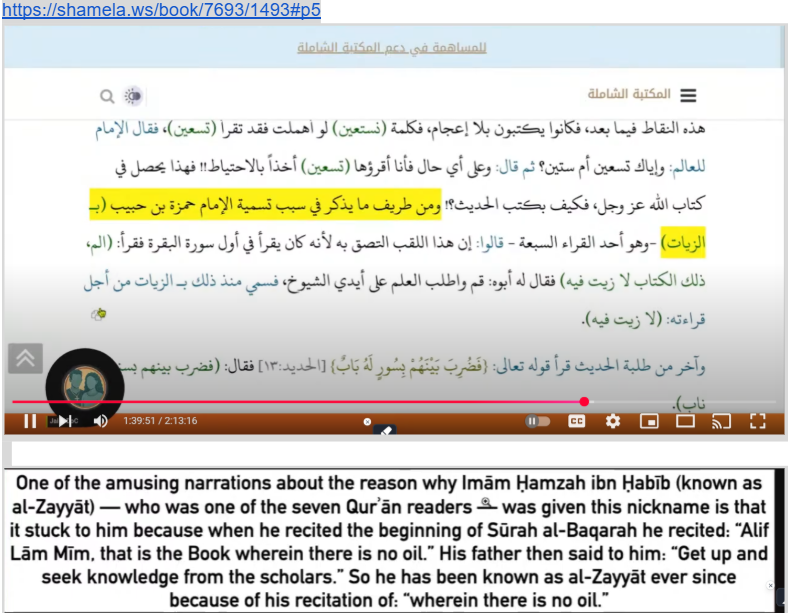
This is not hypothetical.
One of the 7 canonical Qur’an readers —
Hamzah ibn Habib (al-Zayyat) — reportedly made this exact mistake.
Source:
https://shamela.ws/book/7693/1493#p5
He recited Surah 2:2 as:
“That book has no oil in it”
Instead of:
“That book has no doubt in it”
Why?
Because rayb (doubt) and zayt (oil) look identical without dots. His father corrected him and told him to go learn properly. That mistake stuck.
He was nicknamed “al-Zayyat” (the oilman) because of it.
Let that sink in:
This is not a random guy.
This is a canonical Qur’an reader.
— THE CONSEQUENCE
His father corrected him and told him to seek knowledge.
That mistake stuck. He became known as:
al-Zayyat — “the oilman.”
— THE QUESTION THEY CAN’T ANSWER (Post 8)
If the original Qur’an:
Then who decided what it actually says?
Was it:
Because once you admit this:
The Qur’an was not self-explanatory.
It had to be: