@Anime_ArtDir: Art Director: Hiromasa Ogura |...
@Anime_ArtDir
7 views
May 16, 2026
Advertisement
1
Art Director: Hiromasa Ogura | 小倉宏昌
Anime: Ghost in the Shell | GHOST IN THE SHELL / 攻殻機動隊
Year: 1995
Anime: Ghost in the Shell | GHOST IN THE SHELL / 攻殻機動隊
Year: 1995
2
Hiromasa Ogura is a legendary art director, who frequently collaborated with renowned director Mamoru Oshii. Ghost in the Shell, one of the most influential anime movies of all time, is their most widely known collaboration and arguably represents the peak of their ambitions.


3
Ogura started his career as a background artist in 1977, under the supervision of Shichirou Kobayashi at his studio Kobayashi Pro. He contributed backgrounds to standout productions of that time such as the Space Adventure Cobra movie and Lupin III: The Castle of Cagliostro.


4
In 1983, Ogura left Kobayashi Pro alongside Toshiharu Mizutani and Hiroshi Oono and the three of them founded Studio Fuga. There, Ogura served as art director for e.g. Royal Space Force: The Wings of Honneamise in 1987. After this Ogura left Fuga and became an independent artist.


5
It was at this point where Ogura's collaborations with Mamoru Oshii started (Twilight Q and the two Patlabor movies) and Ghost in the Shell is the culmination of Ogura's depiction of Mamoru Oshii's artistic vision, which placed realism at its core.


6
More specifically, Oshii's realism focuses on emulating the use of live action cameras. Consequently a lot of emphasis is placed in the perspective work, which can be very complex and even resort to distortion when the intention is to emulate the use of a wide angle lens.


7
On top of emulating the use of real cameras in the backgrounds, Ogura also made sure that the visual density was very high by adding a lot of detail in the form of decay, light sources bouncing off surfaces differently depending on the material, cluttered spaces and more.


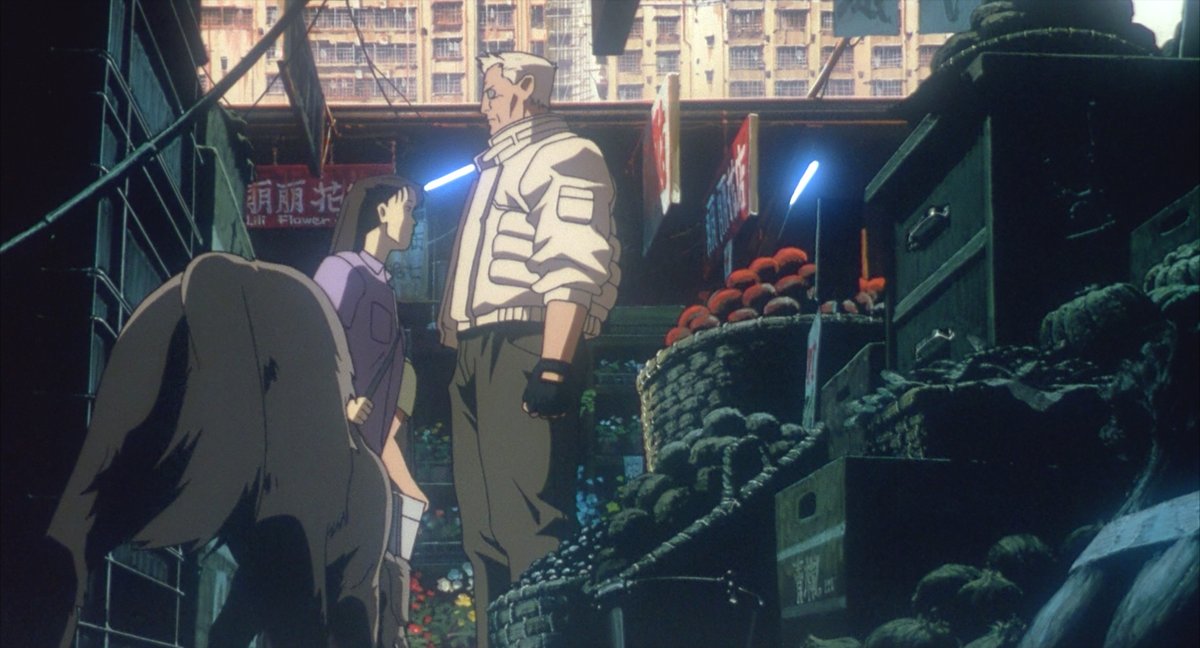

8
All of these choices make the art direction very difficult to execute well. It was an herculean effort that Ogura executed brilliantly. However, the key behind this success was arguably the clear artistic vision behind the movie and the art direction's integral role in it.
9
This movie depicts an advanced, futuristic society where humans can replace their organic body parts with enhanced artificial parts and, where robots and AIs are so complex that they could pass as living beings. The barrier between the living and artificial becomes blurry.
10
The movie's protagonist, Major Kusanagi, lies at the center of this conflict as she is a full cyborg with the exception of her brain. On the other side is the Puppet Master, who is a complex program that gained self awareness and claims to be a living being.


11
Upon coming into contact with the Puppet Master, Major Kusanagi starts to ponder about her own humanity and this leads to the iconic montage sequence of the Major going through the city. No dialogues, only background music and some of the best anime background art ever.
12
The Puppet Master gained self awareness after traversing the net for multiple years and the montage sequence with the Major mirrors this process but for a human in the real world. As a result, the city itself represents a complex network, where information is constantly flowing.


13
The city is filled with sign boards, a representation of information units found in a network. The water roads of the city allude to the flow of information within such a network. The high level of detail in the backgrounds makes this concept even more palpable to viewers.


14
Another important concept is the fact that the net is built upon older versions of itself. Instead of creating something entirely new from scratch, it is being built upon progressively. The city of this movie reflects this with the contrast between the old town and new town.


15
On the one hand, Ogura chose to depict the more modern parts of the city as sterile, favoring the use of blue tones in the backgrounds and achieving a high density with densely packed skyscrapers. This "cleanliness" can be associated with a more efficient network.


16
On the other hand, the old parts of the city are cluttered and chaotic. The objects themselves are detailed and signs of decay in the structures, buildings and objects are everywhere. This can be associated with a less efficient network, but one that feels more "alive".


17
The movie's city was based off Hong Kong, which according to Oshii was very close to his vision with its contrasting old and new zones. Location scouting was made and reference photos were taken in black and white, in order to not bias the color choice of the background art team.
18
The detailed art direction was a departure from Ogura's representative style, which is closer to that of Shichirou Kobayashi, favoring stylization and abstraction of detail. This movie is proof that this is just a preference of Ogura's, showing his versatility as an artist.
19
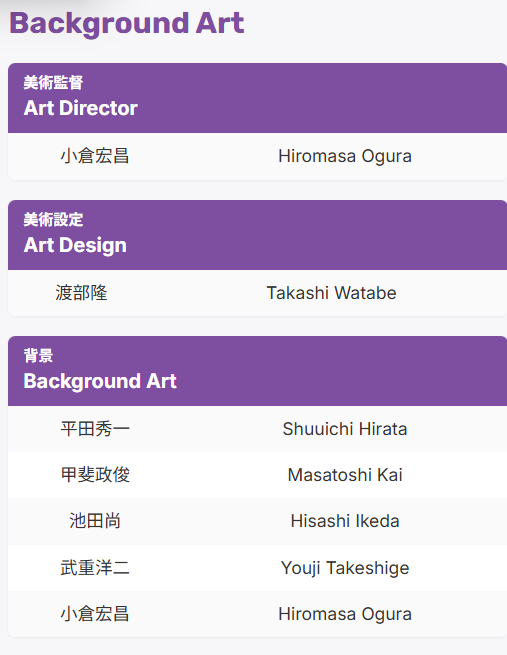
The team of background artists under Ogura was also very capable and talented. The name that stood out the most was arguably that of Shuiichi Hirata, who later became one of the industry's most standout art directors known for the extreme level of detail in his backgrounds.


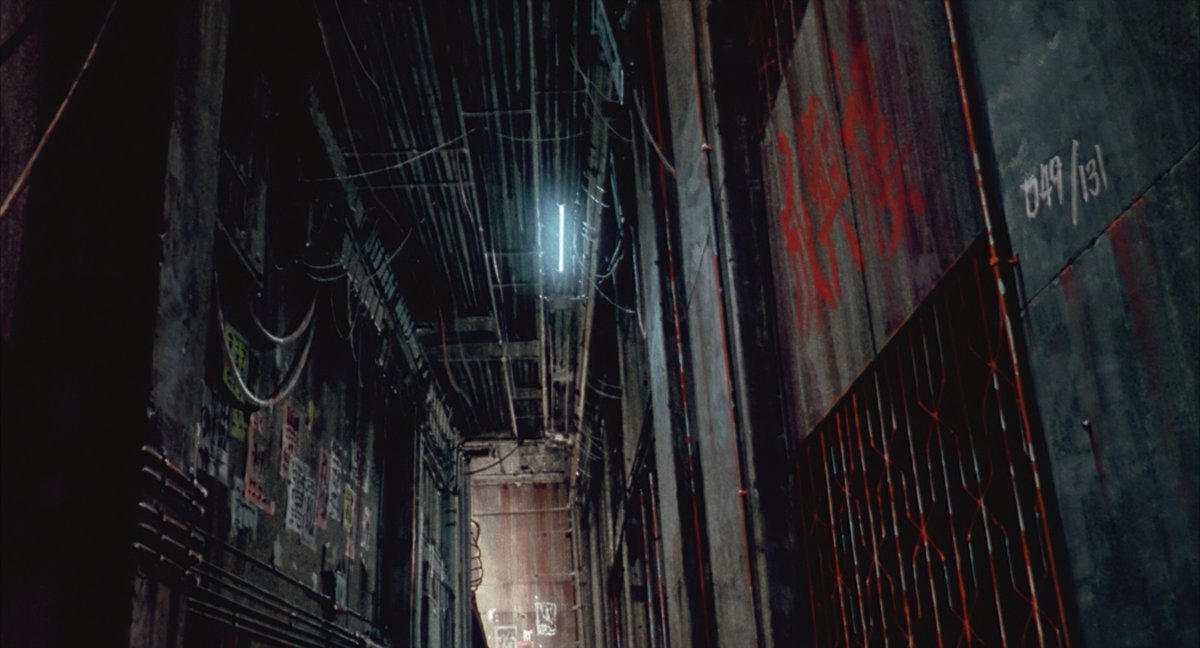
20
Hirata painted mostly backgrounds of the old town, specifically the chase sequence in the market and the first half of the montage sequence, where the old town during daylight is depicted. His style was a perfect fit for this task.

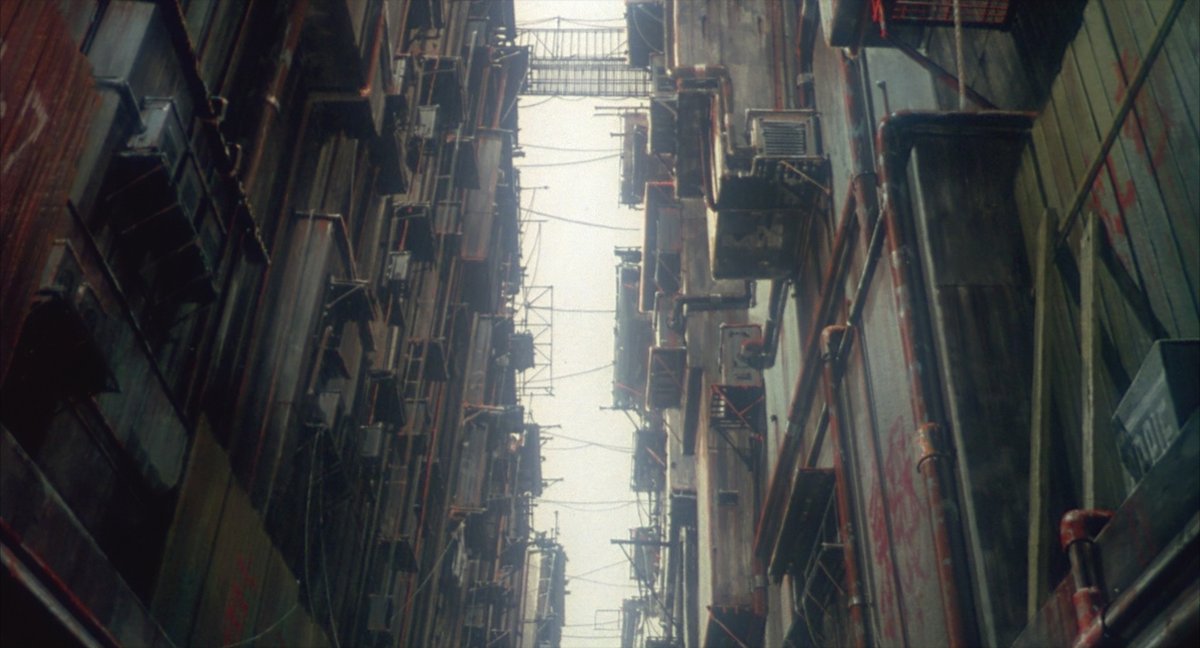


21
Ogura also painted a lot of backgrounds himself, focusing mostly on the new town and night time scenes, particularly the latter half of the montage sequence where the city is shown under the rain and during the night.


22
Ogura's signature stylizations were a good fit to depict the sterility of the futuristic parts of the city, but he also took charge of many of the most challenging backgrounds that needed special consideration of perspective, lens effects and lighting.


23
The chase scene in the market offers an interesting comparison between Ogura's and Hirata's styles. The background of the first image with its meticulous level of detail was painted by Hirata and the second one with more visible brush strokes, by Ogura.


24
This piece of background art serves as a good representation of Ogura's style. Rough brush strokes are clearly visible in the metalic frame of the traffic light at the center, a technique frequently used by Ogura which is used here to evoque detail.

25
Oshii's clear artistic vision combined with Ogura's art direction, making full use of his and other artists' quirks resulted in a captivating world that left a lasting impression on viewers. It's proof that as a narrative tool, background art can be just as important as animation
26
Further proof of this is how iconic the montage sequence is, which puts the background art at the forefront. Even if many viewers didn't grasp the themes of the movie and the meaning of this scene, it is still one of the most widely remembered and celebrated scenes of the movie.


27
The team of background artists was relatively small for an effort as ambitious as this one, but at the same time a reduced team is more fit to consistently depict Oshii's worldview. Full movie credits at keyframe-staff-list.com/staff/ghost-in…
28
The source for most of this thread's information (in particular the authorship of specific backgrounds) is Stefan Riekeles' (@ reallyriekeles) "Anime Architecture" book (available for purchase in e.g. Amazon). Official site for the book: anime-architecture.org/#publications