@cremieuxrecueil: I simulated 100,000 people to ...
@cremieuxrecueil
42 views
Apr 23, 2026
Advertisement
1
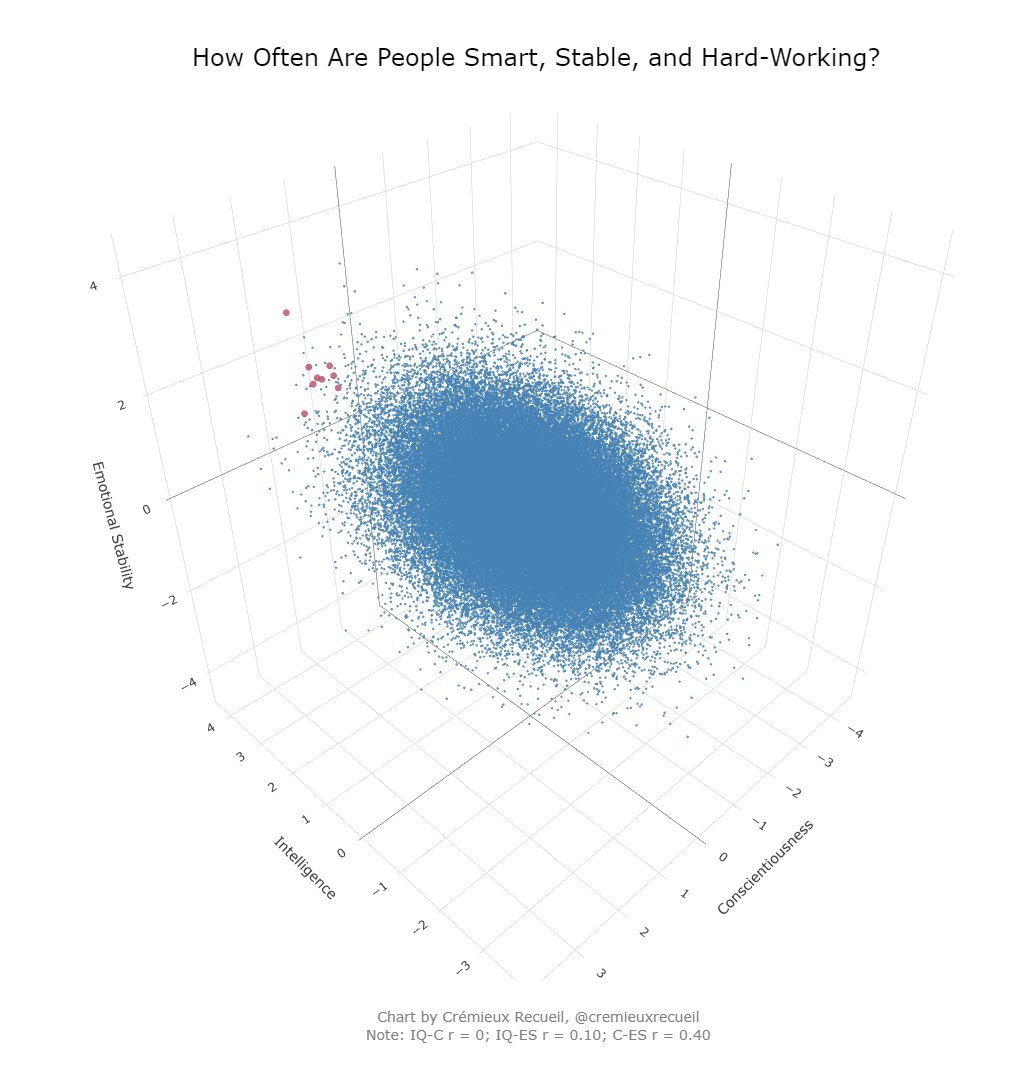
I simulated 100,000 people to show how often people are "thrice-exceptional": Smart, stable, and exceptionally hard-working.
I've highlighted these people in red in this chart:
I've highlighted these people in red in this chart:
2
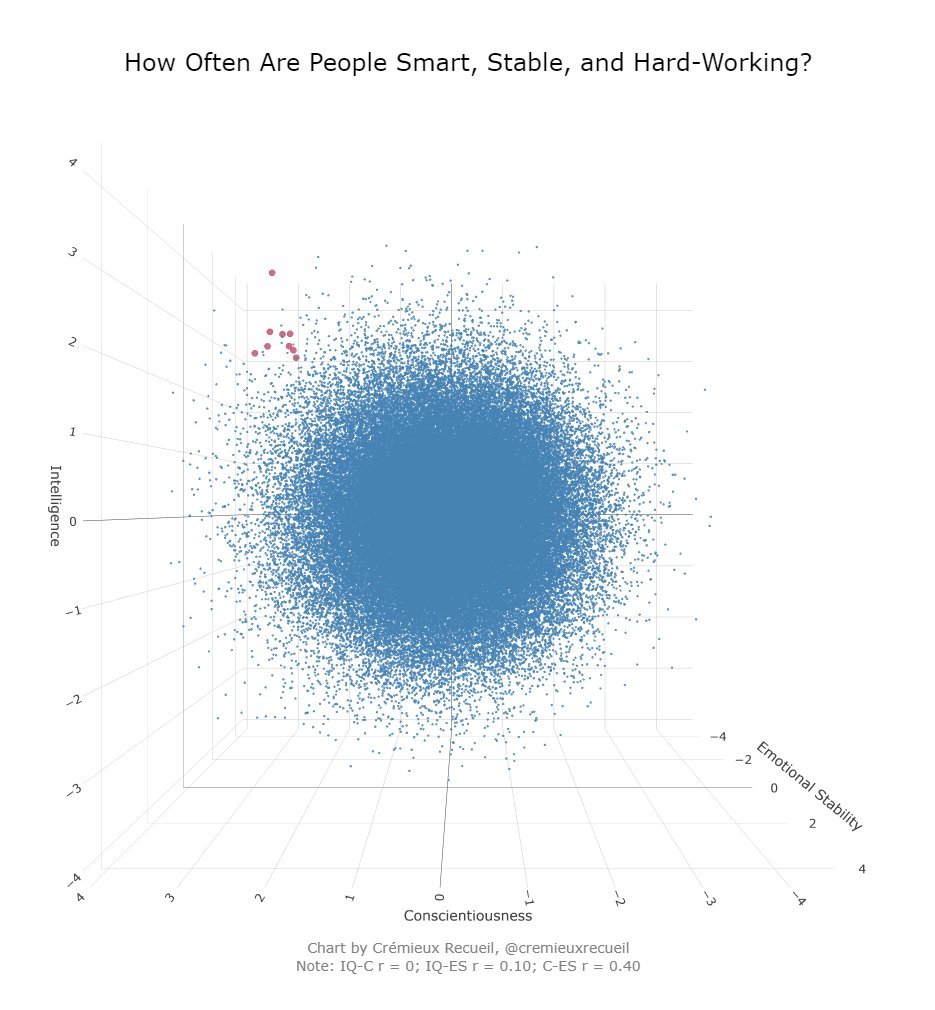
If you reorient the chart to a bird's eye view, it looks like this:
3
In short, there are not many people who are thrice-exceptional, in the sense of being at least +2 standard deviations in conscientiousness, emotional stability (i.e., inverse neuroticism), and intelligence.
To replicate this, use 42 as the seed and assume linearity and normality
To replicate this, use 42 as the seed and assume linearity and normality
4
The most impactful lesson from seeing the numbers is that it is unlikely that you know many people who are genuinely thrice-exceptional.
It is even more unlikely that you know anyone who is profoundly exceptional in the sense of being +3 SDs on each dimension.
It is even more unlikely that you know anyone who is profoundly exceptional in the sense of being +3 SDs on each dimension.
5
Employers seeking to find these people will also be out of luck if they set their thresholds too high on all dimensions. If they set this as the bar, the only way they'll be satisfied is applicant lying. There just are not that many people who are great on each dimension.
6
This also throws a lot of water on the idea of students at the Ivy League all being exceptional across several important dimensions.
There aren't enough people in the population in general to fill the Ivy Leagues with the multiply-exceptional, young or not.
There aren't enough people in the population in general to fill the Ivy Leagues with the multiply-exceptional, young or not.
7
Some of these points were just made in this paper, which used similar correlations for its simulation.
Link: sciencedirect.com/science/articl…
Link: sciencedirect.com/science/articl…