@IterIntellectus: Last month <b><a target="_blan...
Last month I shared what my wife and I found to work for her to avoid the first trimester nausea by changing her diet. Some women got really upset about it, but a lot of other women, and surprisingly all men that reacted, asked for more information. So here it is. Everything we did, when, why, and what happened.

Before I start, these are probably not the best possible protocols for you. Every couple is different, and anyone who tells you they have the universal answer is lying to sell something. This is what we did, why we did it, and what happened. That said, many interventions can be adopted by most, and that's why I am writing this.
Some say we were lucky, and I hate it. Unless "waking up every morning at 4 AM to prepare her breakfast and go to the gym" or "changing all your daily habits and diet" or "spending hours every evening researching" or "having spent the last ten years looking after your health" is considered being lucky. Then sure, we were lucky, the same way someone who drinks every day is unlucky when the baby has fetal alcohol syndrome, or how someone drunk driving is unlucky if he gets into an accident.
My wife had a straightforward and easy pregnancy, a fast labor, a baby who latched in the first hour, and a milk supply that came in on schedule. Not everyone gets that and I know it. But I also think we created most of our luck, and the creating part is what I can share.
I am a biomedical engineer by training, and I love reading research papers on things I care about – and I care a lot about health. I pride myself on being an old-school researcher, skeptical of most findings when people have a financial interest in finding specific results. Especially in medicine, where somewhere along the way we forgot that the goal was to treat people instead of managing symptoms while making hospitals as much money as possible. I obsess over trying to trace the mechanism to the right causal layer whenever possible, and build a system from there.
When my wife told me she was pregnant I started thinking about one question only: what does a human infant actually need to develop properly, and how far has the standard approach drifted from the answer?
Apparently very far. Disturbingly and disgustingly far.
The Inputs
Fortunately, we already had good diets. Both of us have cared about what we eat for years, so the change when we found out we were having a child wasn't too big of a change. When buying or making food, the question quickly went from "is this good for us?" to "is this the best possible input for a woman building a human from scratch?" and that reframing changed only slightly what we ate daily.
The logic is very simple: the developmental environment for a baby is the mother's body. Every molecule the mother eats, breathes, or produces hormonally becomes the raw material for building a new human. The quality of the building materials is the quality of the baby.

Alcohol was easy. Neither of us drinks much (I enjoy my wine as every other Italian), so cutting it was a non-event. Coffee was supposed to be harder, both of us love it, so I was braced for a negotiation, but the pregnancy handled it itself. By week 3/4 coffee tasted awful to her, and she stopped on her own. The body knew something we didn't and acted on it before we had to. To our amazement, she became coffee-averse before we knew we were having a baby, and in hindsight it was the first signal.
The food part was not so much about removing as about optimizing. The baseline was already healthy: meat, fish, eggs, avocados, dark leafy greens, berries, nuts, bone broth, sardines, etc. so we only had to change the amounts and timings. This to many sounds like the normal diet, but unfortunately to some it's not. Some would even call it "extreme". The standard Western pregnancy diet actually is seed oils, refined sugar, processed everything, and fast food. All of it fed to a woman whose body is trying to build a brain from scratch.
The supplement stack changed the same week. A prenatal (with methylfolate instead of folic acid), Omega-3s, vitamin D, creatine, and choline. Choline is the nutrient very few talk about and which I think about constantly. The developing fetal brain needs it for cell membrane synthesis and neural tube development. The official adequate intake during pregnancy is 450mg per day (with some studies showing continued benefit up to 1000mg). The prenatal supplement our gynecologist recommended, supposedly the best a soon to be mom could buy, contained 25mg. Twenty-five. To get the right dose from that supplement alone she would have had to take eighteen times the labeled dose, which is both impossible and insane. Three eggs a day cover most of it. I cannot think of a cleaner example of how far the standard of care has moved away from the actual biology and towards simple mitigation: the official prenatal, prescribed by the specialist, delivering about five percent of the nutrient the baby's brain needs most.
My wife and I joke about this often, but our gynecologist never once covered what to eat. She spent considerable time over multiple appointments stressing what to avoid, among which there were runny eggs. The concern about salmonella is relatively legitimate, but the result is that mothers end up choline deficient because of an overblown fear of it. The system is better at scaring you away from the inputs than at telling you what the inputs should be.
That pattern repeated itself across almost everything we looked at, and it set the tone for the entire pregnancy. The gap between what the biology needs and what the standard of care provides is not small. And that was infuriating. The problem is that nobody in the system has an incentive to make things as good as they can be; they must avoid problems for themselves, avoid the worst outcomes, minimize risks, but never maximize benefits, or aim at the best possible outcomes –– so that's what we set ourselves up to find out.
The Nausea
First trimester nausea started affecting Andrea around week three and did not leave until we found out it was due to the pregnancy and we figured out how to avoid it.
The standard advice from every pregnancy website and every forum we read as well as every well-meaning relative was to keep crackers by the bed or eat bland carbs. This advice is mechanistically wrong for most women, and I want to explain why, because it affects almost every pregnant woman who goes through it and almost none of them hear the actual explanation.
First trimester nausea is hormonal. It is driven by the surge in hCG, the hormone that peaks between weeks 8 and 12 and then drops off. You cannot eat your way out of a hormonal state. But you can make the nausea dramatically worse by destabilizing blood glucose, which is exactly what the crackers-and-cookies-to-absorb-the-gastric-acids approach does.
The cycle is simple. Simple carbs spike blood glucose fast, insulin increases too much. During pregnancy the overshoot is worse because pregnancy increases insulin resistance as a baseline. Glucose crashes, the crash triggers cortisol, which triggers another wave of nausea, and she reaches for more crackers because that is what everyone told her to do. Forty-five minutes later the same thing happens again and she spends the whole day feeling terrible while following the advice correctly because the advice is the problem.
Protein and fat don't do any of this. They digest slowly, release glucose gradually and don't have any of the spike-crash-nausea loop. Steady glucose, steady insulin, fewer triggers stacking on the hormonal baseline you cannot change anyway.
So the rule became: protein and fat before sleep, protein and fat first thing in the morning, never let the body run empty overnight. The developing baby feeds off glucose, so a diet heavy on carbs and sugar also makes the baby fatter, which complicates delivery later. So, every night before bed I made Andrea a bowl of full-fat Greek yogurt with berries and a drizzle of honey. Yogurt is protein and fat, slow fuel that holds through the night. Berries are slow-digesting carbs and antioxidants. The honey acts as a small glucose bridge to prevent the overnight trough that makes the morning nausea hit harder than it needs to, it's good for the baby, and the wife likes it. This kept her blood sugar stable while she slept, which meant the 6 AM nausea wave was light at most, barely detectable otherwise.
First thing in the morning, before she was awake, i'd make sourdough toast with avocado and eggs. Sourdough has a lower glycemic index than regular bread because the fermentation partially pre-digests the starches. Avocado is fat. Eggs are protein, fat, and choline, two eggs alone cover roughly 300mg of the 450mg daily target. When she wanted variation we rotated in cottage cheese and prosciutto crudo, parmesan and bresaola, a soft-boiled egg with sardines, full-fat ricotta with walnuts and honey – or any combination of these – fats, proteins, and high quality carbs before leaving the bed.
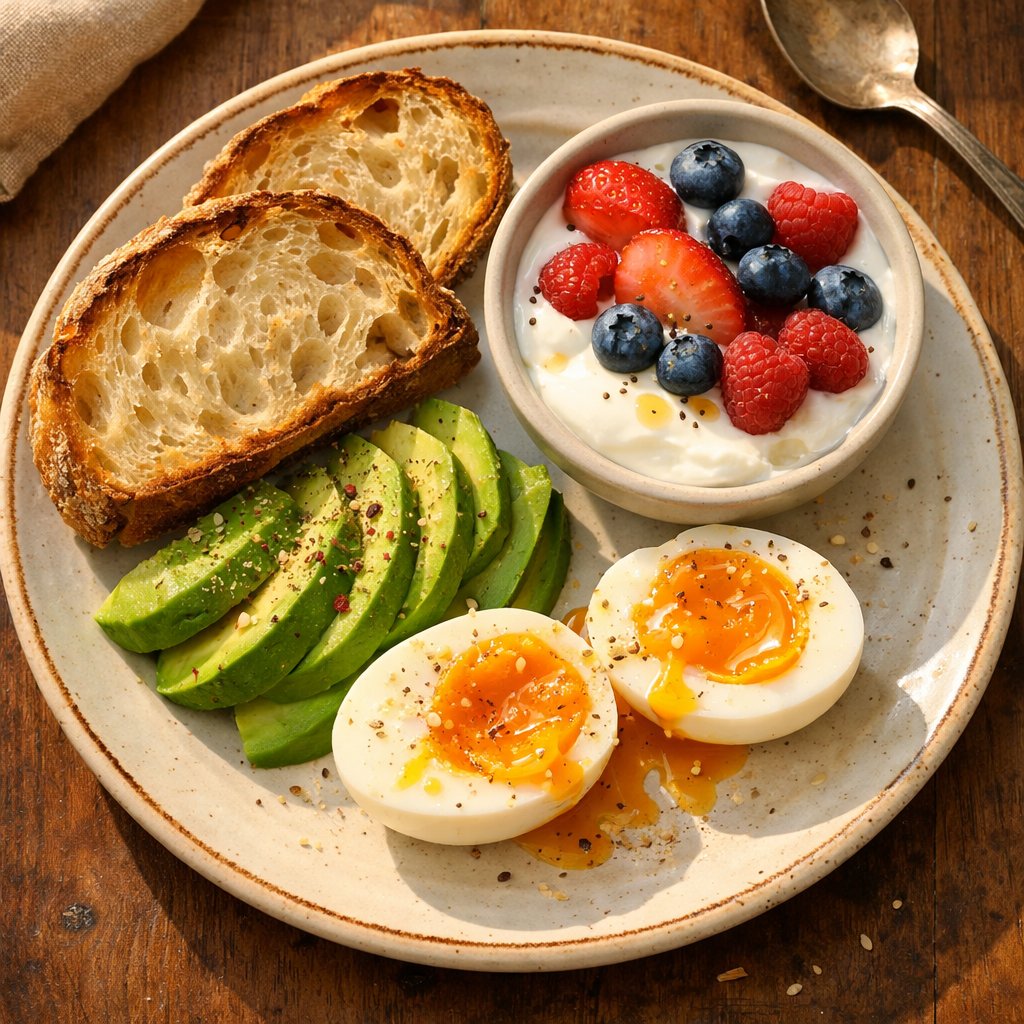
She was not hungry, obviously, and when she still had some nausea, the last thing she wanted was food in front of her face. I knew she had to eat. She knew she had to eat. But she felt sick, so she would try to refuse. I would prepare the food, plate it, bring it to her, talk her through it, "you know it's going to make you feel better," and she would eat it, and feel better. That was our routine for most mornings of the first trimester. Then we went to the gym at 6 AM. She never vomited once across the entire pregnancy.
The Reading
Seeing how well she responded to the adapted diet, compared to what years of terrible pregnancy advice had prepared us for, made us question everything else we were being told. So we started reading. And we didn't stop.
Within a few months we could hold a conversation about cord clamping, about why lithotomy position should not be suggested for almost everyone who gets put in it, about the tradeoffs of different birth positions, about the mechanics of the pelvis and the birth canal, about the hormonal cascades during the golden hour and more. Every question we asked had another couple of questions behind it and another paper to read or research to do, and the answers kept contradicting the advice we were being given by people whose job, supposedly, was to know it.
Take cord clamping. The default is to clamp within the first minute after birth. But for several minutes after the baby arrives the placenta is still transfusing oxygenated, iron-rich blood to her, and delayed clamping (waiting until the cord stops pulsing) transfers up to a third more blood volume and reduces infant anemia for months. In a healthy birth the downside is essentially zero. Nobody told us. It was in every paper. And it was the template for almost every other question we asked.
Huge thanks to DeepResearch: throughout the pregnancy I ran about 200 DeepResearches and had Grok help me distill them into protocols.
Bottles, Formula, and the Boob
Even though we knew we were going to exclusively breastfeed, we wanted to be prepared for the worst. Bottles were going to be part of the picture anyway: my wife's family lives nearby and we wanted them in the picture – you can't expect a woman to raise a child completely by herself, and we refuse to have strangers do it – so we were expecting grandma to babysit once in a while, and having her bottle-feed expressed milk was going to become a necessity at some point. So we went looking for the best bottles and, just in the worst case, the best formula.
The formula research was depressing. Most commercial formulas are built on cow's milk protein with added vegetable oils, corn syrup solids, a nutrient profile that approximates breast milk the way a photograph of a meal approximates dinner. Add to it that the supposedly "best" brands were found to contain heavy metals, endocrine disruptors and some have even been recalled recently for containing botulism toxin. The best options we found were goat milk-based, which is closer to human milk in fat globule size and protein structure, easier to digest, and less likely to trigger the inflammatory response that cow's milk formulas sometimes produce. But even the best formula is a distant third choice. The hierarchy is clear: the mother's own breast milk first, then donor breast milk from a milk bank (the hospital we delivered in had a breast milk bank), then formula only if the first two are genuinely unavailable and some medical complication demanded it. We bought one tin of goat milk formula, put it in the back of the pantry, and never opened it.
On the breastfeeding side, our OB told us something I think every expectant mother should hear early: barring breast reduction surgery, mastectomy, or a small number of rare and severe medical contraindications, essentially every woman can breastfeed. The problem is almost never supply. The problem is that the first 72 hours are hard, the support is missing, and the formula is right there on the counter and seems like it could solve so many problems (it does in the short term, it worsens them in the long), and the hospital hands it over at the first sign of difficulty because it is faster than teaching a latch. Once that bottle goes in, the feedback loop breaks, supply drops to match the reduced demand, and a week later everyone says "I just couldn't produce enough" when what actually happened is that nobody gave the system time to start. We decided early that we were not going to let that happen.
The plastic question came later, once we started reading the postpartum literature and thanks to the separate research I was doing on microplastics for the supplement I have been developing. Polypropylene baby bottles release microplastic particles into the milk, which increase by orders of magnitude when heated, and the numbers are difficult to process: babies are exposed to hundreds of times more microplastics than adults, which makes it much worse for them since their physiological barriers are much weaker (blood-brain, gut), and their developing endocrine systems are much more prone to disruption. We switched to glass. Then we went further and researched bottle nipple shapes, because most commercial nipples are designed to ease milk flow, which sounds helpful and is actually a problem: the baby develops a preference for the bottle over the breast, and the unnatural shape affects oral and palate development over time. The shape that actually mirrors the breast passes what's called the triangle test, where the nipple compresses into a triangular cross-section under the tongue the same way a real nipple does. We found a brand that met the criterion and bought only those. No pacifiers, ever, for the same reason and a few others I will get into later.
What made the project work, and what I want to be specific about because I think it's the part most people get wrong, is that while the wife and I were in this together, she is an extraordinarily intelligent, and skeptical in the right amount, which is the reason why I am so lucky and why things have been going so well. She pushed back on every conclusion. She is not contrarian and not credulous. She lives in the narrow band between the two, where every claim has to earn its place, has to make sense for her, and it has to be supported by both data and logic. Half the things that ended up in the final protocol are there because she asked a question I couldn't answer on the first try and I had to go back and read more until I could.
Sleep
Sleep became its own project by the second trimester because the data on what poor sleep does to a pregnancy is worse than people think. Women who sleep fewer than six hours a night in the last month average around 29 hours of labor. The cesarean rate in that group goes up about four and a half times. And poor sleep (even when total hours look good) pushes the cesarean risk up over five-times. Sustained high cortisol from poor sleep overwhelms the placental barrier and reaches the fetus, where it shapes brain development and stress response in ways that affect the baby long after birth. As hard as this is, sleep cannot be a comfort variable or an afterthought, it is one of the most important inputs to the build.
Third trimester sleep is terrible by default and there's not much you can do about this. The belly makes every position uncomfortable. The bladder wakes you every ninety minutes. Hormonal shifts make temperature regulation unpredictable. You cannot control all of this but you can stop making it worse.
We did the basics aggressively. Blackout curtains. Room at 18 degrees, AC running even through the South African winter. No screens for an hour before bed. Gave her a WHOOP to track her sleep. The yogurt-and-berries habit doubled as a sleep intervention because the same blood glucose stability that prevented the morning nausea also prevented the overnight cortisol spike that affects sleep. And a pregnancy pillow that wrapped around her entire body, which I think changed things for her more than anything else on this list (seriously, get or give your wife a preggy pillow, you won't regret it). The configuration took a few nights to get right and once it was right I was forbidden from disturbing it under any circumstances.
We went to bed at 9:30 falling asleep almost immediately, I woke up at 3:30 to start my day, and she slept until six. I learned to get out from under the covers without pulling them, to find my clothes in the dark without turning on a light and breaking my toes on the bed feet (happened once), to leave the bedroom without the door making the click it makes when the latch catches. One morning I had to use the bathroom and the bathroom was on her side of the bed, so I put on my shoes, ran out of the house, and drove to the gym praying to make it in time rather than risk waking her up. If one of us was going to sleep well, it was going to be the one building a human.
Somewhere in the second trimester we also got a dog. A white toy pomeranian, absurdly small and fluffy, and comically pleased with herself at all times. She became our test child, and in hindsight she was at times more demanding than a tiny human. I do not have a citation for "emotional support pomeranian puppy lowers third trimester cortisol and makes your life better" but I watched it work for six months.
The Cascade
From the second trimester, once the nausea was gone, the focus shifted from adapting and surviving to preparation for the birth itself. This is where the project got intense, because the more I read about what actually happens in a delivery room, the more I realized the biggest risk to a normal birth is not the birth. It is the room.
Interventions cascade. An epidural removes mobility. Without mobility, labor stalls and becomes longer (+1h on average). Stalled labor gets synthetic oxytocin. Synthetic oxytocin can cause fetal distress. Fetal distress becomes an emergency cesarean. A cesarean means separation from the mother, which means poor microbial seeding, which means an immune system that starts life on the wrong foot. Separation also delays the first latch, which delays the hormonal cascade the mother needs to prevent postpartum depression and to establish supply. A delayed latch means formula. Formula means a broken feedback loop, and so on down the chain.
One decision, twenty consequences, each one documented. And the chain usually starts not with an informed choice by the mother but with fear of a pain she was told to expect and never trained for, which the hospital protocol was built to accommodate on a schedule that belongs to the institution.
The solution is not being braver but preparing better and in advance, because a body that has been trained for the performance feels pain differently from a body that has not.
Once you see the cascade you cannot unsee it, and it reframes every preparation decision as: how do we keep the first domino standing?
The wife's exercise program was built around the evidence and data on vaginal birth outcomes. A 2025 meta-analysis found that exercise during pregnancy reduced cesarean rates by 34 percent and shortened the first stage of labor by about an hour. That number should be on the wall of every OB's office but somehow it never is.
She trained every day. At least thirty minutes of Stair-master and +10k steps throughout the day until the 39th week. Deep bodyweight squats with sustained holds. Every evening she sat on the birth ball working through hip circles and figure-eights, which looked slightly absurd and really funny, but it was apparently very effective. The thing that I think helped most was the daily stretching and hip mobility: pigeon pose, butterfly stretches, cat-cow, deep hip openers, every day from the third trimester onward. The goal was a pelvis that could move freely and muscles that could release. Birth is a physical performance (and a hard one!) but you can train for it.
Giving birth is NOT easy! I will never imply it is, but you must prepare to make it easier.
She also practiced what she called "hugging the baby," which is belly breathing. Slow diaphragmatic breaths directing the air deep into the abdomen so it expands outward, not chest breathing. During contractions this drives the diaphragm down and creates gentle compression that works with the uterus. She practiced it every day. When labor came, it was automatic.
From 34 weeks onward we introduced perineal massages, three to four times a week. It reduces tears requiring suturing by 9 percent in first-time mothers, and reduces severe third and fourth degree tears by 44 percent. The massage is not complicated. The consistency is what matters, and the fact that most couples are too embarrassed to do it together is exactly why most couples should.
From 36 weeks she ate six dates a day. I know it sounds woo woo but multiple studies show that women who ate 70 to 75 grams of dates per day in the last four weeks arrived at the hospital already 3.5 cm dilated instead of 2, had 96 percent spontaneous labor onset compared to 79 percent, shorter latent phase by 4 to 7 hours, and needed less induction. The reason is that dates contain oxytocin-like compounds, tannins, and high potassium and magnesium that promote smooth muscle contraction. Cheap, safe, nutritious, wife likes them, and it works better than many if not most pharmaceutical interventions in the literature.
The Birth Plan
At 34 weeks we did the hospital tour. The midwife who gave it was not the same one who would eventually help deliver our daughter, but she was the typical case. She was warm, competent, open to discussion, and visibly irritated that we had already done our research and were in disagreement with a lot of protocols. Hospitals are used to couples who arrive with questions about parking and what pain relief methods they suggest and end up with whatever protocol is the one they use for everyone. We were not that couple and you could feel it, a sense of "who do you think you are", which went away every time we cited the research. To her credit, she did concede on most of our disagreements. But the baseline we were negotiating from was hers, and it was the standard over-medicated protocol: continuous monitoring from admission, IV lines on arrival, epidural strongly suggested, time limits on each stage, augmentation if things weren't progressing on schedule.
There were two other couples on the tour with us. They were asking questions the way you ask when you are hoping someone tells you the answer. I was asking the way you ask when you already know the answer and you want to see if the person in front of you does too. That gap is what the cascade runs on. Most people walk into that room still holding blind faith in the medical system, and they should, if the medical system were still what it claims to be. "First, do no harm" used to mean something. It has somehow turned into "avoid any risk, treat everyone as identical, design everything around the bottom quartile", which is not the same and produces very different outcomes. The baseline assumes every woman walking in is overweight, sedentary, on a poor diet, likely pre-diabetic, on medication, over 30. For the average pregnant woman in a western hospital in 2026, that baseline probably saves lives. For a woman who has spent years doing the opposite, it actively interferes with a birth that would otherwise go well, and the system has no mechanism to tell the difference. The intervention chain is bureaucratic. It runs because the people in the room genuinely believe they are helping, that's what they've been taught after all, and the people across from them have no reason to think otherwise.
We spent two months drafting the birth plan covering labor, delivery, cord and placenta management, the golden hour, newborn procedures, postpartum, etc. and a full contingency tree for every emergency we could anticipate, with an explicit line for what we would defer to the OB on and what we would not. We met with her three separate times to walk through it. Each meeting she pushed back on something. We either conceded where the evidence was thin or held the line where the evidence was strong. By the third meeting she signed it, and so did we, and when labor came we brought the physical document to the hospital and the midwife on shift read it and signed it too.
We did not use a doula even though the data on doulas is some of the strongest in the entire birth literature: continuous labor support reduces cesarean birth by about 25 percent, and up to 39 percent with a doula, with zero identified risks! If the partner has not done the reading, get a doula. We skipped it because Andrea felt comfortable enough with me in the room and we had practiced the breathing and the positions together enough that I was going to function as hers.
Something for which I am eternally grateful is that Andrea never complained once during the pregnancy. Not because she suppressed anything, but because the preparation actually worked and because she is an exceptional woman. The nausea was managed by the food-timing protocol. She trained through all three trimesters, ate the dates, did the perineal massage, practiced the belly breathing every day, and arrived at term with a body that was ready and a plan that had been signed by everyone who mattered. All that was left was the labor.
The Birth
Labor started on the night of December 23rd, around 11 PM. I was already asleep. Andrea, in her characteristic way, decided there was no point waking me up for early labor, so she lay next to me in the dark and timed her own contractions on her phone, waiting for them to settle into the 5-1-1 pattern: five minutes apart, one minute long, for one full hour.
My alarm went at 3:30 AM the way it always does. I sat up and reached for my gym clothes and she put her hand on my arm and said, "I don't think you should go to the gym today."
I looked at her. "What? Are you in labor?"
"Yes. I think."
"Oh shit. Let's go."
I sent her to the shower. I made breakfast. I went outside to pack the car, came back in, helped her finish getting ready while she sent the message to her mother, who arrived at 6 AM to pick up the dog. By then Andrea had been in active labor for seven hours without a sound from her, which is something I still have trouble processing. The pomeranian knew something was happening and would not stop trying to get into the car.
The drive was one of the best parts of the whole pregnancy. On the way to the hospital, to avoid any issue, I drove as carefully as possible, as if she was made of glass, but somewhere near the first roundabout she said, "Can you go a bit faster," with the exact tone of a woman in labor being driven by a man who is overcautious in the one situation where that should not be happening. I accelerated. A minute later she said, "Okay, but not this fast," which is also what a woman in labor says, and for the next ten minutes we couldn't stop laughing.
We got to the hospital at 7:30 AM. Check-in was calm. We were in the labor room by 8. The midwife on shift met us there, I handed her the birth plan, she read it, she signed it, and I reminded her that during labor and the golden hour all communication would come through me. She nodded. Good one. The OB came in at 9 AM to check Andrea and found her already at 6 centimeters. "It's going to take another four to eight hours," she said. "Take it easy."
We did not take it easy because, obviously, Andrea's body had other plans. The contractions intensified fast. Every time one came I stood behind her and pressed on her lower back with slow outward movements, the counter-pressure technique we had practiced with a tennis ball on the living room floor for weeks. Between contractions I handed her water and electrolytes and she drank whatever I put in her hand and gave the bottle back without saying much because she was deep in the belly breathing, automatic now the way we had trained it to be. At 10:30 she came up out of a contraction and said, "I think she's coming. I feel the urge to push."
I went to get the midwife. She came in mildly dismissive, because in her experience women who announce the urge to push at 10:30 when they were checked at 6 cm at 9 are almost never actually about to push. She put on gloves. She checked. And then her face changed and she was suddenly moving fast, and she rushed out to get the doctor because the baby's head was already visible.
Andrea got onto all fours.
The doctor came in at 10:45.
Andrea gave one push and the doctor stopped her and said that given the shape of her pelvis she needed to turn onto her back. This contradicted everything we had prepared for. Upright positions widen the pelvis, use gravity, shorten pushing, every paper I had read said the same thing. But she was crowning already, the delivery was going to be measured in minutes, and the gravity that helps in a normal labor actually increases tearing risk when things move this fast. The labor was telling us what it needed and Andrea turned onto her back without hesitation. This is the thing about protocols: they are built on population-level evidence and you are not a population. You are one person, in one labor, and the labor will tell you what it needs if you have done the reading to know the difference between a good call and an institutional default.
One contraction, one push, half the head was out. Next contraction, push, the whole head. Third contraction, push, and our daughter was in the world.
11:00 AM on the morning of December 24th.
Three pushes. 15 minutes. No tears. No episiotomy. No vacuum. No epidural. No augmentation. No cascade. Nothing.
She went directly onto Andrea's bare chest, still connected by the cord, and for what felt like a very long time nobody in the room said anything. The midwife stood back. The doctor stood back. I stood at Andrea's side holding her hand and trying to remember how breathing worked. I looked at her smiling, more beautiful than i've ever seen her, her face immaculate, not a sign of pain or discomfort, just joy, and I could do nothing but start crying. I was not embarrassed about it then and I am not embarrassed about it now.
The baby opened her eyes, turned her head toward the warmth, found the breast and latched within the first hour. Completely on her own. Nobody guided her and nobody repositioned her, she just knew where to go. Her brainstem had been running the rehearsal for forty weeks and all it needed was skin, a heartbeat, and the smell of her mother.
The gynecologist, who had spent three meetings patiently pushing back on our birth plan and who had told us two hours earlier to take it easy, stood there watching the golden hour unfold and said, "This was an extremely fast textbook birth. It was a first for me." The first for her. After a career of deliveries. Somewhat presumptuously, I think about that sentence a lot.
Andrea held our daughter on her chest for ninety minutes, undisturbed, the door sign keeping routine interruptions away. The cord stayed intact until it had gone white and limp and stopped pulsing, then it was clamped and I cut it. Symbolic, but it made me feel something, as if I had just a little to do with sending a new human into the world. Apgar 10 out of 10 at every check. No eye ointment. No hepatitis B. No bath for 48 hours. Everything deferred the way we had written it on the birth plan.
Andrea stood up one hour after giving birth and walked around the room. No sweat. No exhaustion. I am telling you this because I want it on the record: my wife looked more beautiful one hour after pushing a human being out of her body than she had looked walking into the hospital that morning. She was smiling. She was glowing in a way I had always assumed was a cliché until I saw it happen and realized the cliché exists because the phenomenon exists. I have a photograph from that moment and I still cannot fully process it.
We slept in the hospital room that night, the three of us, our daughter next to us, and the next morning at 11 AM we were discharged. By noon on Christmas Day we were home celebrating Christmas as a family of three.
Unfinished
A human baby should gestate for roughly twenty-one months. That sounds wrong until you look at the numbers. Every other great ape, adjusted for brain size and developmental maturity, is born with 40 to 50 percent of its adult brain volume already built. Humans arrive at 25 percent. The brain is too large and the pelvis too narrow, so evolution decided to push the baby out at forty weeks and finish the construction on the outside. The first three to four months after birth are not infancy in any real sense. They are the fourth trimester. External gestation. The construction site is the environment you build for her.
The brain triples in size in the first year. All the wiring for stress regulation, emotional control, attachment, social cognition, language, all of it is being laid down in real time and the instructions come entirely from the environment. A mother's heartbeat. A father's voice. Warm skin. How fast someone comes when the baby cries. Whether the face looking back is engaged or looking at a phone. For the first year of life the environment is the parents' bodies. Every input is an instruction. Every missing input is a missing instruction, and the brain builds itself around what it gets, not around what it should have gotten.
Once I understood this properly, I got angry. Not a little angry, seriously angry.
There is an entire cultural script around having children that I now find genuinely repulsive. The endless complaining. The "I haven't slept in six months, kill me" jokes. The memes about wine o'clock and counting down to bedtime. The woman who announces, loudly and proudly, that motherhood is the hardest thing anyone has ever done and that her children are ruining her life. This is performance of suffering rehearsed so many times it has replaced the thing it was supposed to describe. It may even be their true experience, but it's obviously a product of a culture that describes children as something that destroys someone's individuality and is genuinely terrible to endure. They accept that as the truth, and they manifest it for themselves. This is downstream of one thing only: not understanding what a baby actually is.
A baby is an unfinished human whose only communication channel is crying and whose only needs are sleep, warmth, milk, presence, and a response when she calls. That is the whole list. She is not manipulating you, she is not being difficult, she is not trying to ruin your life. She is doing what her species has programmed her to do for two million years and she is running it on the inputs you provide. If the inputs are good she will be calm and regulated and easy in a way most modern parents never get to experience because they set up the environment wrong and then blamed the baby for the consequences.
I am not claiming any of this is simple. I am claiming it is easier than the culture pretends, for reasons the culture systematically refuses to confront. The steps are knowable and doable, and the steps work. The reason it does not feel that way for most families is that the steps have been hidden, ridiculed, replaced with the convenient version, and the convenient version does not work in the long term, and nobody tells you that until you are already two months in and wondering why your baby will not stop crying.
Once you understand that the baby is unfinished, a whole set of decisions stop being decisions and become obvious. Co-sleeping, skin-to-skin, breastfeeding on demand, zero pacifiers, baby-wearing, immediate response to every cry, none of it is a preference and none of it is "attachment parenting". Babies NEED their parents. It is developmental neuroscience. The baby's brain evolved to receive these specific inputs and it will build itself in their absence, but it will build itself wrong, and the cost shows up twenty years later in someone else's therapy bill.
Now look at what we actually do instead. Newborns in separate nurseries hours after birth. Cry-it-out sleep training at eight weeks because the baby's crying is inconvenient for the adults and their careers. Car seats and bouncers and plastic swings where babies spend half their waking hours without touching skin. Pacifiers handed out in the hospital so nobody has to feed on demand. Formula pushed on mothers whose milk would have come in fine if anyone in the building had been trained to help. Mothers alone in apartments with no extended family, told that needing help means failing at something women have supposedly been doing effortlessly since the beginning of time, which is a lie. In every hunter-gatherer society ever studied, in every traditional culture, in every primate species, mothers had a network of alloparents helping them from day one. A mother alone with a newborn for twelve hours a day is living in conditions that did not exist before the twentieth century and that no human brain was designed to handle.
We organized birth and infancy around the convenience of institutions and the schedules of the people who run them, and then we built a culture on top of that arrangement which tells mothers the exhaustion is normal and the baby is the problem. The baby is not the problem. The arrangement is the problem.
The Fourth Trimester
With all of that as the operating philosophy, the postpartum decisions were mostly already made before she was born.
The priority hierarchy is simple and nobody states it out loud and everybody figures it out eventually, usually too late. The mother's purpose is to keep the baby alive. The father's purpose is to keep the mother alive, and by alive I mean rested, fed, supported in every possible way so that she has the reserves to do the thing only she can do. Who helps the father? Nobody. Grow a pair. A child is a gift worth everything. The mother has done so much that there's nothing the father can do to repay her. The whole system only works if everyone understands their slot and stops trying to renegotiate it.
The night shift is the clearest example. We decided before birth that our daughter was going to be exclusively breastfed, which meant there was no bottle for me to use. Once that decision was made, it didn't make sense for me to wake up at night, so I didn't. Andrea did every feed drifting back to sleep between wakings. I slept from 9:30-ish PM to 3:30, went to the gym, came back by 6, waited for the morning feed, took the baby off her chest and onto mine for the next three hours. Andrea put on an eye mask and got a second block of uninterrupted sleep. She averaged about six/seven hours a night from the first week, in two chunks, because we planned around protecting her rest at the cost of mine, which was exactly the point.
Breastfeeding went well. The baby latched from the first hour. Milk came in on schedule around the third day. There was a round of cluster feeding around one month when our daughter suddenly wanted to nurse every twenty minutes for 3 hours for two days straight, which is just the way the baby has to have the mom increase supply – cluster feeds often happen around growth spurts. The whole system is a closed-loop feedback controller optimized over two million years and it works unless you interrupt it, which is exactly what handing a formula bottle to a tired mother does. It breaks the loop. The breast gets the signal that demand is lower, supply drops to match, and then everyone says "I tried but I couldn't produce enough," which is true in the same sense that a car ran out of gas because nobody filled the tank.
One other thing that makes me so opposed to formula unless absolutely necessary is that breast milk is not a single substance that can work for every baby or even the same baby at any time. There isn't a "one size fits all" for breast milk. It is a dynamic output that varies across the day according to the mother's circadian rhythm and the baby's needs. Morning milk contains cortisol and stimulating amino acids, it wakes the baby up. Night milk contains melatonin, tryptophan, and sleep-promoting nucleotides, which settles her down. Mom's body is literally programming the baby's circadian rhythm through the milk itself, which is why breastfed babies synchronize to day-night cycles faster than formula-fed babies and why a baby who gets night milk at breakfast gets the wrong signal at the wrong time. Every bag of stored milk in our freezer gets labeled with the time it was expressed, and we feed it back to her at the same time of day as needed.
Glass bottles only. Zero pacifiers, and this one is non-negotiable for us. When babies suck on breasts, they do it for more than just feeding. Sucking signals supply, releases oxytocin in the mother (huge contributor to preventing postpartum depression), regulates the baby's cortisol, and transfers antibodies tuned to whatever the baby is currently fighting off and the mom is exposed to. Every suck on a pacifier produces nothing (other than a deformed palate). You are teaching the baby to suck on plastics for what? Some quiet while you watch Netflix? You can do that while the baby sleeps at your chest.
No phones during feeds and no screens near the baby, period. Babies study their mom's face and her expressions during every interaction, running the serve-and-return loops that build her mirror neuron system and her social cognition (this is what "socializes" a baby, not schooling). A phone breaks the loop, and worse, it breaks it silently: she does not know why you looked away since she has no concept for "phone", only that you did. The Still Face Experiment is one of the most reliable ways ever found to distress an infant in a lab. Do not run it on your own child forty times a day because Instagram is open.
We do not have a TV and we do not watch anything on our phones while holding her. Zero screen exposure for as long as we can manage it.
Skin-to-skin was something I had mostly ignored in the pregnancy literature. Then our daughter was born and within the first day I noticed something I couldn't argue with: she fell asleep on our chests in under five minutes, every single time, without fail. Put her in the bassinet two meters away and she'd wake up immediately. Put her back on the chest and she was out again in twenty seconds, so I looked into it.
A newborn has spent nine months in a very specific environment, completely regulated by someone else's body. Skin-to-skin is the closest you can get to that regulation on the outside. Your body temperature adjusts in real time to warm or cool the baby. Your heartbeat, which she already recognized from the womb, stabilizes her heart rate and breathing. Your cortisol profile buffers hers, which is why babies held skin-to-skin show measurably lower stress hormone levels than babies in the bassinet in the same room. And the contact triggers oxytocin in you too, which matters more than people realize, especially for fathers who don't have the breastfeeding oxytocin loop to draw from.
So I claimed the morning nap slot. She'd wake at 6 AM for her feed, Andrea nursed her, and by 6:30 I'd wrap her to my chest in a carrier and sit at my desk. She'd be asleep within minutes and stay there for two or three hours while I worked. I got the work done, she slept. I cannot think of a better deal in parenting.
"The Mozart Effect" has been debunked, but in those first weeks the house sounded like a concert hall with the classics playing all day long. Complex music is one of the best possible inputs for a developing brain. The specific genre doesn't matter for the brain, it matters for taste, and we figured she might as well start with the good stuff.
And the last piece: the village. We have one, but we built it on purpose. We moved to be close to Andrea's parents specifically so this would be possible. Her mother comes to our house almost every day to help with the baby. She often brings food, helps with chores, looks after the baby when Andrea goes to the gym. A lot of the heroic-individual-parenting content online pretends the village is optional. It is not. We could not solve the support problem through willpower, and we didn't want to solve it with strangers, so we solved it by moving, and by being lucky enough to have families that show up when it counts. If you do not have that already, build it: move closer to your parents, or move your parents closer to you, or find friends who are willing to help. The baby does not care whether the person holding her is genetically related. The baby cares that someone is there.
The Gap
Something I noticed throughout this experience is the difference between me and my wife, and it's the most important thing I have learned in six months.
Sometimes, when our daughter cries, I get impatient. Not for long, and not in any way that affects how I respond to her (I still pick her up, still rock her, still do the thing). But there is a voice somewhere in the back of my head that says "can you please just stop", as if somehow she was able to understand adult conversations. The wife does not have this voice. When the baby cries, Andrea's face changes into something I can only describe as if I was observing a different species. She picks her up, she says "but you're just a baby" in a voice so soft I cannot replicate it, and she starts to dance. Slow, swaying, humming something that is not quite a song, and the baby calms down before her mom has even finished getting upright almost every time. Andrea is with the baby, all the way, without the background voice I have. I have watched her do this a hundred times and I still do not fully understand how. The closest I can get is that she does not experience the crying as an interruption of something else she was doing. For her, in that moment, the crying is the thing she is doing, and the thing she is doing is the only thing worth doing. She really is the best mom I could have asked for.
The gap between us is the gap between having read about the fourth trimester and being the fourth trimester. I can construct the right behavior from principles. She just is the right behavior. And this is why the hierarchy has to be what it is. The mother has something the father does not have. I can get close, I can do the work, I can rehearse what to do and try to do it well, I can wake up at 3:30 and wrap the baby to my chest and play the Bach and read the papers, but I am not going to out-mother my wife, and my job is not to try. My job is to protect the conditions that let her do what only she can do, and to notice, quietly, that the small frustrations I feel when the baby cries are exactly why the hierarchy exists in the first place.
The baby is antifragile. She is built to develop across a range of conditions, not just perfect ones, and built specifically to forgive the small failures of the adults around her doing their best. I am doing my best. My wife is something else entirely. Our daughter is going to be fine, and I think she is going to be more than fine.
There are two decisions in this protocol I have been quiet about until now, because I know what happens to people who talk about them. But the entire thing so far has been an exercise in tracing interventions back to the right causal layer instead of accepting the default, and these two decisions were made with the exact same logic as the choline and the cord clamping. Leaving them out would make this essay dishonest.
Vaccines. Our daughter has not received a single injection since she was born.
We looked at the data, evaluated the risk/benefit for her specifically, and saw no benefit to vaccinating her before six months. My father-in-law is an immunologist and strongly suggested not to. That settled it.
The standard schedule starts on day one with a universal Hep B shot, which is a vaccine against a virus transmitted through sexual contact and shared needles, given to every newborn for convenience rather than individual benefit, on the theory that catching every baby at the hospital is easier than screening the actual at-risk populations. The CDC has since shifted to shared decision-making for infants born to Hep-B-negative mothers, which is the right call and roughly a decade overdue.
We declined it. We declined everything else too. We are not "anti-vaccine" but we are pro-thinking, and the current schedule was designed, as most of modern medicine, for convenience. It optimizes for getting every baby vaccinated before they miss an appointment, not for what is actually optimal for a specific baby in a specific month of her life, or in a specific environment and with a specific family history. Our daughter is healthy, lives in a healthy environment, is exclusively breastfed, is not in daycare, and is not exposed to large groups. The risk/reward calculation for her does not make any sense, and pretending otherwise is how you end up injecting eight antigens into a two-month-old because a form said so. We will reevaluate at six months.
Circumcision. Our daughter is a girl so this did not apply to us directly but it applies to roughly half of everyone reading this, and I am not going to let the accident of our daughter's sex let me off the hook for saying what I think.
Routine infant circumcision is genital mutilation. I'm not even trying to be edgy about this, that is the description: the surgical removal of a functional, erogenous, nerve-dense piece of a healthy child's body, without anesthesia in most cases, without consent by definition, for no reason.
The health arguments are post-hoc. UTI rates, HIV transmission, penile cancer, none of them hold up in populations with basic hygiene and modern medicine, and the effect sizes are so small that no other body part would ever be removed on that basis. Nobody suggests prophylactic mastectomy for newborn girls on the grounds that breast cancer exists. We understand intuitively that you do not cut healthy tissue off a child on the chance that something might go wrong with it later. We understand this for every part of the body except one.
The religious arguments are worse. Traditions have, at various points, required human sacrifice, the stoning of women, the execution of apostates, and the genital cutting of girls. "My holy book says so" is not an argument. A child cannot consent. The child's body belongs to the child. Removing a piece of it because your tradition demands it is a violation of the exact same principle that makes female genital cutting in Somalia a human rights crisis. One is legal in most Western hospitals and the other is a criminal offense, which is a legal inconsistency, and a moral one.
Circumcising a male infant for non-medical reasons is in the same moral category as female genital mutilation. The tissue is different but the structure of the act is identical: an adult, on cultural or religious grounds, performing an irreversible surgical alteration on the genitals of a child who cannot refuse, for reasons that serve the adult's worldview and not the child's body.
Now
Our daughter is three and a half months old. She has rolls on her thighs that tell me the milk supply situation is well in hand. She tracks my face across a room with an intensity I find either flattering or mildly threatening depending on how much sleep I got. Her grip strength is structurally implausible for her size. She sleeps on her mother and when she wakes up she reaches for skin. And in the last two weeks she has started rolling onto her stomach and laughing, which is, I can say without any exaggeration, the best thing that has ever happened in my life.
I do not know if we got everything right but I know we showed up and tried doing our best. Every feed, every cry, every morning nap wrapped to my chest while I worked, every 6 AM handoff, every bowl of yogurt and berries I made Andrea before bed, every paper I read on a phone on the toilet. The house is filled with her and her mother's laughs while they dance to Bach as I type this, and this is the life I wanted before I knew how to want it.
When Andrea was pregnant I went looking for one document that covered all of this. That document did not exist. So I built one. The full protocol, every supplement, every dose, every decision we made from three months before conception through the fourth trimester, with the evidence behind each one, is on my Substack. If this essay was the overview, the protocol is the operating manual.
The most important thing a civilization does, building the next generation of humans, has been handed over to institutions that run on throughput instead of outcomes. The conditions the human brain evolved to develop in have been replaced, piece by piece, with whatever was cheaper, faster, or more convenient for the adults in the room. The information needed to make good decisions exists, is accessible, is not even particularly controversial once you read the primary sources, and almost nobody hears it until it is too late. An entire generation of parents has been told their exhaustion is normal, their babies are the problem, and their instincts are wrong, when in fact the arrangement is the problem and the instincts are the last piece of evolutionary wisdom anyone has left.
You do not need to do all of this. You need to figure out what you're willing to do, where you are starting from, and what's around you, and then guard it like your child's brain depends on it, because it does. Be skeptical of what most people tell you and ask whether the mechanism holds (you should do the same for this essay too). You need to treat the fourth trimester as part of the pregnancy as it actually is, and stop apologizing for the fact that you care.
Our daughter will grow up in a world that is getting this wrong at scale and I cannot fix that. What I can do is make sure she did not start there. And I can try to help those who want to be helped.
This is how we built a human. Not the only way, obviously, but a way that seems to be working and that I would do again tomorrow without changing much.
Do the best you can. It is always enough, if you actually do it.