@ZouhairsMurid: <a target="_blank" href="https...
@ZouhairsMurid
26 views
Apr 18, 2026
Advertisement
1
sadrianphilosophy.wordpress.com/2020/11/24/the…
Lest I be accused of being mean-spirited, let's look at his actual posts on the matter and evaluate whether they are truly deserving of interest:
Lest I be accused of being mean-spirited, let's look at his actual posts on the matter and evaluate whether they are truly deserving of interest:
View Tweet
2
At the very beginning he is showing a lack of mastery over the argument by postulating 4 premisses and a conclusion. The original form is based on 2:
-If emergents exist, then an eternal creator exists.
-Emergents exist.
->Therefore, an eternal creator exists.
Here he confuses
-If emergents exist, then an eternal creator exists.
-Emergents exist.
->Therefore, an eternal creator exists.
Here he confuses

3
2 arguments, hence why he adds some premisses - burhan al huduth (which proves God's existence) and burhan huduth al ajsam (which proves the emergence of whatever has emergent attributes).
This on its own is sufficient to show how little grasp he has over the statements of
This on its own is sufficient to show how little grasp he has over the statements of
4
Mutakalimin, but let's go further:
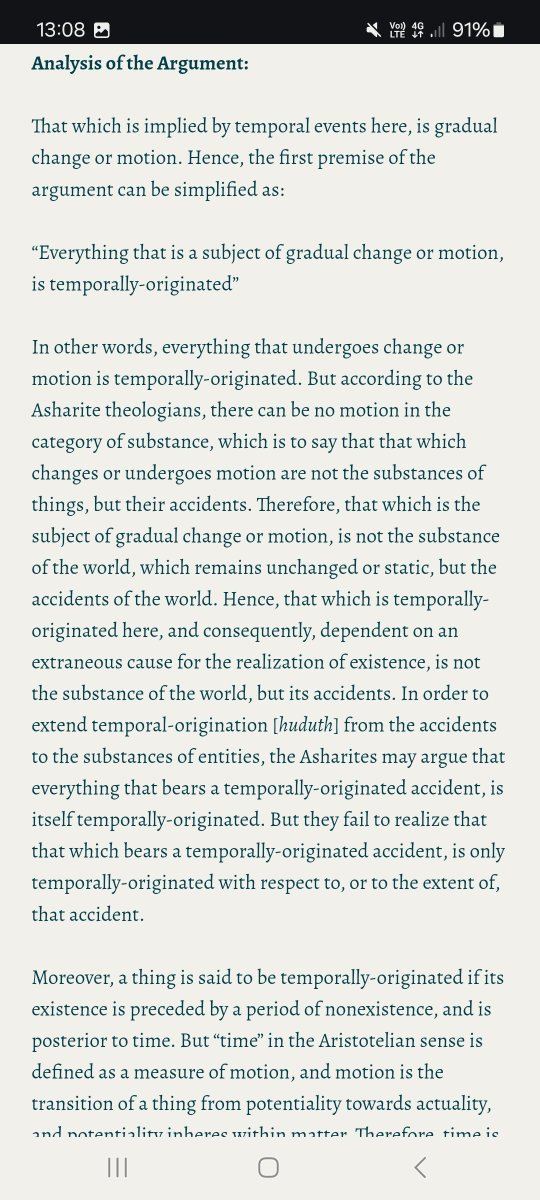
Here he attempts to "simplify" the argument... which does not simplify since he himself states he takes the lazim of the statement. So he erases the primary connection (huduth) for change when change is occurence of hawadith...
Here he attempts to "simplify" the argument... which does not simplify since he himself states he takes the lazim of the statement. So he erases the primary connection (huduth) for change when change is occurence of hawadith...
5
But more importantly he shows an utter lack of comprehension when he states: "But according to Asharite theologians, there can be no motion in the category of substance".
Here by substance he means what we call essence - and yes essences do not change. But because he presupposes
Here by substance he means what we call essence - and yes essences do not change. But because he presupposes
6
His own theory to be correct, he becomes confused by the terminology and fails to understand that we establish a difference between the essence of a thing and an entity.
Essences do not change, but entities certainly can - every contingent one does, did or will.
Essences do not change, but entities certainly can - every contingent one does, did or will.
7
"Therefore, that which is the subject of gradual change or motion, is not the substance of the world, which remains unchanged or static, but the accidents of the world."
Further into his confusion he states this. 2 issues arise:
-The mutakalimin do not hold to hylemorphism. The
Further into his confusion he states this. 2 issues arise:
-The mutakalimin do not hold to hylemorphism. The
8
World does not have a substance of its own but is rather a concept - a set of particular substances. It accepts change by virtue of occuring changes within the particulars it is composed of. Nothing is static in the world besides its general definition as "the sum of contingents"
9
His failure to understand our terminology lead to him thinking that al Ghazali failed in his argument
Additionally he states:
"But they fail to realize that that which bears a temporally-originated accident, is only temporally-originated with respect to, or to the extent of, that
Additionally he states:
"But they fail to realize that that which bears a temporally-originated accident, is only temporally-originated with respect to, or to the extent of, that
10
Accident."
Here he fails to understand, again due to his terminology, that an accident is not other than the entity but is only other than the essence of said entity. An accident occuring in the entity does change the entity which is the sum of both essence and attributes.
Here he fails to understand, again due to his terminology, that an accident is not other than the entity but is only other than the essence of said entity. An accident occuring in the entity does change the entity which is the sum of both essence and attributes.
11
For him to posit otherwise, he has to admit that the accidents are other than the entity itself such that it's not "X's redness" but "redness itself" that is considered. This also requires him to admit that any entity is pure essence and that accidental properties are derived
12
Directly from said essence - which leads to quite the issues such as everything that shares a genus being identical as every accidental properties should be the same.
He then adds:
Moreover, a thing is said to be temporally-originated if its existence is preceded by a period of
He then adds:
Moreover, a thing is said to be temporally-originated if its existence is preceded by a period of
13
nonexistence, and is posterior to time"
"And is posterior to time" is something he added that we do not posit. Rather preceded by nonexistence is the requirement. As for time, we accept it as the measure of change, but that means there is no time prior to the first emergent.
"And is posterior to time" is something he added that we do not posit. Rather preceded by nonexistence is the requirement. As for time, we accept it as the measure of change, but that means there is no time prior to the first emergent.
14
"Hence, time exists due to the material world, and there can be no time in the absence of the physical cosmos."
Ironically he agrees, but he seem to think we say otherwise based on his hylemorphism.
But he then states:
"Therefore, to posit the temporal-origination of the world
Ironically he agrees, but he seem to think we say otherwise based on his hylemorphism.
But he then states:
"Therefore, to posit the temporal-origination of the world
15
implies the existence of time before time"
He himself just stated that time is based on the material world, so time is concomittent to it, not prior. So where is the issue that he tries to force by inventing a criterion no one posited?
He himself just stated that time is based on the material world, so time is concomittent to it, not prior. So where is the issue that he tries to force by inventing a criterion no one posited?
16
And perhaps he is confused by "preceded by a period of non-existence". He can just replace that with "preceded with non-existence" because the non-existence is eternal, not a period of time".
But what seems to be the case is that he presupposed that we posit time as an existent
But what seems to be the case is that he presupposed that we posit time as an existent
17
Additional to the existence of a contingent. This is not the case - and ironically a textbook example of what he accuses al Ghazali of - to misunderstand the opponent.
18
He partially acknowledges that it's the case for estimative time (something he got right, congratulations). But he fails that the time during or after the occurence of the world is not more real than the time prior in terms of existence, only in terms of being derived from*

19
Something existent. Both do not existent, do not require a cause additional from the effect they are derived from, and thus the critique falls on its head. He further states that the time of origination is estimative... why would it be when a contingent exists? Again a question
20
Which would be useless if he understood what he read.
As for the last paragraph, he presupposes (yet again, I know) hylemorphism. We don't posit the possibility of a thing requires a prior material substrate, or a prior time. This is what he has to prove to be required,
As for the last paragraph, he presupposes (yet again, I know) hylemorphism. We don't posit the possibility of a thing requires a prior material substrate, or a prior time. This is what he has to prove to be required,
21
And he fails miserably to do so.