@BoxTraderVK: <b>1 /</b>...
1 /
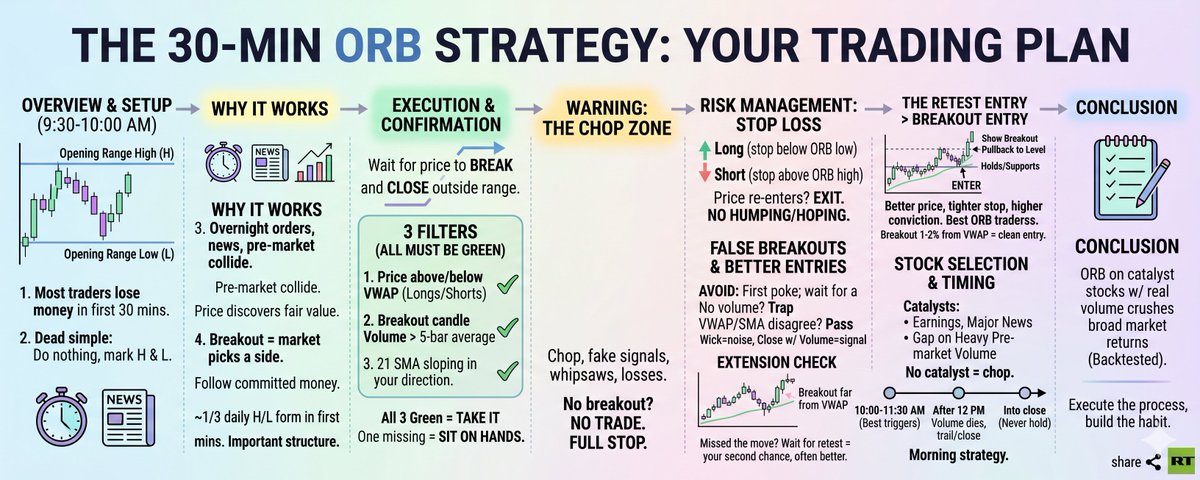
Most traders lose money in the first 30 minutes.
Smart traders use those 30 minutes to set the entire trade.
The 30-Min ORB strategy — thread 🧵
2/
Opening Range Breakout. Dead simple.
9:30–10:00 AM EST → do nothing. Mark the high. Mark the low. Wait for price to break AND close outside that range. Trade the direction.
No guessing. No predicting. Just levels.
3/
Why it works:
Overnight orders, news, pre-market positioning — all collide at 9:30.
First 30 minutes = price discovering fair value. The breakout = the market picking a side.
You're not forecasting. You're following committed money.
4/
Roughly 1 in 3 daily highs or lows form inside the first 30 minutes.
That opening range isn't just a time window.
It's the most important price structure of the day.
5/
This is where most people blow up:
Price still inside the range after 10:00 AM?
No breakout = no conviction. Inside range = chop. Chop = fake signals, whipsaws, losses.
No break above the high or below the low?
No trade. Full stop.
6/
3 filters. All must be green.
All 3 ✅ = take it. One missing = sit on your hands.
7/
Stop loss. Non-negotiable.
Long → stop below ORB low or previous 30 minute candle LOW. Short → stop above ORB high or previous candle high
Price breaks out then re-enters the range?
Your thesis is dead. Exit. No arguing. No hoping.
8/
False breakouts will eat you alive if you let them.
How to avoid:
→ Don't trade the first candle that pokes outside the range. Wait for a CLOSE above/below. → No volume on the breakout candle? It's a trap. → Price breaks out but VWAP and 21 SMA disagree? Pass.
One candle wick outside the range is noise. A close with volume is signal.
9 (The Retest Entry):
The retest entry > the breakout entry. Every time.
Price breaks above ORB high → Pulls back to test that level as support → Holds → enter.
Better price. Tighter stop. Higher conviction.
The best ORB traders aren't fast. They're patient.
10 (Missed the Move?):
Missed the morning breakout? You're not out of the game.
Price almost always retests the ORB level.
Wait for the pullback. Let it prove support (or resistance for shorts). Enter on the hold.
The retest IS your second chance. Often it's the better trade.
11 (Extension Check):
One more killer mistake — chasing price that's already extended.
If the breakout candle ran hard and price is now stretched far from VWAP and the 21 SMA:
Don't chase. Let it come back.
A breakout 1–2% from VWAP = clean entry. A breakout 5%+ from VWAP = you're buying someone else's exit.
12:
Not every stock works for ORB.
You need fuel:
→ Earnings catalyst (beat or miss) → Major news (FDA, contract, upgrade) → Gapping on heavy pre-market volume
No catalyst = no commitment = price stays in range = chop.
13:
Time kills ORB trades.
Best setups trigger 10:00–11:30 AM. After 12 PM → trail or close. Volume dies. Into the close → never hold hoping for a miracle.
Morning strategy. Use it in the morning.
14
ORB on catalyst stocks with real volume has consistently crushed broad market returns in backtests.
But backtests don't trade. You do.
Save this. Build the habit. Execute the process.
RT if this helped 🔁
Disclaimer —
⚠️ Educational only. Not financial advice. Trading involves substantial risk. Past performance ≠ future results. Do your own research. Manage your own risk.
"The market spends the first 30 minutes deciding where it wants to go.
Your job is to wait for the decision — then follow it.
That's the ORB strategy. That's the edge."
"If price is still inside the opening range after 10 AM, that's not an opportunity.
That's a trap.
No breakout = no trade."
"The best trade of the day rarely happens at 9:31.
Mark the 30-minute range. Step back. Let the market show its hand.
Then strike."
"30-Min ORB in one sentence:
Mark the high and low of the first 30 minutes.
Wait for price to break and close outside it.
Trade the direction. Manage the risk.
That's it."
"Amateur traders look for trades at the open.
Professional traders let the open BUILD their trade.
The ORB range is the setup. The breakout is the signal. Discipline is the strategy."