@BoringBiz_: AI can 5-10x the speed and qua...
AI can 5-10x the speed and quality of your investment process if you know where to use it.

Over the past 6 months, I have had conversations with some of the top hedge fund analysts working across the most prestigious hedge funds on Wall Street to better understand how they use AI in their diligence process
My sample set spanned different strategies (long/short vs macro), sizes (large cap vs small cap), exposures (market neutral vs net long), and types (single manager vs multi manager).
Here are the most common answers of how analysts are already using AI today and where pain points still exist.
AI as a Screening Tool
AI platforms can be a fantastic funnel that turns human intuition and pattern recognition into actionable ideas. As an analyst, a lot of your job revolves around forming a view of what the world looks like in a year.
This part of the job is still inherently human. As good as AI is, it still cannot correctly predict the future. And even if you ask it to, the most common answers will involve things that are either inherently priced into the market or a moonshot that requires binary bets.
Here is an example of an answer where I asked Claude to give me predictions for 1 year out from today (April 2026)

Even more importantly, Claude is providing the same answers to everyone using this prompt. As a hedge fund analyst, this part of the idea generation is where there is still alpha today.
If you are outsourcing your first step of idea generation to AI, you have already failed. You just gave up your most valuable edge when it comes to investing today.
Only once you have a general sense of what you are looking for, these tools give you incredible research capabilities that make you 10x more efficient in the initial screen.
A favorite tool here is Perplexity Finance, which has a built-in screener that you can prompt like any other LLM.
In the example below, I gave Perplexity a prompt to find me companies with at least $10bn market cap that grew revenues >20% and EBITDA margins >20%.
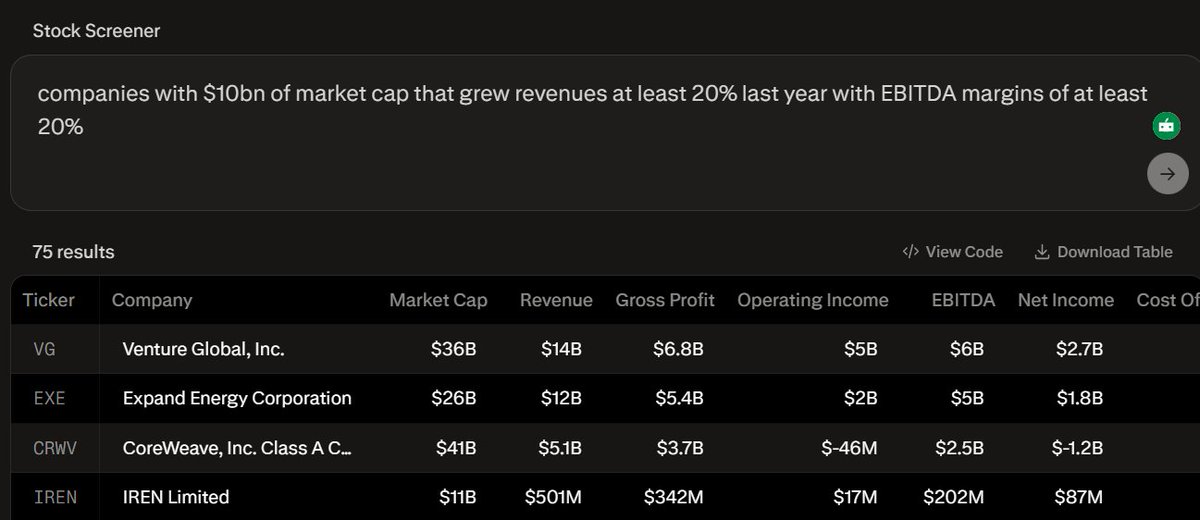
However, most AI platforms still lag far behind when it comes to qualitative screeners. For example, if you ask for a list of companies that have said the word "AI" at least 20x in their recent earnings call, these tools run into trouble. The context window and amount of data ingestion required to solve for that are too large for the capabilities that exist today.
As a hedge fund analyst, your firm might provide you with additional enterprise tools that solve for this issue. From my conversations, the best tools for this type of screening are AlphaSense, Rogo, and Hebbia.
These are native AI platforms built for financial analysts. Each of them can pull data from earnings or research reports, making it a curated platform for banks, private equity firms and hedge funds.
Incumbent AI tools such as the "ASKB" function in Bloomberg are also targeting this same market.
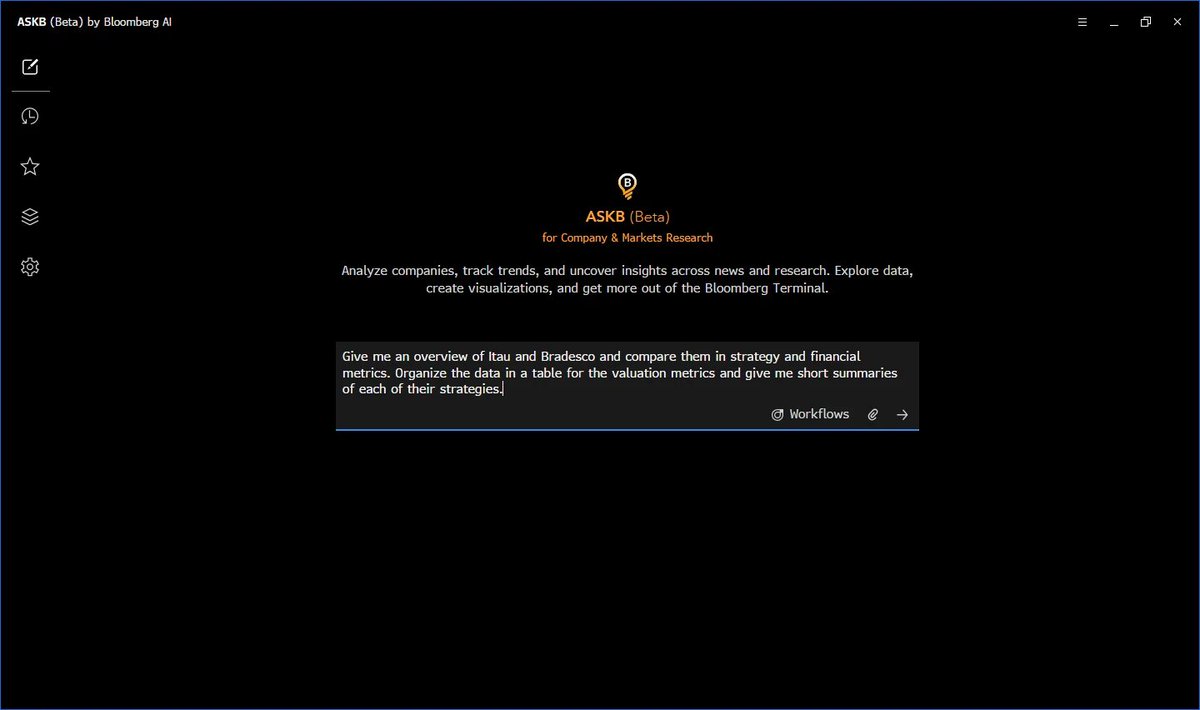
Still, none are perfect since they don't have every integration in one place. AlphaSense is great at scraping the equity research reports and transcripts, but the screener lags behind when it comes to real-time news flow. The universal screening dashboard does not yet exist, and you must build it yourself with a combination of various tools
Diligence Process
The next step as a hedge fund analyst is the initial DD process. This is where you read the 10K/Q, learn what the company does, and get a basic idea of where it sits within the value chain.
AI has already made a real dent today in this part of the process. In a pre-ChatGPT world, getting up to speed on a name was a week-long procedure. Today that can be done within the span of days, if not hours.
These are some examples of the prompts you might want to use
Going through the responses on this list gives you a good sense of whether it is a stock you want to spend more time on. If your firm has access to expert networks and equity research reports, you can also add these on as sources for your AI platform
The best tool for this right now is ChatGPT. You can build dedicated folders on specific companies, upload all the relevant materials on that company (filings, investor presentations, earnings transcripts, expert network calls, ER reports), and create an indexable search universe for yourself just on that name

Now, I want to warn against relying on AI too much. There is still an incredible amount of alpha left in reading the filings and footnotes. You will catch things that AI will just simply miss, even with the capabilities today.
More importantly, investing is a muscle. The more you work it, the more it develops. One of the most common complaints from senior PMs at hedge funds is that their junior analysts are too reliant on AI when making decisions.
One of the best PMs I know recommends the following technique to exercise these muscles, especially if you are new to the industry
Maybe a little extreme, but this process will teach you more about the anatomy of a 10K than anything else. More importantly, you will have figured out how to form a thesis on a stock in a short timeframe with limited information available.
It is also the perfect replica of how case studies are run during the interview process at large institutional hedge funds. This is exactly what you will be asked to do, so what better way to prepare than by actually doing it?
Building the Model
The next step from there is actually digging into the financials and getting a sense of where you think fundamental valuation should be.
To be clear, most hedge funds already know that stocks do not always trade based on fundamentals in the short term. There are external headlines and fund flows that drive stock prices. When a stock moves 8% in a single day, no one is claiming that the discounted value of their future cash flows just went up or down by 8%.
Still, even funds that trade based on quarterly earnings have some form of valuation multiple in their head when they look at a business.
And here is the dirty secret: The best investors view the financial model as the journey, not the conclusion
Everyone knows that the model is not accurate. But building a financial model of a company is often the best way to learn how the business actually works.
Let's take an example
Each line item becomes a critical thought experiment on how the business functions and what levers they have available. A model is not meant to give you the right answer, but it forces you to think about which answers might be correct.
The agentic LLM models are creating a dent in this process. Claude recently launched Claude for Excel, which is fantastic at taking a first pass through a projection model. Analysts who have used the product all claim that it is the same as having a solid intern working for you 24/7 in Excel.

But human intervention remains a necessity. Even though Claude has absolutely blown people's minds, it remains subpar compared to most experienced analysts today.
Models can come back with errors, hard codes, and nits that make it impossible for a senior PM to check the numbers. That is the biggest bottleneck in more AI adoption within hedge funds today.
The work can be done, but it cannot be audited very easily. The tide is slowly turning as LLMs become smarter at checking its own work
There are also a number of "AI in excel" tools targeting this space. Notably, the company Shortcut has made a lot of progress in making excel work smoother for analysts. I expect many more incumbents (FactSet, CapIQ) and new companies to try and disrupt this space moving forward.
Expert Calls & Networks
At most companies, a lot of institutional knowledge sits inside of people's brains that never gets documented anywhere. This is exactly the type of information that AI cannot give you access to, and why expert calls are still valuable in the investing process today.
The main AI use case revolves around making these calls more productive than before. By the time you are sitting down for a conversation with an expert, LLM models can create a target list of questions and discussion topics.
Some quotes from analysts who I spoke with
The next frontier for most expert network companies will be integrating their vast database of network transcripts with these AI platforms. AlphaSense already has some of these capabilities, and more are slowly coming to the rest of the LLM providers.

A prediction of mine here is that we will get to see a broadly outsourced expert call network sometime within the next decade, thanks to AI. There are companies who are working on building "AI experts" that can speak and talk like a human, and are installed with knowledge databases of specific companies.
Portfolio Monitoring
The analyst work of portfolio monitoring is really twofold
Earnings releases are always an incredibly busy time for analysts. They might be juggling 2-4 earnings calls at any given time, updating their models for latest quarters, and jumping on phone calls to decide whether to buy/sell/hold their existing positions.
At most hedge funds, analysts are responsible for quickly summarizing the earnings, putting it side by side with analyst estimates and their internal model estimates, and creating a shortened memo with recommendations to their PM.
This earnings summary memo tends to be relatively standardized for the fund or pod, and usually rarely changes for any given company. A memo for 2Q on Company XYZ will not look that far off from a 3Q memo on the same company next quarter.
This is exactly where AI comes in. Using both external and internal tools, analysts are now able to plug in a new 10Q/K and earnings transcript into AI, and ask it to quickly put together a summary based on last quarter's template.
Analyst intervention is still always required, particularly when it comes to putting together the recommendation on what to do with a position. However, the consensus is that AI tools have significantly reduced the time burden on getting up to speed on earnings releases.
Another fantastic tool is updating the equity research reports after earnings into a ChatGPT project folder, and asking it to analyze the sentiment after earnings.
At the end of the day, you will never make a decision based on equity research estimates. But understanding where the broader market thinks this company should be priced is an excellent way of figuring out where alpha is.
News flow is the other critical piece of this. This is an area where AI still lags behind incumbents. One of the most common complaints from analysts were that AI tools seem to be lag behind on what the latest news is.
ChatGPT or Claude will sometimes offer up insights from many months ago when you ask it a question. In a fast paced market environment, this means answers that are stale or where circumstances have changed.
Gemini and Grok are cited as the best LLM platform when it comes to real time news and information. Google search answers containing Gemini results are still the best for getting quick blasts of information. Perplexity also stands out in this category.
On top of that, hedge fund analysts are usually connected up to the Bloomberg terminal and subscriptions to various news sites that solve this pain point. Software companies that provide access to unique or real time data remain well guarded, despite risk that market is assigning to their stocks because of AI.
As far as I can tell, most analysts don't expect to materially cut their data and news subscription spend anytime in the near future.
Algorithms as Analysts
The reality is that AI is already having a meaningful impact on productivity across most investment firms. Some are much better at using it than others, and even these others are playing catch up to onboard these AI tools as fast as possible.
Within the next 12-18 months, almost every institutional firm will be hooked up to some sort of enterprise AI tool, whether from an incumbent SaaS or new model provider.
The question that always follows is: what happens to the junior analysts? If AI becomes good enough to do all the tasks, are junior analysts even going to be needed anymore?
The answer is: yes, but fewer of them.
Human intervention is still needed. There is a lot of judgement that goes into the job of an investor, and most LPs will never feel comfortable outsourcing that to an AI model.
Imagine a firm where there are only PMs who use AI tools and have no junior analysts underneath. Inevitably, these PMs retire one day. What happens then? The next generation of analysts are important for the firm, even if they are not revenue generators today.
Junior analysts are also cheap for most firms in the larger context of the business. If you do some basic math, most junior analysts get paid salaries that might be 2-3% of the overall P&L of the fund at most.
With that said, the productivity boost is still real and will likely lead to headcount reduction on a long enough timeline.
AI can make the best junior analysts at least 2-3x more productive TODAY. This is not a pipe dream many months or years away. This is happening. Now.
And as time goes on, expect these AI tools to only improve even further. This is the worst that AI models will ever be in our lifetimes. It is a scary thought, but that is the reality of the situation.
So what can you do as a junior analyst to make yourself AI-proof?