@heynavtoor: 🚨 In 1513, a man was thrown in...
@heynavtoor
52 views
Apr 03, 2026
Advertisement
1
🚨 In 1513, a man was thrown in prison, tortured, and exiled. So he wrote a book about power.
The Catholic Church banned it. Napoleon was caught with a copy in his carriage after his final defeat. Stalin kept it on his bedside table and wrote notes in the margins. Mussolini read it. Kissinger and Nixon used it as bedtime reading.
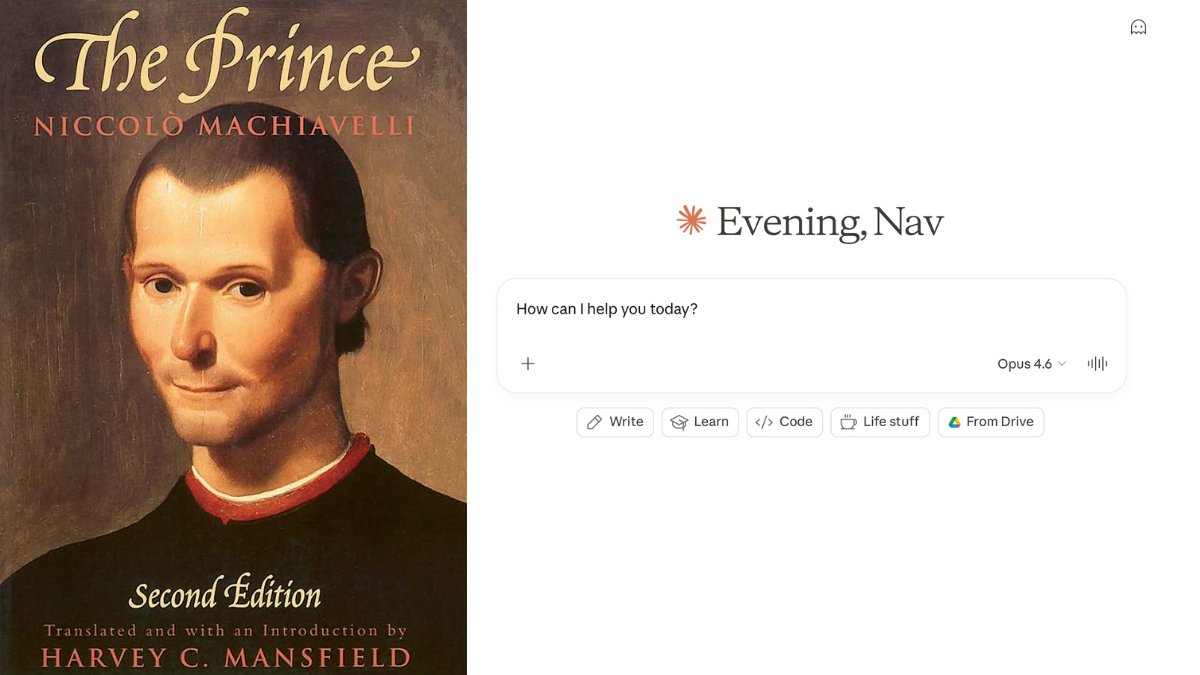
The book is The Prince by Niccolò Machiavelli. It's 500 years old. It invented the word "Machiavellian." And it's still the most dangerous book on power ever written.
I turned Machiavelli's core strategies into 12 Claude prompts.
You describe any power struggle (office politics, negotiations, competition, leadership) and it gives you the exact Machiavellian counter-move.
Here are all 12:
The Catholic Church banned it. Napoleon was caught with a copy in his carriage after his final defeat. Stalin kept it on his bedside table and wrote notes in the margins. Mussolini read it. Kissinger and Nixon used it as bedtime reading.
The book is The Prince by Niccolò Machiavelli. It's 500 years old. It invented the word "Machiavellian." And it's still the most dangerous book on power ever written.
I turned Machiavelli's core strategies into 12 Claude prompts.
You describe any power struggle (office politics, negotiations, competition, leadership) and it gives you the exact Machiavellian counter-move.
Here are all 12:
2
Prompt 1: The Lion and the Fox
Machiavelli's most famous strategy (Chapter 18): A leader must be both a lion and a fox. The lion uses raw force. The fox uses cunning. Most people only know how to be one.
"I'm facing this situation: [describe your power struggle — office politics, negotiation, competition, conflict]. Analyze it through Machiavelli's Lion and Fox framework. Tell me: (1) What is the 'lion move' — the direct, forceful action I could take? What are its risks? (2) What is the 'fox move' — the cunning, strategic, indirect approach? What are its risks? (3) Which one should I use in THIS specific situation and why? (4) Is there a way to combine both — appear as the fox while positioning the lion? Give me the exact words to say and actions to take."
Machiavelli's most famous strategy (Chapter 18): A leader must be both a lion and a fox. The lion uses raw force. The fox uses cunning. Most people only know how to be one.
"I'm facing this situation: [describe your power struggle — office politics, negotiation, competition, conflict]. Analyze it through Machiavelli's Lion and Fox framework. Tell me: (1) What is the 'lion move' — the direct, forceful action I could take? What are its risks? (2) What is the 'fox move' — the cunning, strategic, indirect approach? What are its risks? (3) Which one should I use in THIS specific situation and why? (4) Is there a way to combine both — appear as the fox while positioning the lion? Give me the exact words to say and actions to take."
3
Prompt 2: The Feared vs. Loved Calculator
Machiavelli wrote (Chapter 17): "It is much safer to be feared than loved, if one must choose." But he also warned: fear without hatred is the key. Cross into hatred and you lose everything.
"I'm in a leadership position at [your role/context]. I need to make a tough decision: [describe the decision]. Using Machiavelli's 'Feared vs. Loved' framework, tell me: (1) What would the 'loved' approach look like? Where does it make me vulnerable? (2) What would the 'feared' approach look like? Where does it risk crossing into hatred? (3) Where is the exact line between respected fear and destructive hatred in this situation? (4) Give me the specific approach that commands respect without creating enemies. Script the exact conversation or action."
Machiavelli wrote (Chapter 17): "It is much safer to be feared than loved, if one must choose." But he also warned: fear without hatred is the key. Cross into hatred and you lose everything.
"I'm in a leadership position at [your role/context]. I need to make a tough decision: [describe the decision]. Using Machiavelli's 'Feared vs. Loved' framework, tell me: (1) What would the 'loved' approach look like? Where does it make me vulnerable? (2) What would the 'feared' approach look like? Where does it risk crossing into hatred? (3) Where is the exact line between respected fear and destructive hatred in this situation? (4) Give me the specific approach that commands respect without creating enemies. Script the exact conversation or action."
4
Prompt 3: The Effectual Truth Test
Machiavelli rejected idealism. His core principle (Chapter 15): Don't focus on how things SHOULD be. Focus on how things ARE. He called it "verità effettuale" — the effectual truth.
"I'm dealing with this situation: [describe a problem, decision, or strategy]. Most advice would tell me what I SHOULD do ideally. I don't want that. Give me Machiavelli's 'effectual truth' instead: (1) What is actually happening here — not what I hope or assume? (2) What are the real motivations of every person involved? Assume self-interest, not goodwill. (3) What will actually work vs. what sounds morally correct but will fail? (4) What is the uncomfortable truth I'm avoiding? Say it directly."
Machiavelli rejected idealism. His core principle (Chapter 15): Don't focus on how things SHOULD be. Focus on how things ARE. He called it "verità effettuale" — the effectual truth.
"I'm dealing with this situation: [describe a problem, decision, or strategy]. Most advice would tell me what I SHOULD do ideally. I don't want that. Give me Machiavelli's 'effectual truth' instead: (1) What is actually happening here — not what I hope or assume? (2) What are the real motivations of every person involved? Assume self-interest, not goodwill. (3) What will actually work vs. what sounds morally correct but will fail? (4) What is the uncomfortable truth I'm avoiding? Say it directly."
5
Prompt 4: The Fortress or the People
Machiavelli argued (Chapter 20): Some leaders build fortresses to protect themselves. Smart leaders build loyalty with the people instead. The people are your best fortress.
"I'm trying to protect my position at [your context — company, team, project, business]. I feel threatened by [describe the threat — rival, restructuring, competition, politics]. Using Machiavelli's 'Fortress vs. People' framework: (1) What 'fortresses' am I building right now? (processes, rules, barriers, isolation) Are they actually protecting me or cutting me off? (2) Who are 'the people' in my situation — the allies whose support would make me untouchable? (3) What would it look like to abandon the fortress strategy and invest in people instead? (4) Give me 3 specific actions this week to build loyalty that protects my position better than any fortress."
Machiavelli argued (Chapter 20): Some leaders build fortresses to protect themselves. Smart leaders build loyalty with the people instead. The people are your best fortress.
"I'm trying to protect my position at [your context — company, team, project, business]. I feel threatened by [describe the threat — rival, restructuring, competition, politics]. Using Machiavelli's 'Fortress vs. People' framework: (1) What 'fortresses' am I building right now? (processes, rules, barriers, isolation) Are they actually protecting me or cutting me off? (2) Who are 'the people' in my situation — the allies whose support would make me untouchable? (3) What would it look like to abandon the fortress strategy and invest in people instead? (4) Give me 3 specific actions this week to build loyalty that protects my position better than any fortress."
6
Prompt 5: The Fortune vs. Virtue Engine
Machiavelli's boldest claim (Chapter 25): Fortune controls half of your life. But the other half? That's YOUR virtue — your skill, preparation, and boldness. He wrote: "It is better to be impetuous than cautious."
"Here is my current situation: [describe your career, business, or life situation]. Using Machiavelli's Fortune vs. Virtue framework: (1) What parts of my situation are 'fortune' — outside my control, random, dependent on luck or others? (2) What parts are 'virtue' — things I CAN control through skill, preparation, boldness, and action? (3) Where am I wasting energy fighting fortune (things I can't change) instead of maximizing virtue (things I can)? (4) Machiavelli said 'build dams in calm weather.' What specific 'dams' should I build right now to prepare for when fortune turns against me? (5) Where should I be more impetuous — taking bold action instead of waiting cautiously?"
Machiavelli's boldest claim (Chapter 25): Fortune controls half of your life. But the other half? That's YOUR virtue — your skill, preparation, and boldness. He wrote: "It is better to be impetuous than cautious."
"Here is my current situation: [describe your career, business, or life situation]. Using Machiavelli's Fortune vs. Virtue framework: (1) What parts of my situation are 'fortune' — outside my control, random, dependent on luck or others? (2) What parts are 'virtue' — things I CAN control through skill, preparation, boldness, and action? (3) Where am I wasting energy fighting fortune (things I can't change) instead of maximizing virtue (things I can)? (4) Machiavelli said 'build dams in calm weather.' What specific 'dams' should I build right now to prepare for when fortune turns against me? (5) Where should I be more impetuous — taking bold action instead of waiting cautiously?"
7
Prompt 6: The Flatterer Filter
Machiavelli dedicated an entire chapter (Chapter 23) to the most dangerous threat: flatterers. He warned that courts are full of them, and the only defense is selecting a small group of truth-tellers.
"I am [your role] and I make decisions about [your domain]. Using Machiavelli's Flatterer Filter framework: (1) In my professional life, who might be telling me what I want to hear instead of what I need to hear? What are the signs? (2) When I ask for feedback on [specific project or decision], what would a flatterer say vs. what would a truth-teller say? Give me both versions. (3) What questions can I ask that make it impossible for someone to flatter me — questions that force honest, uncomfortable answers? (4) Build me a 'council of truth-tellers' framework — how do I select 3-5 people whose honest input I trust, and how do I structure conversations so they speak freely?"
Machiavelli dedicated an entire chapter (Chapter 23) to the most dangerous threat: flatterers. He warned that courts are full of them, and the only defense is selecting a small group of truth-tellers.
"I am [your role] and I make decisions about [your domain]. Using Machiavelli's Flatterer Filter framework: (1) In my professional life, who might be telling me what I want to hear instead of what I need to hear? What are the signs? (2) When I ask for feedback on [specific project or decision], what would a flatterer say vs. what would a truth-teller say? Give me both versions. (3) What questions can I ask that make it impossible for someone to flatter me — questions that force honest, uncomfortable answers? (4) Build me a 'council of truth-tellers' framework — how do I select 3-5 people whose honest input I trust, and how do I structure conversations so they speak freely?"
8
Prompt 7: The Cruelty Calculator
Machiavelli's most controversial advice (Chapter 8): If you must do something painful, do it all at once. Never drag out the pain. Benefits should be given slowly so they're savored. Injuries should be inflicted all at once so they're forgotten.
"I need to make a difficult decision that will hurt some people: [describe — layoffs, restructuring, ending a partnership, tough feedback, budget cuts, canceling a project]. Using Machiavelli's framework of 'all cruelties at once, benefits over time': (1) What is the clean, decisive version of this action — done once, done completely, done now? (2) What does the dragged-out, indecisive version look like — and why is it actually MORE cruel? (3) How do I deliver this decision in a way that is direct and firm but avoids creating lasting hatred? (4) After the difficult action, what small, steady benefits can I give over time to rebuild trust and loyalty? Give me a timeline."
Machiavelli's most controversial advice (Chapter 8): If you must do something painful, do it all at once. Never drag out the pain. Benefits should be given slowly so they're savored. Injuries should be inflicted all at once so they're forgotten.
"I need to make a difficult decision that will hurt some people: [describe — layoffs, restructuring, ending a partnership, tough feedback, budget cuts, canceling a project]. Using Machiavelli's framework of 'all cruelties at once, benefits over time': (1) What is the clean, decisive version of this action — done once, done completely, done now? (2) What does the dragged-out, indecisive version look like — and why is it actually MORE cruel? (3) How do I deliver this decision in a way that is direct and firm but avoids creating lasting hatred? (4) After the difficult action, what small, steady benefits can I give over time to rebuild trust and loyalty? Give me a timeline."
9
Prompt 8: The New Territory Playbook
When Machiavelli advised on conquering new territories (Chapters 3-5), his advice wasn't about war — it was about what happens AFTER you win. Most leaders fail not in the conquest, but in holding what they've gained.
"I just entered a new territory: [new job, new team, new market, new role, new client, new industry]. Using Machiavelli's framework for holding new conquests: (1) What are the existing power structures I need to understand before I change anything? Who are the 'nobles' (established power players) and who are 'the people' (the broader group)? (2) Which small wins should I secure immediately to establish credibility? (3) What potential threats will emerge in 30/60/90 days as the 'honeymoon period' fades? (4) Should I make allies with the existing power structure or replace it? What are the risks of each? (5) Give me a 90-day plan to secure this new territory permanently."
When Machiavelli advised on conquering new territories (Chapters 3-5), his advice wasn't about war — it was about what happens AFTER you win. Most leaders fail not in the conquest, but in holding what they've gained.
"I just entered a new territory: [new job, new team, new market, new role, new client, new industry]. Using Machiavelli's framework for holding new conquests: (1) What are the existing power structures I need to understand before I change anything? Who are the 'nobles' (established power players) and who are 'the people' (the broader group)? (2) Which small wins should I secure immediately to establish credibility? (3) What potential threats will emerge in 30/60/90 days as the 'honeymoon period' fades? (4) Should I make allies with the existing power structure or replace it? What are the risks of each? (5) Give me a 90-day plan to secure this new territory permanently."
10
Prompt 9: The Appearance Engine
Machiavelli wrote (Chapter 18): "Everyone sees what you appear to be, few experience what you really are." A leader must appear merciful, faithful, humane, and religious — even if circumstances require the opposite.
"I need to navigate a situation where perception matters more than reality: [describe — a presentation, a negotiation, a leadership moment, a public decision, a competitive situation]. Using Machiavelli's Appearance framework: (1) What does my audience NEED to see from me right now? What qualities must I project? (2) What is the gap between what I need to project and what I actually feel or want to do? (3) How do I close that gap without being fake — what specific words, body language, and actions project the right image authentically? (4) What would a master of appearances do in this exact situation? Script it for me — what I say, how I say it, and what I do immediately after."
Machiavelli wrote (Chapter 18): "Everyone sees what you appear to be, few experience what you really are." A leader must appear merciful, faithful, humane, and religious — even if circumstances require the opposite.
"I need to navigate a situation where perception matters more than reality: [describe — a presentation, a negotiation, a leadership moment, a public decision, a competitive situation]. Using Machiavelli's Appearance framework: (1) What does my audience NEED to see from me right now? What qualities must I project? (2) What is the gap between what I need to project and what I actually feel or want to do? (3) How do I close that gap without being fake — what specific words, body language, and actions project the right image authentically? (4) What would a master of appearances do in this exact situation? Script it for me — what I say, how I say it, and what I do immediately after."
11
Prompt 10: The Self-Sufficiency Audit
Machiavelli's test for whether a state can survive (Chapter 10): Can it defend itself without depending on others? If you need allies to survive, you are already weak.
"Audit my professional self-sufficiency using Machiavelli's framework. Here is my current situation: [describe your role, income sources, skills, dependencies]. (1) What am I currently dependent on that could be taken away? (a single employer, a single client, a single skill, a single platform, a single relationship) (2) If that dependency disappeared tomorrow, could I survive and rebuild? How long would it take? (3) What skills, resources, or relationships would make me truly self-sufficient — needing no one's permission to thrive? (4) Give me a 6-month plan to eliminate my biggest vulnerability and build the 'army' Machiavelli says every prince needs — my own capabilities that no one can take from me."
Machiavelli's test for whether a state can survive (Chapter 10): Can it defend itself without depending on others? If you need allies to survive, you are already weak.
"Audit my professional self-sufficiency using Machiavelli's framework. Here is my current situation: [describe your role, income sources, skills, dependencies]. (1) What am I currently dependent on that could be taken away? (a single employer, a single client, a single skill, a single platform, a single relationship) (2) If that dependency disappeared tomorrow, could I survive and rebuild? How long would it take? (3) What skills, resources, or relationships would make me truly self-sufficient — needing no one's permission to thrive? (4) Give me a 6-month plan to eliminate my biggest vulnerability and build the 'army' Machiavelli says every prince needs — my own capabilities that no one can take from me."
12
Prompt 11: The Advisor Intelligence Test
Machiavelli wrote (Chapter 22): You can judge a leader's intelligence by the people around them. There are three kinds of intelligence: those who understand things on their own, those who understand when shown, and those who understand neither.
"I need to evaluate the people around me — my team, advisors, partners, or collaborators. Using Machiavelli's Three Intelligences framework: (1) For each person in [my team/circle], which category do they fall into: understands on their own, understands when shown, or understands neither? Be honest. (2) Am I keeping anyone in my inner circle out of loyalty or comfort rather than capability? Who? (3) What does my current circle say about MY intelligence as a leader? (4) If I had to rebuild my advisory circle from scratch to maximize my success, what 3-5 roles would I fill and what qualities would I look for? (5) Who in my current network fits those roles that I'm not utilizing?"
Machiavelli wrote (Chapter 22): You can judge a leader's intelligence by the people around them. There are three kinds of intelligence: those who understand things on their own, those who understand when shown, and those who understand neither.
"I need to evaluate the people around me — my team, advisors, partners, or collaborators. Using Machiavelli's Three Intelligences framework: (1) For each person in [my team/circle], which category do they fall into: understands on their own, understands when shown, or understands neither? Be honest. (2) Am I keeping anyone in my inner circle out of loyalty or comfort rather than capability? Who? (3) What does my current circle say about MY intelligence as a leader? (4) If I had to rebuild my advisory circle from scratch to maximize my success, what 3-5 roles would I fill and what qualities would I look for? (5) Who in my current network fits those roles that I'm not utilizing?"
13
Prompt 12: The Full Machiavellian War Room
This is the master prompt. It combines every framework from The Prince into one strategic analysis.
"I am facing a critical situation: [describe your biggest current challenge — career, business, negotiation, leadership, competition]. Run a full Machiavellian analysis:
SITUATION ASSESSMENT: What is the 'effectual truth' of my situation — what is actually happening, stripped of my assumptions and hopes?
POWER MAP: Who holds power? Who are my allies, enemies, and neutrals? What does each person want?
LION OR FOX: Should I use force (direct confrontation) or cunning (indirect strategy)? Or both?
FEARED OR LOVED: How should I position myself — and where is the line I must not cross?
FORTUNE VS. VIRTUE: What can I control and what can't I? Where should I be bolder?
FLATTERER CHECK: Where am I being told what I want to hear instead of the truth?
THE MOVE: Based on all of the above, what is the single most strategic action I should take this week? Be specific. Tell me exactly what to do, what to say, and when to do it."
This is the master prompt. It combines every framework from The Prince into one strategic analysis.
"I am facing a critical situation: [describe your biggest current challenge — career, business, negotiation, leadership, competition]. Run a full Machiavellian analysis:
SITUATION ASSESSMENT: What is the 'effectual truth' of my situation — what is actually happening, stripped of my assumptions and hopes?
POWER MAP: Who holds power? Who are my allies, enemies, and neutrals? What does each person want?
LION OR FOX: Should I use force (direct confrontation) or cunning (indirect strategy)? Or both?
FEARED OR LOVED: How should I position myself — and where is the line I must not cross?
FORTUNE VS. VIRTUE: What can I control and what can't I? Where should I be bolder?
FLATTERER CHECK: Where am I being told what I want to hear instead of the truth?
THE MOVE: Based on all of the above, what is the single most strategic action I should take this week? Be specific. Tell me exactly what to do, what to say, and when to do it."
14
These 12 prompts are built on the strategies of the most feared political mind in history.
Machiavelli was tortured, exiled, and banned by the Church. 500 years later, his ideas are still being used by the most powerful people in the world.
Now they're yours.
Machiavelli was tortured, exiled, and banned by the Church. 500 years later, his ideas are still being used by the most powerful people in the world.
Now they're yours.
15
I hope you've found this thread helpful.
Follow me @heynavtoor for more.
Like/Repost the quote below if you can:
Follow me @heynavtoor for more.
Like/Repost the quote below if you can:
View Tweet