@Tactx_: We have an upcoming class on t...
We have an upcoming class on this article, which you can pre-register for here

Manchester City’s ability to manipulate pressure was once again on display, but this time the key was their use of the right side through Rayan Cherki. City consistently found a way to expose the space left behind Declan Rice, turning what should have been defensive aggression into a structural weakness.
Arsenal’s press, usually one of their greatest strengths, became disjointed. The timing and coordination were off with individual players using different pressing systems.
As Nico O'Reilly explained: “It was to find the space in the right with Rayan Cherki. We’ve seen the spaces there because [Declan] Rice likes to jump into Rodri or Bernardo [Silva]. We’ve seen Cherki is the free man and that’s where the goals came from – the right side – so it worked.”
This analysis will focus on how City repeatedly targeted that free man on the right, why Arsenal’s press failed to deal with it, and how Arsenal's usual strength became a weakness.
From Hybrid Control to Man-to-Man Aggression
Before analysing the game, it is important to understand Arsenal’s usual pressing patterns. They operate from a hybrid structure, often maintaining a numerical advantage with a plus one, before quickly shifting into a man-to-man press. This transition is typically triggered by Declan Rice, whose aggressive jump forward initiates the press and prompts an Arsenal defender to step out from the defensive line. This space behind Rice is where Man City looked to exploit.
In the example below, we want to highlight Rice's jump and Gabriel's follow-up, while also noting the positions of Saka and Martinelli. The deeper positions allow the central press and add security behind the ball.

Another example, this time with the wide press. Saka and Martinelli join the first line of the press, and Hincapiie is expected to jump to support Rice, who has a potential 2v1 against him. Keep these presses in mind as we look at the Man City game and remember O'Reilly's comments on how they want to exploit the space behind Rice.

Pep's Plan
Pep wanted to use Cherki around the space that Rice would occupy. If Rice followed Rodri or Silva, Cherki would be free and vice versa. Zubimenedi's out-of-possession role was heavily focused on the inverted Nico O'Reilly. This left Rice stretched, a role he is used to, but Man City targeted the space he had to cover.
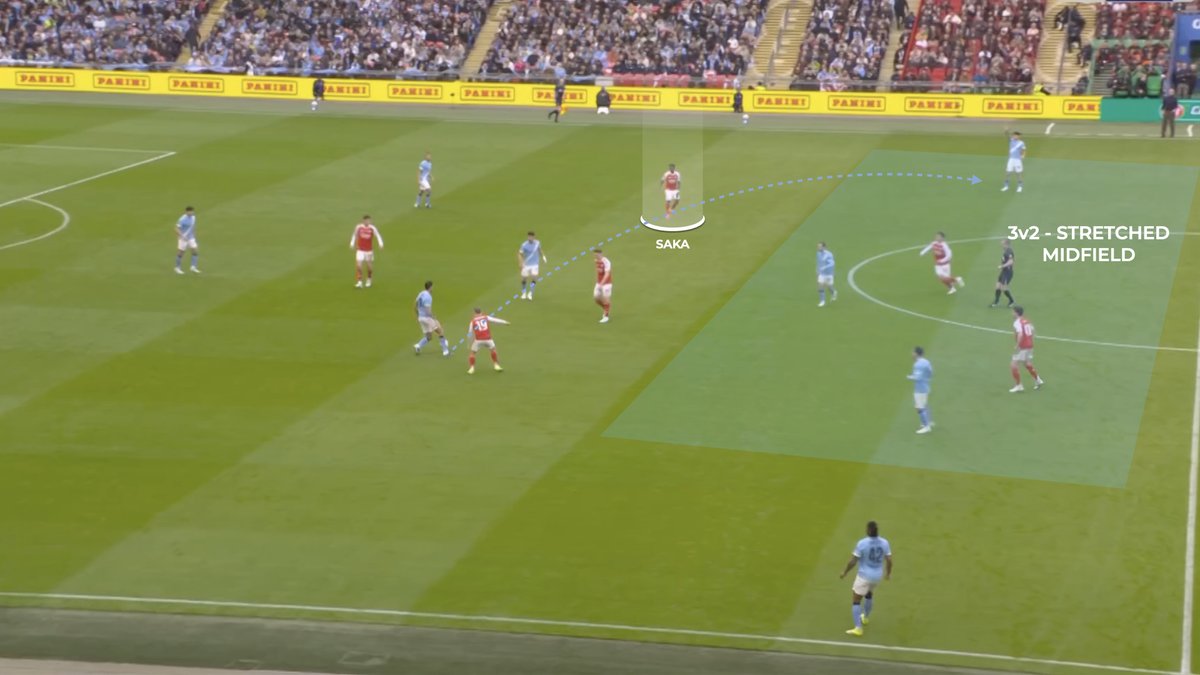
Example: O'Reilly inverts, and Zubimendi marks. A 3v2 develops as Cherki drifts wide. Rice and Trossard are stretched to mark three players.


Zubimendi's fixation on O'Reilly stretched Rice and Trossard. Without Odegaard, the press on the first line did not dictate to the players behind where they could shut off passing lanes. Under a normal wide press, Trossard would be ready to jump, and as he does, Saka would drop as Havertz looks to dictate play one way.

How it should look
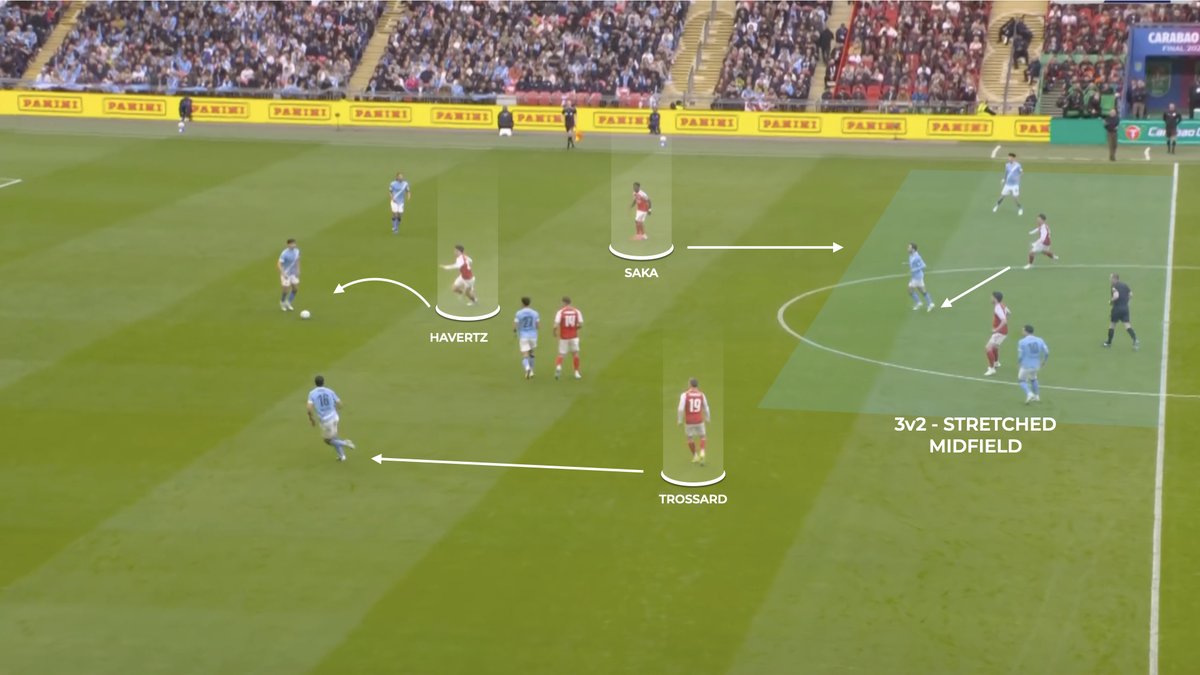
Trossard can't get close enough to Rodri to get ample pressure on the ball, and he switches play to O'Reilly against the stretched midfield of Arsenal. They are caught between the central press and the wide press, doing neither effectively.
Preventing Arsenal Jumping Man-to-Man
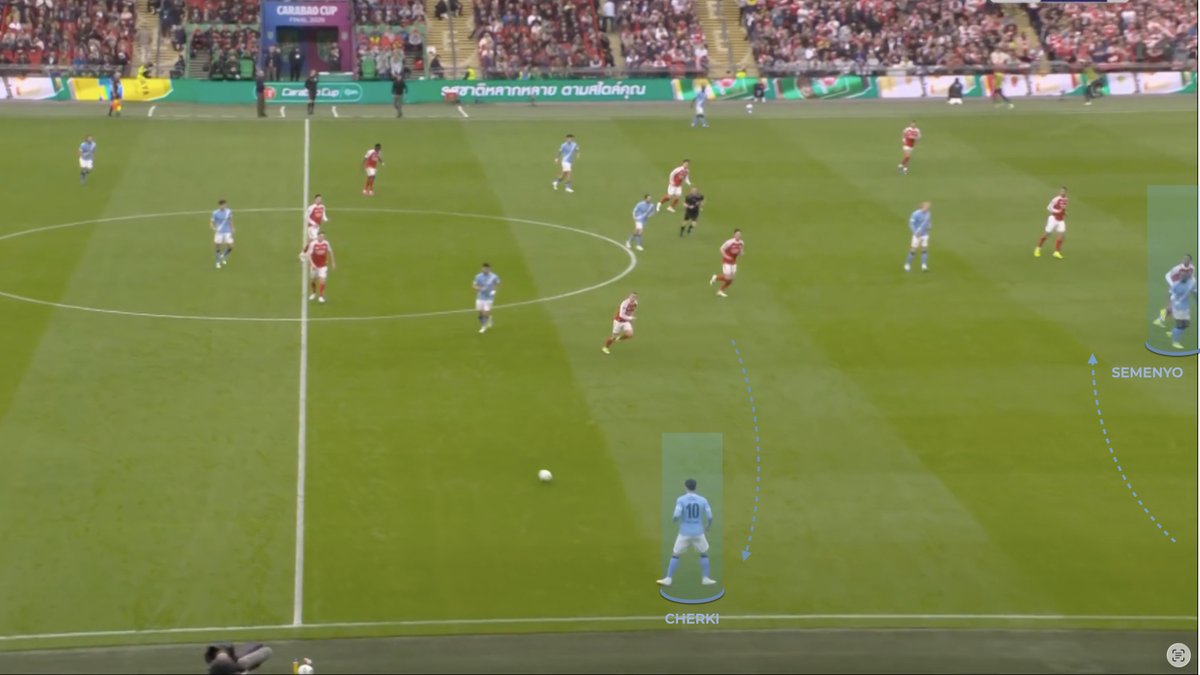
Arsenal's normal solution is for Gabriel or Hincapie to jump out of the back four to support Rice and take the free man. In this instance, Gabriel does it.

Semenyo was smart and used counter movements: as Cherki moved wide, Semenyo moved inside. This pins Gabriel, and Hincapie doesn't have time to react as he was initially pinned by Semenyo.
Arsenal sought to address this at half-time, and Hincapie was much more aggressive. The distance was still substantial, but this was clearly recognised at half-time.

With this aggressive press, Rice jumps onto the deepest Man City midfield player (Silva). With Zubimendi fixed on O'Reilly and Saka not supporting the midfield line, there is space behind Rice to exploit. Nunes breaks the man-to-man press with a double pass and puts in Haaland. Read more here about breaking the man-to-man press with a double pass.

City, through Silva, had smelt blood, and he recognised Arsenal wanted to be more aggressive with Cherki, so he went out and doubled up. Arsenal's press looks similar to City's at this point, with four players high, but they don't prevent passes into wide areas or recover quickly enough once the ball bypasses them.

This put Arsenal in a position where they had to defend their box. With all eleven players 20 yards from the goal. Any regain of possession was met with a string counter-press, and Arsenal continued to lose possession and were forced to deal with attack after attack..
Bernardo Silva, "We felt they lost a bit of energy, and when we felt that, we had to go even more for them. Nico O’Reilly is really good at arriving in the box in those moments. We were lucky to score the first one, and when we are on top, we can find the spaces."

We believe Arteta had prepared for Pep’s 4-2-2-2, but City instead reverted to a more traditional structure, with Semenyo providing width on the right and Doku on the left. With Havertz and Gyökeres leading the press, Arsenal struggled to dictate City’s build-up and often found themselves caught between pressing systems without moving through them with any cohesion.
Trossard and Saka were too eager to join the first line of the press, which only deepened the disconnection within the press. Saka’s role in particular appeared unclear, as he was frequently left in no man’s land without a clear reference point.
This was further exposed by his direct opponent, Nico O’Reilly, who moved inside onto Zubimendi. This stretched Arsenal’s midfield, creating spaces around Declan Rice that Cherki and later Silva and Rodri consistently exploited.
