@KoroushAK: ## Price action patterns don't...
Price action patterns don't work. I've spent years analysing 10,000+ trades to test breakout, reversal, and trending patterns.
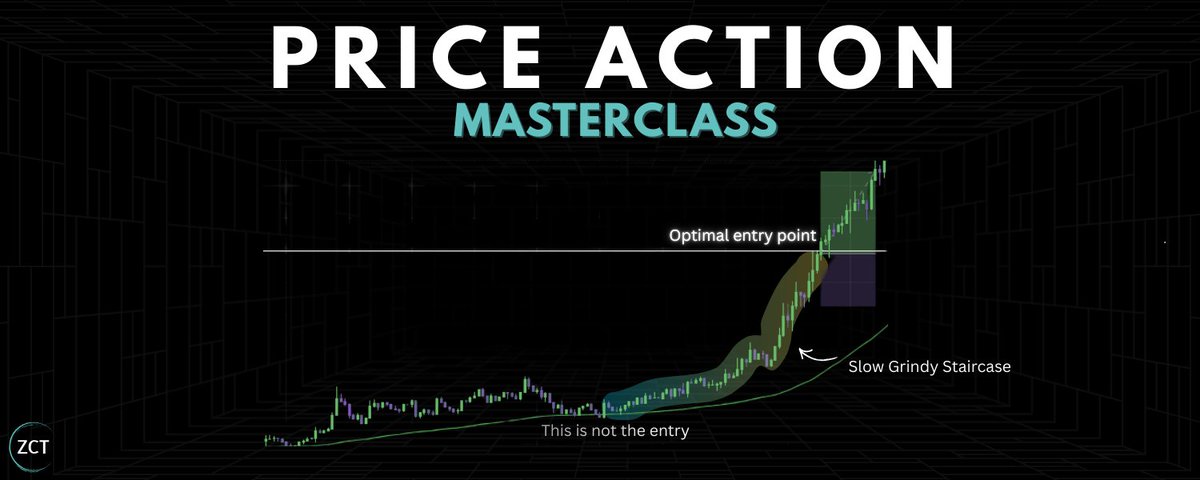
But most traders can't make money from trading patterns because they don't know how to use them.
They treat price action like an art: subjective, interpretive, requiring years of screen time to develop a "feel." That's bullshit.
Price action is a systematic filter that tells you which type of strategy you should be trading right now.
After reading this article, you will be able to↓
Let me show you what you've been missing:
Lesson 1: What Price Action Actually Is
Before you can use price action as a decision tool, you need to understand what it's actually showing you.
To do this, I've created a powerful visualisation technique:
⚔️The Army Analogy
This is a metaphorical battle between bull and bear armies.
We can actually use this to understand every price action pattern in existence. Here's how:
Imagine two armies fighting:
Your charts are built from candles, and each candle represents one battle in an ongoing war.
Price moves because both armies are constantly trying to gain territory and push the other side back.
But how does a candle tell us what actually happened in that battle?
Each candle is built from exactly 4 numbers:
Visually:
These two parts capture everything that happens between the bear and bull armies.
What Those Parts Actually Represent
The Body (Territory Gained)

The thick part of the candle is the body. It shows the distance between where price opened and where it closed during that time period.
In battle terms, this is territory gained.
The size of the body tells you how decisive that victory was:
The body tells you:
Who won the battle- and how strongly.
The Wicks: Rejected Territory
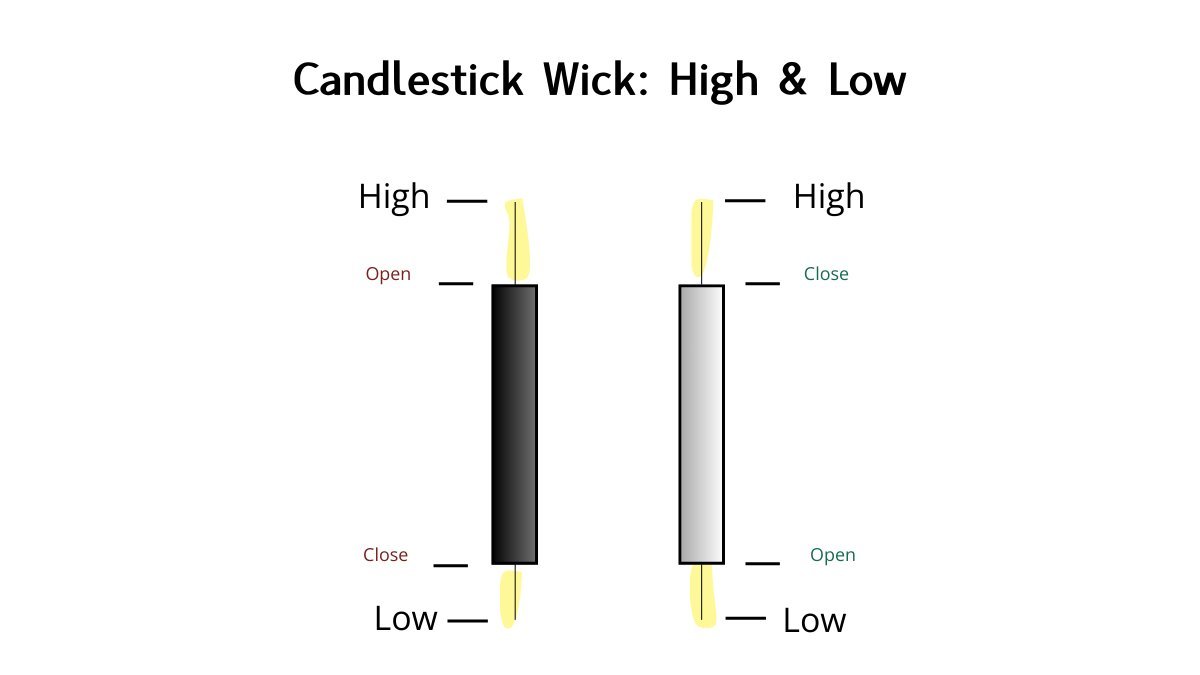
The thin lines extending above and below the body are wicks. They represent levels where price tried to go but failed to hold.
The size of the wick tells you how intense that rejection was:
Wicks tell you:
Where one side attempted to advance- and failed.
Examples
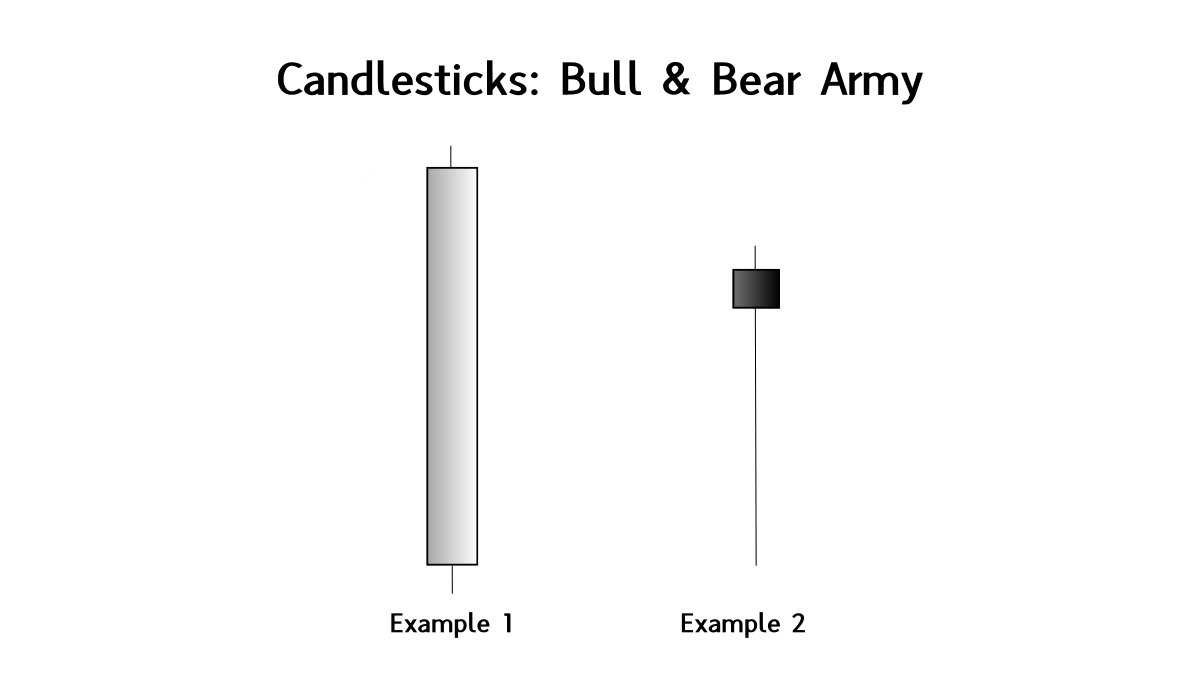
Example 1: A candle with a large green body and tiny wicks means bulls marched far upward with minimal resistance. Bulls dominated that battle completely. (v bullish)
Example 2: A candle with a tiny body and a massive lower wick means bears tried hard to push price down, but bulls annihilated them and reclaimed almost all that territory. (v bullish)
You can now extrapolate this to any price action pattern.
🎓Lesson 1 Summary
Charts are made of candles
Body = territory gained
Wicks = rejected territory
That's all price action is: who won, who failed, and how decisively.
Now that you understand what you're looking at, here's what actually matters:
Lesson 2: The Two Trading Styles
Every trading strategy, every single one, falls into one of two categories.
You're either trading momentum or mean reversion.

1. Momentum Trading
You assume levels will break.
You want continuation. You're betting that whatever was happening will keep happening.
Example: Buying at $100, expecting price to continue to $105.
What you want to see:
2. Mean Reversion Trading
You assume levels will hold.
You want rejection. You want reversal. You're betting that price exhausts at the level and snaps back toward the opposite boundary.
Example: Shorting at $100, expecting price to fall back to $95.
What you want to see:
Here's What Your Job Actually Is:
To identify which environment you're in right now and only trade when your edge is active in that environment.
This is different to market structure (which I will cover in a future lesson).
Let me show you how.
🎓 Lesson 2 Summary
Momentum or Mean Reversion
You want expansion, participation, and follow-through.
You want exhaustion, rejection, and failed attempts.
Now, let's identify 4 of my best patterns:
Lesson 3: The Four Price Action Patterns
These are the only four patterns you need to know.
They tell you when your edge is active and when it's not.
Pattern 1: Large Bodies (Fast Expansion)
What it looks like:
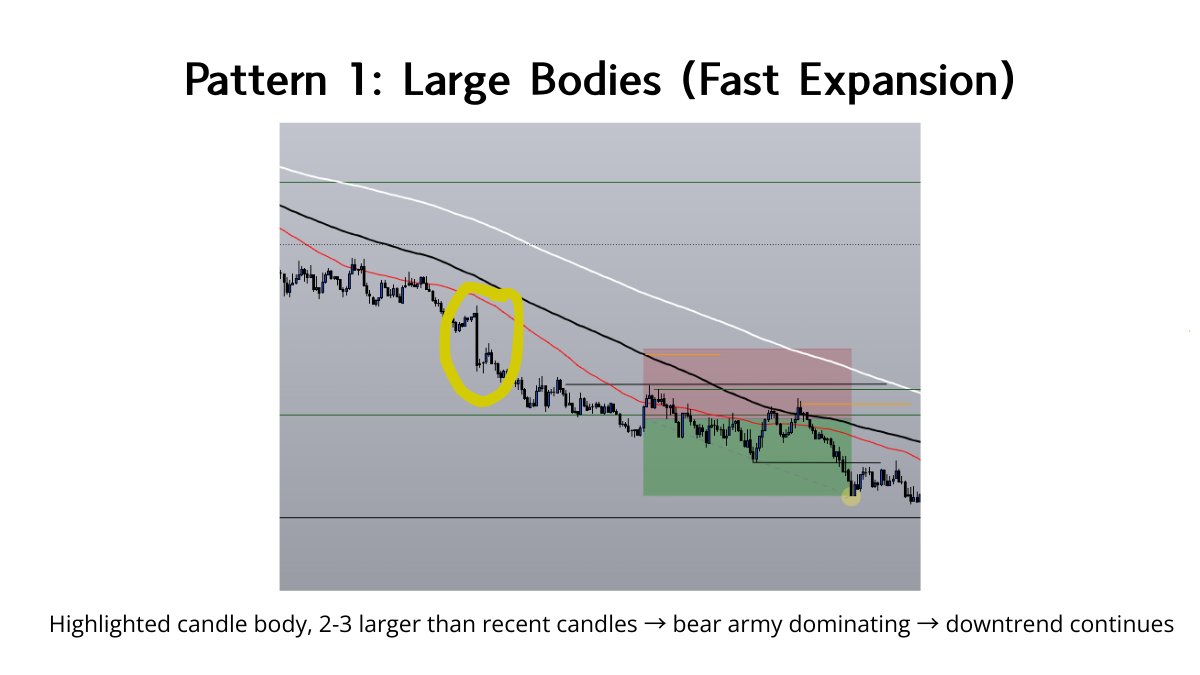
One candle has a body that's 2-3× larger than recent candles.
"Large" is always relative, never absolute. You compare the current candle to the previous 5-10 candles to determine what's normal.
Example: Price has been moving in $0.50 increments. Suddenly, one candle moves $2.00. That's a large body.
What it means:
Large bodies = acceptance = continuation.
⚔️Army Analogy
One army just won a decisive victory in a single charge. They didn't grind forward, they exploded forward. The opposing army is scattered. Reinforcements are arriving for the winners.
This is real momentum: decisive control and follow-through.
Edge Activation:
✅ GOOD for momentum
❌ BAD for mean reversion
Common Mistakes to Avoid:
IMPORTANT: This pattern is about a large body only. A large wick means something completely different (Pattern 2).
Pattern 2: Fast Spike Into Levels (Rejection)
What it looks like:

Price pushes into a key level (support or resistance), wicks beyond it, then closes back inside the range.
Example:
That wick is rejected territory.

⚔️ Army Analogy
This is a failed invasion.
The attacking army (bulls at resistance, bears at support) pushed forward aggressively. They briefly occupied new territory beyond the level.
Then got wiped out.
What it means:
Price closing back inside the range tells you:
Why it signals mean reversion:
Edge Activation:
❌ BAD for momentum
✅ GOOD for mean reversion
Common Mistake to avoid:
Ignoring wick rejections and trading breakouts anyway.
When you see large wicks at resistance, that's significant sell pressure absorbing buy orders. When you see multiple large wicks in the same area, that's a wall. Don't fight it, trade the rejection.
Pattern 3: Consecutive Candles (The Grindy Staircase)
What it looks like:

Multiple candles in a row making:
No big spike. No deep pullbacks. Just steady, grinding progression.
Example: Price moves: $95 → $96 → $97 → $98. Each candle closes higher than the last. Dips get bought immediately. No meaningful pullback forms.
Why it grinds instead of spikes:
Large institutional orders are being executed slowly over time. They can't market-buy large orders (too much slippage), so they split it: small market buys spread over time + layered limit buys absorbing any dips.
This creates the staircase effect.

⚔️Army Analogy
This is a march, not a charge.
The bull army isn't sprinting forward in one explosive battle. They're advancing step by step, securing each position before moving forward.
Each candle represents.
- A small push forward
- A brief pause to consolidate
- Another push
The critical insight:
The bears are trying to push price back down. They're counterattacking constantly.
But every counterattack gets absorbed. Every dip gets bought. No meaningful pullback forms.
This tells you:
- Demand is strong enough that even dips get bought
- The bull army is winning by attrition, not explosion.
Edge Activation:
✅ GOOD for momentum
❌ BAD for mean reversion
Common Mistake to avoid:
Waiting for a pullback that never comes.
This is the highest-probability momentum environment. The pattern is forgiving: entry timing, stop placement, and targets all have wide margins for error because the underlying pressure is so consistent.
Pattern 4: Choppy Price Action (Stalemate)
What it looks like:

Price repeatedly bounces between the same highs and lows.
You know you're in choppy price action when:
Neither bulls nor bears can establish control
Example: Price oscillates between $95 and $100:
What it means:
This is equilibrium. Bulls and bears are evenly matched. Neither side has enough strength to break through and establish a trend.
⚔️Army Analogy
The bull army pushes up → gets destroyed at resistance.
The bear army pushes down → gets destroyed at support.
Territory changes hands briefly, but no side can hold it.
This is a stalemate.
Edge Activation:
❌ BAD for momentum
✅ GOOD for mean reversion
The "no trend" environment is just as important to recognize as trending environments. It tells you: don't trade breakouts here. Trade the range boundaries instead.
Common Mistake:
Trying to trade momentum breakouts in a ranging environment.
When a level has been tested and held 3+ times, it's consolidating, not trending. Breakout attempts in this environment fail because neither side has accumulated enough strength to break through yet.
🎓 Lesson 3 Summary
You only need four price action patterns to know when your edge is active, and when it’s not.
Pattern 1: Large Bodies (Fast Expansion)
❌ Bad for mean reversion
Pattern 2: Wicks Into Levels (Rejection)
✅ Good for mean reversion
Pattern 3: Consecutive Candles (The Grindy Staircase)
❌ Bad for mean reversion
Pattern 4: Choppy Price Action (Stalemate)
✅ Good for mean reversion
These four patterns tell you whether continuation or reversion is favored, and when your strategy has edge.
Lesson 4: The Decision Process

Every chart. Every timeframe.
Ask one question:
"Which of the four patterns am I in right now?"
Then apply the rule:
If none of the four patterns are clear, no edge is active.
No edge = no trade.
That's not a loss. That's capital preservation. That's how you stop overtrading. That's how you stop bleeding money when conditions don't favor your approach.
The Process:
This is the filter that comes before entries, before stops, before targets.
This is what tells you whether your strategy is allowed to operate right now.
What This Actually Means For You
You're no longer reacting to every setup.
You're no longer guessing whether "this time" your strategy will work.
You're no longer a pattern-chaser taking trades based on hope.
You're a structural operator who trades edge confirmation.
This framework doesn't tell you where to enter or where to exit. That's your execution model's job.
🎓 Lesson 4 Summary
Every chart starts with one question:
Which of the four patterns am I in right now?
Apply the rule:
If none of the four patterns are clear, no edge is active.
No edge = no trade.
The process:
This filter comes before entries, stops, and targets.
It tells you whether your strategy is allowed to operate.
If you do not yet have an execution model, here are some
Bonus Resources
1. Volume Analysis Masterclass
https://x.com/i/status/2011442735727976456
2. Support and Resistance Masterclass
https://x.com/i/status/2008873821626122750
🎓Final Summary
Lesson 1: What Price Action Actually Is
Lesson 2: The Two Trading Styles
Lesson 3: The Four Price Action Patterns
Lesson 4: The Decision Process
That's All Friends
If this guide sharpened how you read the market, 👉 Bookmark it 👈
You’ll want to refer back to it as we continue layering more systems on top of this foundation.
Appreciate you reading.
More coming soon.
Many of you have requested a PDF version of the Price Action lesson.
It's now ready for download here: go.koroushak.io/pdf_price_acti…
I want to keep my telegram clean, so this won't be available for long.