@vaticansillo: Charitably refuting Astro and ...
@vaticansillo
21 views
Apr 08, 2026
Advertisement
1
Charitably refuting Astro and the belief that predestination after the consideration of merits (post praevisa merita for the ostentatious) is a "Pelagian" anathematization of the Gospel: 🧵🧵🧵
View Tweet
2
As we must first define terms, "Pelagianism" can be summed up by the propositions below that were condemned by Carthage 418. Notice that beliefs on predestination are wholly absent.

3
Now, it is true that Augustine declared predestination after the consideration of merits to be a Pelagian error, but this charge is irrelevant insofar as the the formal condemnations of Pelagius do not condemn his views on predestination.
View Tweet
4
Furthermore, Astro declares predestination according to foreseen merits to derive its origin from Pelagius, but Augustine, in his earlier life, believed in the selfsame doctrine before he had ever even heard the name of Pelagius:
View Tweet

5
The true orthodox view is predestination after the consideration of merits, and I will employ the most holy saints Jerome, Justin Martyr, Irenaeus, John Chrysostom, John of Damascus, and even Prosper as support. Know, the amount I could employ is endless.
View Tweet
6
Before getting into explicit mentions of predestination, Astro does well to consider Romans 9. But contrary to what is "clearly" taught, consider the readings of these men, including the greatest Scriptural exegete - Saint Jerome.
View Tweet


7
Notice how the idea that God's election is "solely dependent on mercy and good-pleasure of the Divine Will" is completely contradicted, demonstrating that Romans 9 is not so clear and straightforward as Astro makes it seems.
8
Now, I will, by the authority of the holy authors that I invoke, prove that predestination after the consideration of merits, which Astro calls antithetical to the Gospel, is correct.
9
Starting with the great Saint Jerome. Take notice of how in the last image, Jerome speaks of gnostic heretics who posit diverse natures that are assigned to differing fates. I will speak more on this later. What is important now is Jerome's predestination post praevisa merita.


10
The foremost scholar on Saint Jerome, Thomas P. Scheck, and others on Jerome's views:
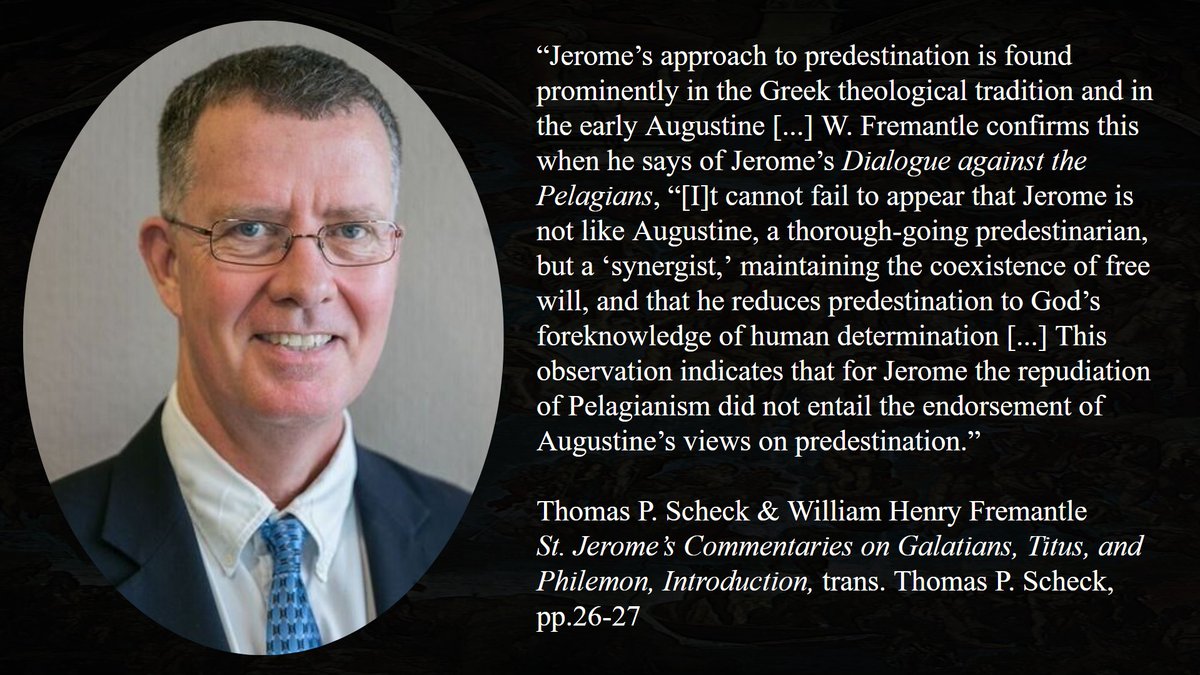

11
Saint Justin Martyr. Also notice how profusely anti-sola fide this divine saint is:
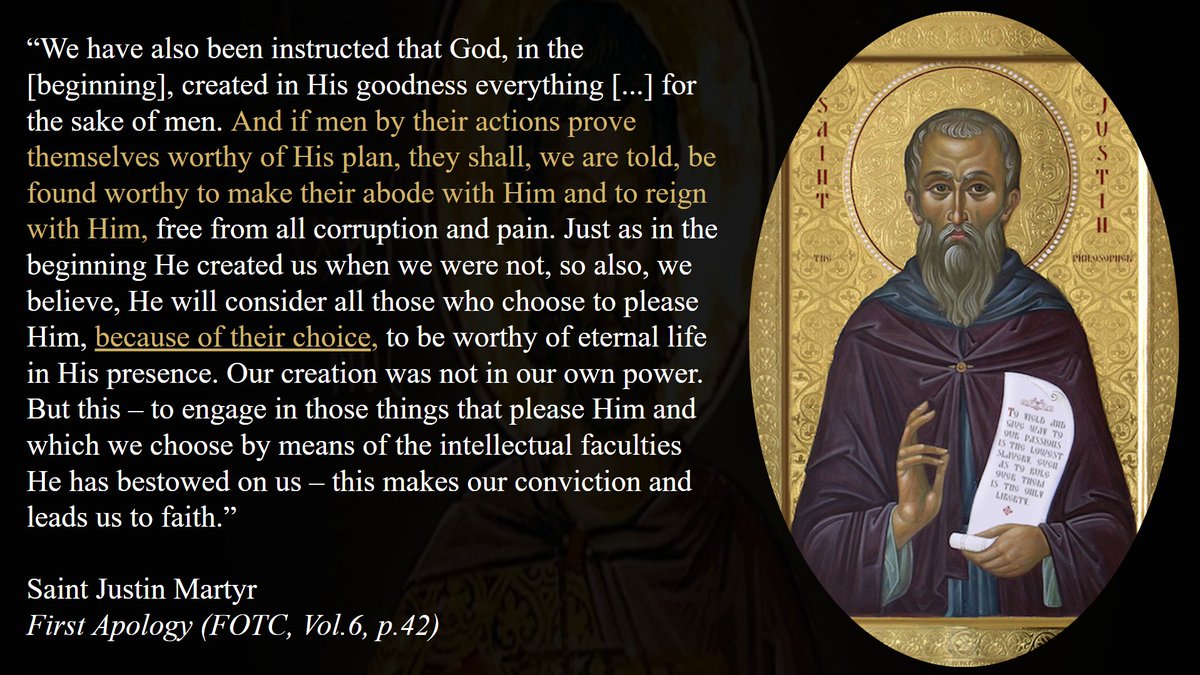


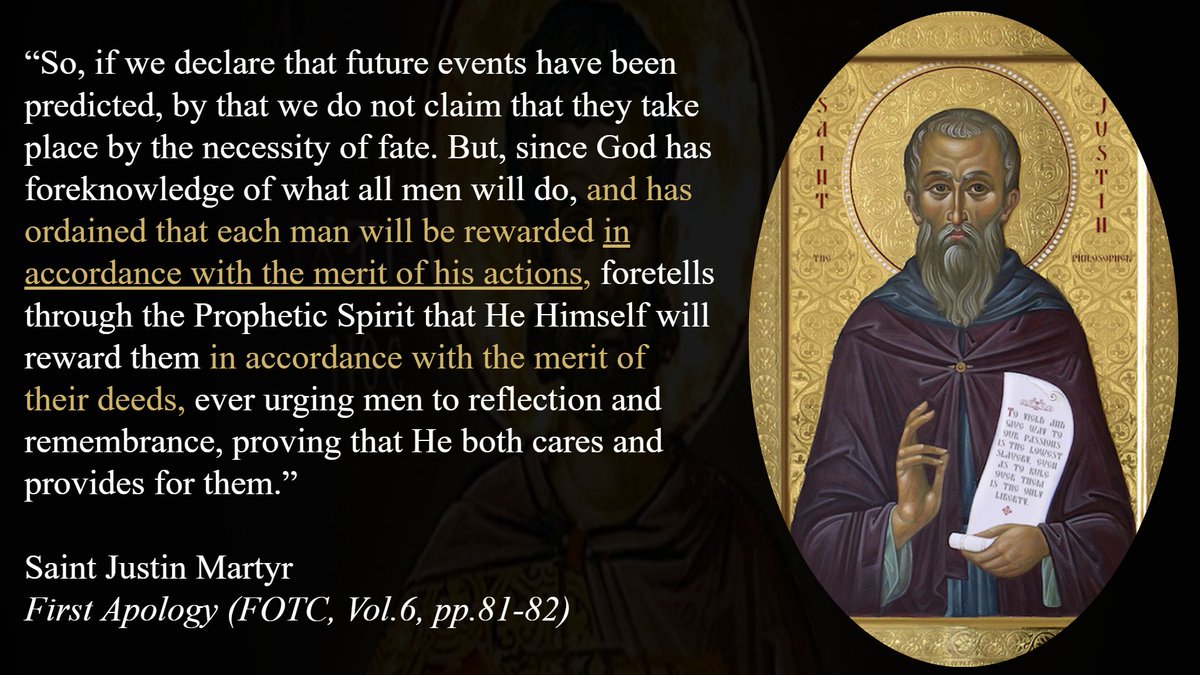
12
Donato Ogliari on Saint Justin's teachings:

13
Saint Irenaeus:


14
Saint John Chrysostom. Notice how Saint John speaks of free will preceding grace in the second quote. I believe this can easily be understood in an orthodox manner, but it's more important now to understand how this view implicates predestination according to foreseen merits:


15
Saint Gregory of Nyssa, the Father of Fathers. Carefully consider how this holy man says that God doesn't even will (in a physical premotion sense) that some are saved:

16
Saint Ambrose of Milan:

17
This passage from "Hexameron, Paradise, Cain, and Abel" is sometimes used to argue that Ambrose believed in predestination before the consideration of merits. The argument fails because Ambrose is referencing the incarnation of Jesus, which no man merited, and not predestination.
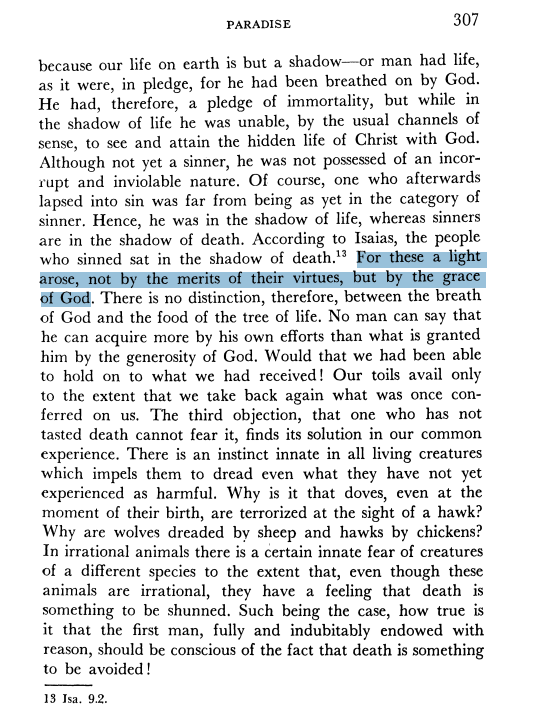
18
Saint John of Damascus. Perceive how similar some of these statements are with the above passage from Gregory of Nyssa:


19
Saint Prosper of Aquitaine himself. This sentiment is so unknown in his earlier works that some have thought that this work is misattributed to Prosper, but this is not the case:

20
Various scholars pointing out that Prosper moderated his once purely Augustinian doctrine on predestination:


21
And here is Saint Prosper making the outstanding concession that all of the fathers before his time believed in predestination after the consideration of merits. For Astro, this means that all of the fathers were heretics who were against the Gospel. Ay caramba!

22
This concession from Prosper, along with the limpidly unanimous voice of the fathers, who wrote in different times and in different places, suffices to show that predestination after foreseen merits was the view of the early Church.
23
Some may try to pretend that this view was widely held rather than unanimous, but that is false. Predestination ante praevisa merita cannot be found in anyone prior to Augustine save the Gnostics.
24
Plus, when one argues with the fathers on a contested point, it is almost unheard of to be able to use this amount of fathers in favor of one position - and keep in mind that several more fathers of the same view have not been included in this thread.
25
In the Catholic Church, all must ordinarily accept the universal consent of the theologians as dogma. Many Thomists take this very seriously. For example, here is "DoorDashThomist" uncharitably calling Trent Horn "Hornstein" over this issue:
View Tweet
26
To end the discussion on the fathers, here are a few Catholic authors recognizing that predestination according to foreknowledge is the historical view in the Church:


27
I will now return to the heretical gnostic belief of diverse natures to segue into a brief argument against Augustinian predestination, primarily against Thomists, before ending the thread.
28
The gnostic belief is that within what we consider human nature, there are actually differing natures wherein "one kind is saved," while "another perishes." Several fathers over centuries fought against this heresy.
29
As Thomas P. Scheck notes, the Manichaeans were part of this group who "denied the free choice of the will in salvation." Saint Augustine was a Manichaean before converting to Roman Catholicism, and his gnostic past seemed to influence his teaching on predestination.
30
I argue that the Thomistic tradition inadvertently teaches the aforementioned gnostic heresy.
Saint Thomas Aquinas clearly teaches that man's natural end is union with God in heaven, that this end is proper to all men, and that this end cannot be obtained by natural means:
Saint Thomas Aquinas clearly teaches that man's natural end is union with God in heaven, that this end is proper to all men, and that this end cannot be obtained by natural means:


31
These work to say one thing: experience of the beatific vision is man's final end, every single particular man without fail is directed towards this one end, and this end cannot be acquired by natural means and is thus in God's control.
My opposing argument is as follows:
My opposing argument is as follows:
