@spicyofc: (only for serious intra-day Tr...
@spicyofc
39 views
Jan 23, 2026
1
(only for serious intra-day Traders)
Thread 🧵
How I use BTC correlation when trading Alts on the 1 minute timeframe
I will cover:
• Correlation Coefficient
• How I measure correlations (with examples)
• Practical Tip that you can use today to take better trades
(1/n) ↓
Thread 🧵
How I use BTC correlation when trading Alts on the 1 minute timeframe
I will cover:
• Correlation Coefficient
• How I measure correlations (with examples)
• Practical Tip that you can use today to take better trades
(1/n) ↓
2
(2/n) Correlation Coefficient
A common way of measuring correlation is the "Correlation Coefficient" indicator on TradingView.
I've used this in the past but I have often found 2 big problems with it:
Problem 1)
• sometimes the CC (correlation coefficient) shows a high value because recent direction happened to be similar, but the price action of the ALT and BTC look completely different.
Problem 2)
• sometimes the CC shows a low value because there was a recent small outlier in the recent direction of the price action, however the price action of the ALT and BTC generally look almost identical.
In the next post below I will explain my own personal approach for measuring correlation. ↓
A common way of measuring correlation is the "Correlation Coefficient" indicator on TradingView.
I've used this in the past but I have often found 2 big problems with it:
Problem 1)
• sometimes the CC (correlation coefficient) shows a high value because recent direction happened to be similar, but the price action of the ALT and BTC look completely different.
Problem 2)
• sometimes the CC shows a low value because there was a recent small outlier in the recent direction of the price action, however the price action of the ALT and BTC generally look almost identical.
In the next post below I will explain my own personal approach for measuring correlation. ↓

3
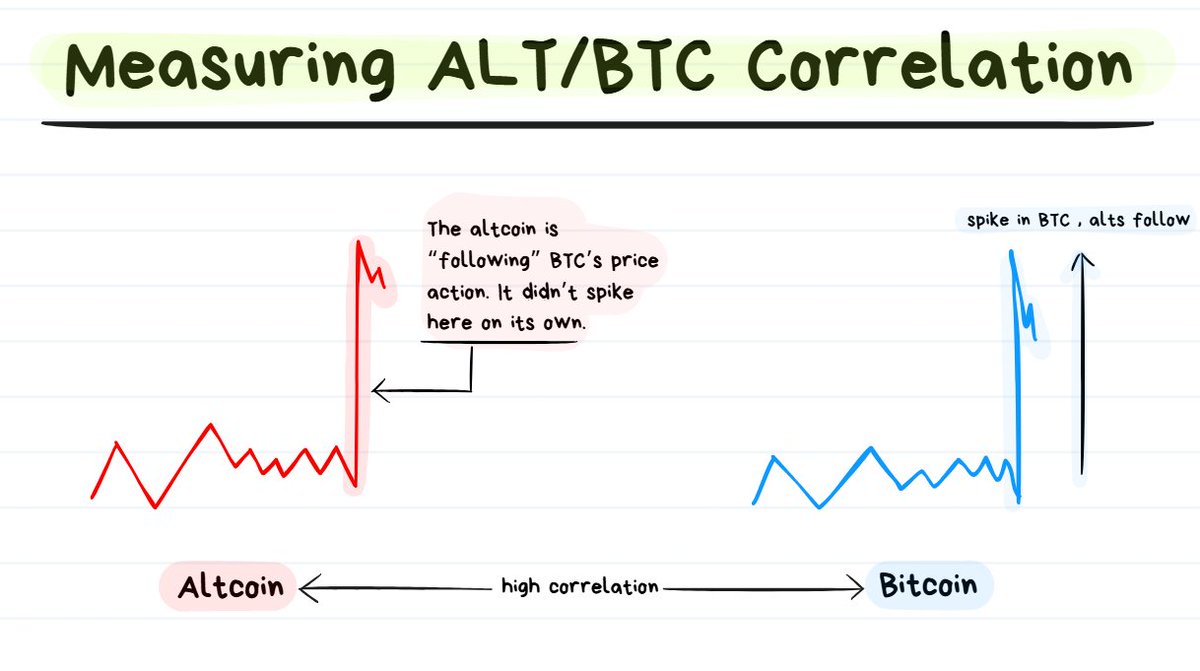
(3/n) My way of measuring the correlation between BTC and an Altcoin
There are a few variables I am comparing between the Altcoin and Bitcoin:
1) The "timing" of each Intra-day Reversal (blue/red lines).
• If both the alt and btc are turning around at roughly the same time, this is a sign of high correlation.
• It's showing that whenever imbalances in Market/Limit orders occur in BTC, they are having a noticeable impact on the Altcoin
2) The "direction" of each Intra-day Reversal (blue/red dots)
• when BTC starts changing direction and moving "upwards", the Altcoin not only has the same "timing" but also has the same "direction".
• BTC makes a low and the Altcoin makes a low at the same time.
• BTC makes a high and the Altcoin makes a high at the same time.
• This shows that positions in the Altcoin are mimicking that of BTC, another sign of high correlation.
3) The timing of "Volume Spikes"
• if the volume in the Altcoin are spiking at the same time as BTC, this is also another sign of High Correlation.
• This is showing that large order sizes are being mimicked in the Altcoin.
There are a few variables I am comparing between the Altcoin and Bitcoin:
1) The "timing" of each Intra-day Reversal (blue/red lines).
• If both the alt and btc are turning around at roughly the same time, this is a sign of high correlation.
• It's showing that whenever imbalances in Market/Limit orders occur in BTC, they are having a noticeable impact on the Altcoin
2) The "direction" of each Intra-day Reversal (blue/red dots)
• when BTC starts changing direction and moving "upwards", the Altcoin not only has the same "timing" but also has the same "direction".
• BTC makes a low and the Altcoin makes a low at the same time.
• BTC makes a high and the Altcoin makes a high at the same time.
• This shows that positions in the Altcoin are mimicking that of BTC, another sign of high correlation.
3) The timing of "Volume Spikes"
• if the volume in the Altcoin are spiking at the same time as BTC, this is also another sign of High Correlation.
• This is showing that large order sizes are being mimicked in the Altcoin.

4
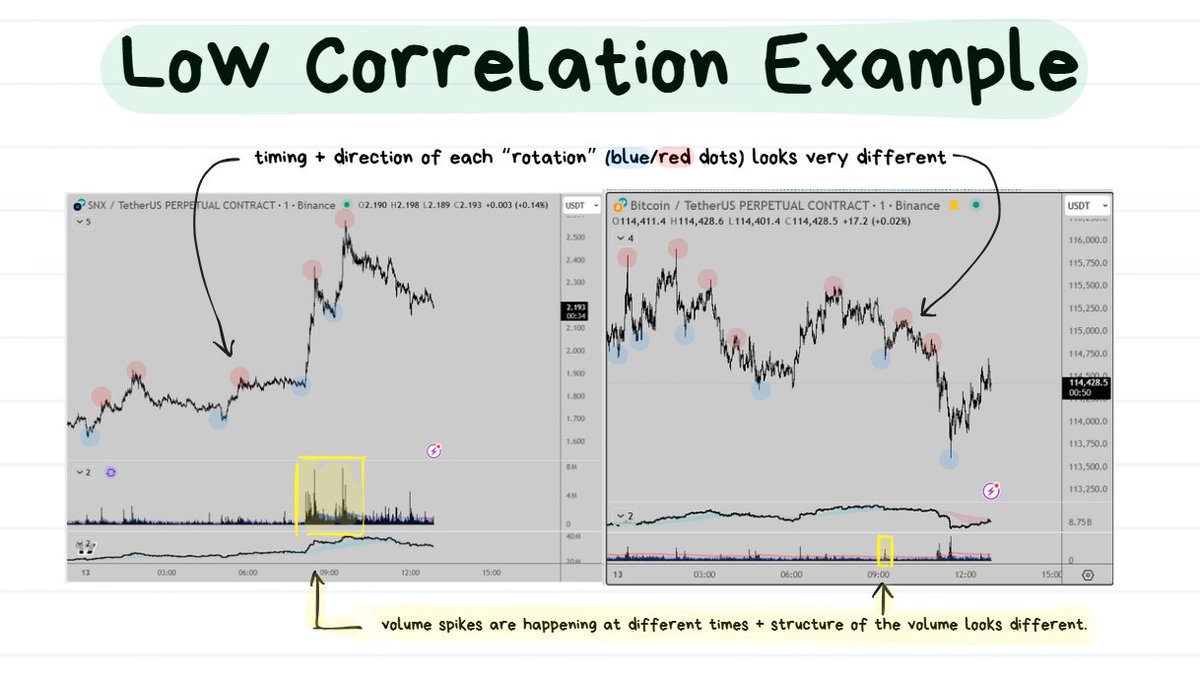
(4/n) Low Correlation Example
In the example below, the 3 variable I spoke about are not in sync. The Altcoin is not "following" BTC's price action and is not too heavily impacted by it.
This is a sign of "low correlation".
1) The "timing" of Reversals:
• the alt and btc are reversing at different times
2) the direction of each Rotation:
• while BTC is moving up or down, the Altcoin doesn't care and is just doing it's own thing.
3) The volume Spikes:
• The big surges of volume in the altcoin come at different times and intensities when compared to BTC.
• the structure of the volume looks noticeably different as well.
In the example below, the 3 variable I spoke about are not in sync. The Altcoin is not "following" BTC's price action and is not too heavily impacted by it.
This is a sign of "low correlation".
1) The "timing" of Reversals:
• the alt and btc are reversing at different times
2) the direction of each Rotation:
• while BTC is moving up or down, the Altcoin doesn't care and is just doing it's own thing.
3) The volume Spikes:
• The big surges of volume in the altcoin come at different times and intensities when compared to BTC.
• the structure of the volume looks noticeably different as well.
5
6
(6/n) Practical Tip that you can use today to take better trades
Quick context:
• One of the strategies I like to trade is the "Fast Spike Reversal".
If I happen to get a "fast spike" into a level, the first immediate thing I MUST do before considering to take the trade is check the correlation of the coin relative to BTC.
If the correlation is HIGH:
• I have to be extra cautious and ONLY take the trade if the reversal idea actually looks good to take in BTC.
• this is because I have to ignore any analysis I did in the altcoin since BTC is going to pull it around.
• Any analysis in the altcoin basically becomes meaningless. I MUST give more focus + attention to BTC in these situations.
If the correlation is LOW:
• I like this.
• Here I can ignore what BTC is doing and just focus on taking advantage of the trapped traders in the Altcoin.
If you want more information on how I trade fast spike reversals, you are welcome to check out this thread ↓
Quick context:
• One of the strategies I like to trade is the "Fast Spike Reversal".
If I happen to get a "fast spike" into a level, the first immediate thing I MUST do before considering to take the trade is check the correlation of the coin relative to BTC.
If the correlation is HIGH:
• I have to be extra cautious and ONLY take the trade if the reversal idea actually looks good to take in BTC.
• this is because I have to ignore any analysis I did in the altcoin since BTC is going to pull it around.
• Any analysis in the altcoin basically becomes meaningless. I MUST give more focus + attention to BTC in these situations.
If the correlation is LOW:
• I like this.
• Here I can ignore what BTC is doing and just focus on taking advantage of the trapped traders in the Altcoin.
If you want more information on how I trade fast spike reversals, you are welcome to check out this thread ↓
View Tweet
7
(7/n)
If you found this useful, just copy Pepe the frog.
↓
If you found this useful, just copy Pepe the frog.
↓