@quantscience_: How to create your own "mini" ...
@quantscience_
25 views
Oct 05, 2025
1
How to create your own "mini" hedge fund with algorithmic trading and Python
A thread 🧵
A thread 🧵

2
1. What is a Hedge Fund
Hedge funds pool money from wealthy individuals or institutions to seek higher, risk-adjusted returns across multiple markets.
Hedge funds pool money from wealthy individuals or institutions to seek higher, risk-adjusted returns across multiple markets.
3
While they often strive to outperform benchmarks like the S&P 500, the focus is usually on lowering risk (drawdowns) rather than purely maximizing returns.
4
2. Define Your Goals
Decide on a target annual return and understand the drawdown (potential loss) you can tolerate.
For instance, aiming for ~20% annual returns may entail accepting a ~10% drawdown.
Decide on a target annual return and understand the drawdown (potential loss) you can tolerate.
For instance, aiming for ~20% annual returns may entail accepting a ~10% drawdown.
5
Extremely high returns (e.g., 100% per year) can be possible but come with huge drawdowns (50–70%), which most investors find difficult to handle psychologically.
6
3. Choose Your Markets:
Trading across different asset classes (e.g., equities, commodities, futures) can reduce overall risk through diversification.
Trading across different asset classes (e.g., equities, commodities, futures) can reduce overall risk through diversification.
7
Example: If equity markets are falling (S&P 500 futures, “ES”), another market like oil (“CL”) might be trending up, which could offset losses.
8
4. Algorithmic Strategy Ideas:
Momentum Strategies: Buy (go long) when the price is above a long-term moving average (e.g., 200-day SMA) or sell (go short) when below.
This aims to catch trends.
Momentum Strategies: Buy (go long) when the price is above a long-term moving average (e.g., 200-day SMA) or sell (go short) when below.
This aims to catch trends.
9
Mean Reversion Strategies: Identify when prices deviate from an average or band (like Bollinger Bands) and expect prices to revert back.
10
Long/Short Pairs: Having both bullish and bearish strategies for each market (e.g., long ES, short ES, long CL, short CL) offers additional diversification and helps hedge exposure.
11
5. Learn Python
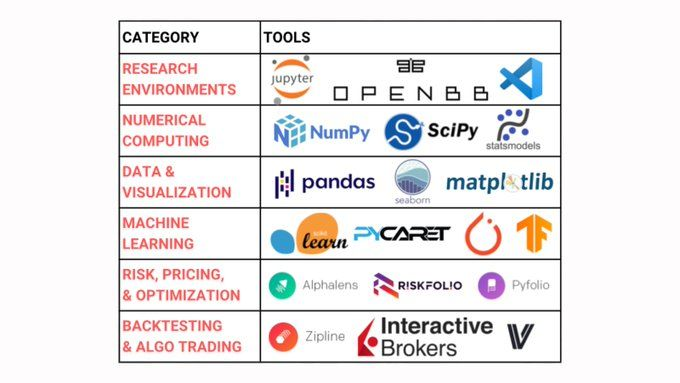
Python Quant Stack is 100% free (and covers data, analysis, research, backtesting, and execution):
OpenBB $0
Pandas $0
NumPy $0
Zipline $0
AlphaLens $0
VectorBT $0
Riskfolio $0
IBAPI $0
Python Quant Stack is 100% free (and covers data, analysis, research, backtesting, and execution):
OpenBB $0
Pandas $0
NumPy $0
Zipline $0
AlphaLens $0
VectorBT $0
Riskfolio $0
IBAPI $0
12
6. Tracking Performance and Grouping Strategies:
Maintain a portfolio of several strategies.
Group them by market type (e.g., equities vs. commodities) or by aggressiveness (e.g., “conservative” vs. “aggressive”).
Maintain a portfolio of several strategies.
Group them by market type (e.g., equities vs. commodities) or by aggressiveness (e.g., “conservative” vs. “aggressive”).
13
Analyze metrics: Regularly monitoring performance, drawdowns, and market conditions is critical for refining your strategy portfolio over time.
14
Want to learn how to do algorithmic trading with Python?
Then join us on September 18th for a live webinar, how to Build Algorithmic Trading Strategies (that actually get results)
Register here (500 seats): learn.quantscience.io/qs-register
Then join us on September 18th for a live webinar, how to Build Algorithmic Trading Strategies (that actually get results)
Register here (500 seats): learn.quantscience.io/qs-register

15
That's a wrap! Over the next 24 days, I'm sharing my top 24 algorithmic trading concepts to help you get started.
If you enjoyed this thread:
1. Follow me @quantscience_ for more of these
2. RT the tweet below to share this thread with your audience
If you enjoyed this thread:
1. Follow me @quantscience_ for more of these
2. RT the tweet below to share this thread with your audience
View Tweet