@EamonnFlanagan: What is “Integral Reactive Str...
@EamonnFlanagan
25 views
Aug 23, 2025
1
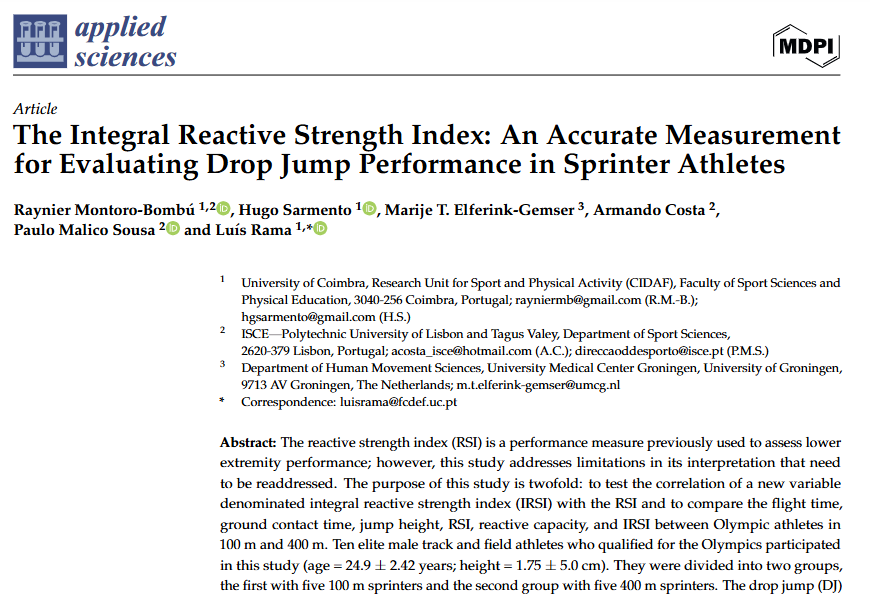
What is “Integral Reactive Strength Index” (IRSI)?
The IRSI is a recently emerging RSI variation used in drop jump assessments.
It adjusts RSI to account for drop height used, possibly providing a more individualized & eccentric load-sensitive measure of reactive strength
The IRSI is a recently emerging RSI variation used in drop jump assessments.
It adjusts RSI to account for drop height used, possibly providing a more individualized & eccentric load-sensitive measure of reactive strength
2
RSI = Jump Ht / Contact Time
Reactive Capacity (RC) = Fall Ht / Jump Ht
IRSI = RSI − RC
IRSI highlights inefficiency at higher drop heights, which can mask deficiencies in reactive strength under high rates of eccentric load
Reactive Capacity (RC) = Fall Ht / Jump Ht
IRSI = RSI − RC
IRSI highlights inefficiency at higher drop heights, which can mask deficiencies in reactive strength under high rates of eccentric load
3
"... IRSI is a key variable... the higher the [drop height]... the greater the dynamic load applied at the start of the eccentric phase.
This measure tends to be more sensitive in detecting increases or decreases in reactive strength during the DJ, as it includes the [drop height] effect"
This measure tends to be more sensitive in detecting increases or decreases in reactive strength during the DJ, as it includes the [drop height] effect"
4
Want to see how Reactive Strength Index (RSI) and Integral RSI (IRSI) evolve differently across athletes?
Let’s compare two high performers across increasing drop heights (30–50 cm).
Hypothetical example with athletes with RSI > 2.0
👇
Let’s compare two high performers across increasing drop heights (30–50 cm).
Hypothetical example with athletes with RSI > 2.0
👇
5
What are we measuring?
RSI = Jump Height ÷ Ground Contact Time
IRSI = RSI − (Fall Height ÷ Jump Height)
This example is from 30, 40, and 50 cm drop heights with 2 hypothetical athletes to show how the IRSI method can reveal very different profiles.
RSI = Jump Height ÷ Ground Contact Time
IRSI = RSI − (Fall Height ÷ Jump Height)
This example is from 30, 40, and 50 cm drop heights with 2 hypothetical athletes to show how the IRSI method can reveal very different profiles.
6
Athlete A:
Strong performer - but their performance doesn’t benefit from increasing eccentric load.
Their RSI drops marginally as drop height increases but the IRSI reduces considerably
Strong performer - but their performance doesn’t benefit from increasing eccentric load.
Their RSI drops marginally as drop height increases but the IRSI reduces considerably

7
Athlete B
Improves RSI as drop height increases - this athlete benefits from increasing eccentric load.
Their IRSI remains stable as drop height increases
Improves RSI as drop height increases - this athlete benefits from increasing eccentric load.
Their IRSI remains stable as drop height increases

8
Summary:
RSI alone may over rate Athlete A
IRSI reveals a greater magnitude of difference in Athlete B’s superior performance at higher drop heights
IRSI puts a greater bias on performance at higher dropping heights (greater eccentric load bias)
RSI alone may over rate Athlete A
IRSI reveals a greater magnitude of difference in Athlete B’s superior performance at higher drop heights
IRSI puts a greater bias on performance at higher dropping heights (greater eccentric load bias)
