@FondOfBeetles: Let’s address what many consid...
@FondOfBeetles
14 views
Jun 02, 2025
1
Let’s address what many consider an uncomfortable topic.
Here, Bunce argues that Khelif was “condemned on her looks”.
That’s not true.
Here, Bunce argues that Khelif was “condemned on her looks”.
That’s not true.
View Tweet
2
People argued that Khelif appears to be male.
They may not have always been as polite as Bunce’s sensitivities required, but this is not “condemning” someone “on their looks”.
It’s noting that Khelif looks male/masculinised/(a man, if you prefer), and raising urgent alarms about what that means in boxing.
They may not have always been as polite as Bunce’s sensitivities required, but this is not “condemning” someone “on their looks”.
It’s noting that Khelif looks male/masculinised/(a man, if you prefer), and raising urgent alarms about what that means in boxing.

3
Sportswomen are no strangers to being called “men”. It’s an ugly, misogynistic way to attack gender-nonconforming women.
Tall women, lesbian women, women with short hair and no makeup.
Tall women, lesbian women, women with short hair and no makeup.
4
And in boxing - what could be more gender nonconforming for a woman than punching someone else in the face? - I’m sure plenty the female athletes get more than their fair share of this misogyny.
I expect Bunce to be alive to this fact, and hypervigilant against it.
I expect Bunce to be alive to this fact, and hypervigilant against it.
5
The thing is: nobody really thinks that these sportswomen are really men. It’s just a way to put women down.
And even in an environment where such namecalling might be endemic, nobody said Angela Carini was male/a man.
Because she doesn’t look like a male person.
And even in an environment where such namecalling might be endemic, nobody said Angela Carini was male/a man.
Because she doesn’t look like a male person.

6
What other sportswomen are called men?
Dopers.
And this is relevant.
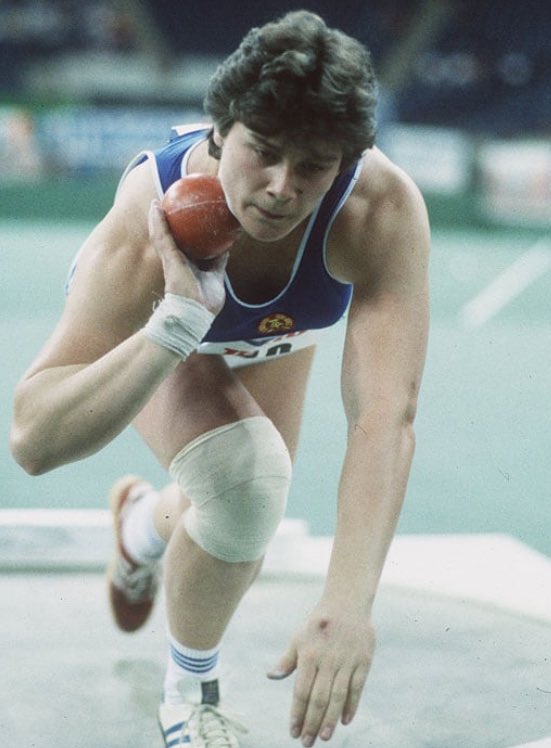
(This is Heidi/Andreas Kreiger, a former GDR athlete who was fed so much testosterone and god knows what else, she later transitioned and now lives as a man).
Dopers.
And this is relevant.
(This is Heidi/Andreas Kreiger, a former GDR athlete who was fed so much testosterone and god knows what else, she later transitioned and now lives as a man).
7
Pumping a body full of anabolic steroids has an effect on your appearance.
For doping in sports, the goal is to put on muscle, improve CV fitness and so on.
For females, that comes with other changes: facial appearance, skin and hair texture, unusual muscle growth (a female sprinter turning up with newly-massive shoulders and neck is going to red flag their way into a doping test).
For doping in sports, the goal is to put on muscle, improve CV fitness and so on.
For females, that comes with other changes: facial appearance, skin and hair texture, unusual muscle growth (a female sprinter turning up with newly-massive shoulders and neck is going to red flag their way into a doping test).
8
When people say Khelif looks male, they are recognising the effects of anabolic steroids, specifically testosterone, on a body, on secondary sexual characteristics.
Humans are excellent at recognising such sex markers and using them to discriminate between males and females.
Humans are excellent at recognising such sex markers and using them to discriminate between males and females.
9
We also know that clinically, a woman who inexplicably starts to masculinise might need a hormone check.
Because masculinisation in a woman is a medical priority.
And ironically, the TRAs are all about arguing that women with elevated testosterone are somehow a bit man-not-woman.
Because masculinisation in a woman is a medical priority.
And ironically, the TRAs are all about arguing that women with elevated testosterone are somehow a bit man-not-woman.
10
The TRAs themselves know the signs of masculinisation due to hormone imbalances: the appearance of facial hair, some redistribution of muscle/fat.
It is the height of hypocrisy to say that a woman with high T because of PCOS is less of a woman if she develops some masculinised secondary sex characteristics, but tell us to ignore a whole-scale masculinised body in a boxing ring.
It is the height of hypocrisy to say that a woman with high T because of PCOS is less of a woman if she develops some masculinised secondary sex characteristics, but tell us to ignore a whole-scale masculinised body in a boxing ring.
11
Khelif’s body isn’t the product of doping.
Khelif’s body is the result of surges of testosterone throughout development.
It is normal for humans to recognise that. It is relevant - and routine in endocrinology clinics - to assess masculinisation as a clinical marker (and not a misogynistic namecall).
Khelif’s body is the result of surges of testosterone throughout development.
It is normal for humans to recognise that. It is relevant - and routine in endocrinology clinics - to assess masculinisation as a clinical marker (and not a misogynistic namecall).
12
It might not be comfortable to understand the fact that masculinisation is a recognisable pattern of morphological development/change, sometimes a clinically-relevant one, and a pattern that is routinely reported in the scientific and medical literature.
I get it.
I get it.
13
I’ve spoken to several medics about this athlete.
None shy away from describing Khelif as being, in clinical terms, masculinised. Only a couple were cautious about discussing *why* Khelif is masculinised. That’s fine, of course.
None shy away from describing Khelif as being, in clinical terms, masculinised. Only a couple were cautious about discussing *why* Khelif is masculinised. That’s fine, of course.
14
But all the evidence we have paints a single picture: Khelif is masculinised because Khelif has experienced testosterone-driven development.
(The product of a Y chromosome carrying SRY that directed testicle formation).
(The product of a Y chromosome carrying SRY that directed testicle formation).
15
Not one part of this analysis is “condemning Khelif for her looks”.
And many of us have been arguing in the academic literature that the way to avoid Khelif’s picture being splashed over the front pages is to have screened Khelif long before anyone knew the name.
Thankfully, World Boxing have taken our advice.
And many of us have been arguing in the academic literature that the way to avoid Khelif’s picture being splashed over the front pages is to have screened Khelif long before anyone knew the name.
Thankfully, World Boxing have taken our advice.
16
Now, if Bunce @bigdaddybunce wishes to have a sensible discussion about this, I am happy to do so (as would @cathydevine56 @Scienceofsport @runthinkwrite etc).