@rohanpaul_ai: A 340 page huge report on AI t...
@rohanpaul_ai
61 views
Jun 01, 2025
1
A 340 page huge report on AI trends - released by @bondcap
Some wild findings from this report.
🧵1/n
Some wild findings from this report.
🧵1/n

2
🧵2/n
Meta’s Llama Downloads Exploded 3.4× in Eight Months.
an unprecedented developer adoption curve for any open-source LLM.
bondcap. com/reports/tai
Meta’s Llama Downloads Exploded 3.4× in Eight Months.
an unprecedented developer adoption curve for any open-source LLM.
bondcap. com/reports/tai

3
🧵3/n
AI Chatbots Now Mistaken as Human 73 Percent of the Time
In Q1 2025, testers mistook AI responses for human replies 73 percent of the time in Turing-style experiments. That’s up from roughly 50 percent only six months earlier—showing how quickly models have learned to mimic human conversational nuance
AI Chatbots Now Mistaken as Human 73 Percent of the Time
In Q1 2025, testers mistook AI responses for human replies 73 percent of the time in Turing-style experiments. That’s up from roughly 50 percent only six months earlier—showing how quickly models have learned to mimic human conversational nuance

4
5
6
7
🧵7/n
Annual AI Inference Token Revenue Potential Jumped from $240K to $7 Billion in 8 Years
In 2016, a $1 billion-scale data center could handle about 5 trillion inference tokens per year (~$24 million token revenue).
By 2024, that same $1 billion facility could process ~1,375 trillion tokens (theoretical revenue ~$7 billion)—a 30,000× shift in earnings opportunity
Annual AI Inference Token Revenue Potential Jumped from $240K to $7 Billion in 8 Years
In 2016, a $1 billion-scale data center could handle about 5 trillion inference tokens per year (~$24 million token revenue).
By 2024, that same $1 billion facility could process ~1,375 trillion tokens (theoretical revenue ~$7 billion)—a 30,000× shift in earnings opportunity

8
🧵8/n
inference costs per million tokens plunging nearly 99.7% from late 2022 to early 2025.
In September 2022, GPT-3.5 cost over $10 per million tokens. By mid-2023, those fees dropped to around $1
inference costs per million tokens plunging nearly 99.7% from late 2022 to early 2025.
In September 2022, GPT-3.5 cost over $10 per million tokens. By mid-2023, those fees dropped to around $1

9
🧵9/n
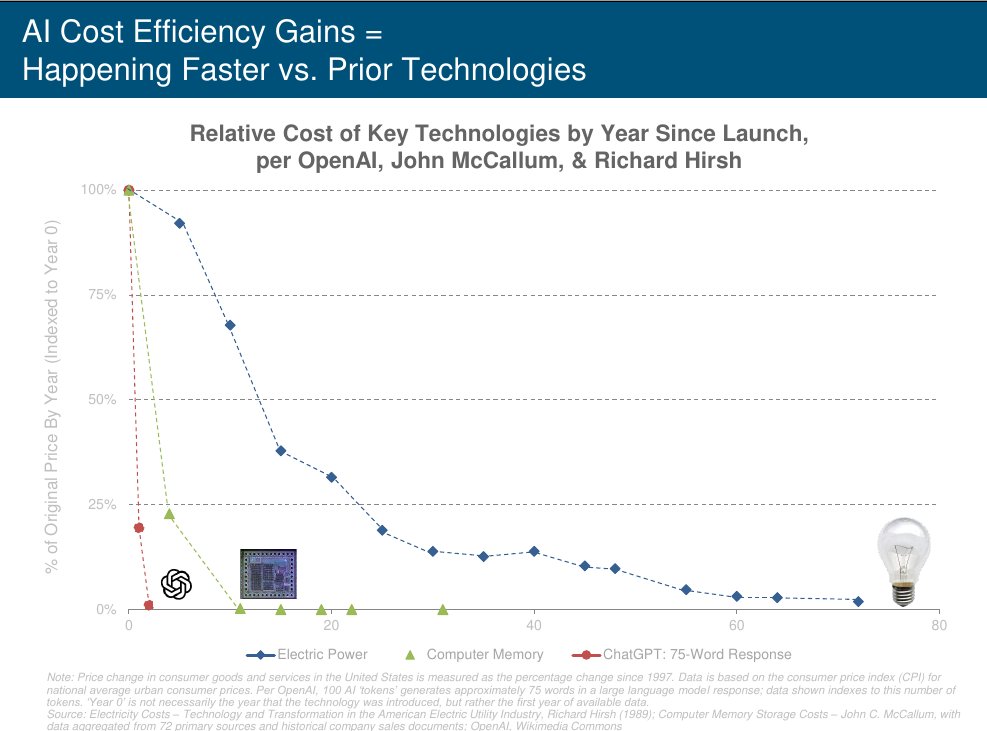
Cost declines of several technologies over time.
ChatGPT’s price for a 75-word response dropped nearly to zero within its first year.
Computer memory costs fell to almost zero in under two decades.
Electric power costs declined more gradually, reaching roughly 2–3% of their initial price after 60–70 years.
By contrast, the light bulb’s cost remained nearly flat over the same span
Cost declines of several technologies over time.
ChatGPT’s price for a 75-word response dropped nearly to zero within its first year.
Computer memory costs fell to almost zero in under two decades.
Electric power costs declined more gradually, reaching roughly 2–3% of their initial price after 60–70 years.
By contrast, the light bulb’s cost remained nearly flat over the same span
10
🧵10/n
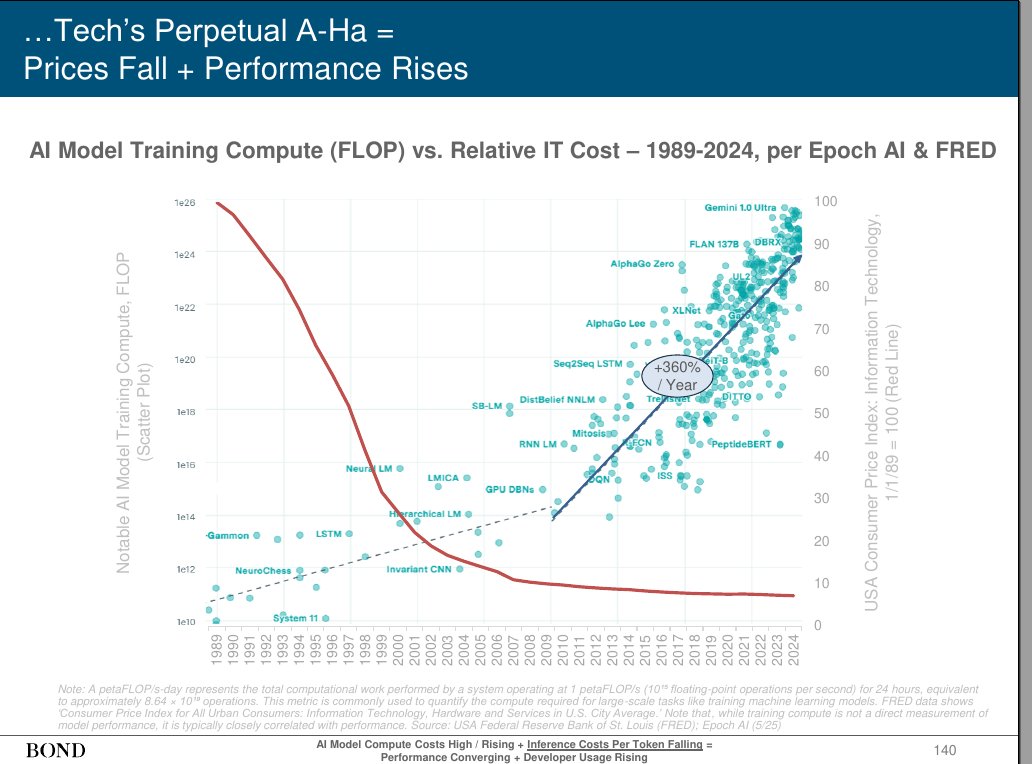
IT consumer-price index (red line) from 1989–2024.
It shows compute requirements rising roughly 360% per year since around 2010—reaching 10²⁶ FLOP by 2024—while IT costs fell from an index of 100 to below 10.
In other words, training power has surged as hardware has become dramatically cheaper.
IT consumer-price index (red line) from 1989–2024.
It shows compute requirements rising roughly 360% per year since around 2010—reaching 10²⁶ FLOP by 2024—while IT costs fell from an index of 100 to below 10.
In other words, training power has surged as hardware has become dramatically cheaper.
11
🧵11/n
Performance of Top AI Models on LMSYS Chatbot Arena – 1/24-2/25, per Stanford HAI
Performance of Top AI Models on LMSYS Chatbot Arena – 1/24-2/25, per Stanford HAI

12
🧵12/n
Share of Developers Currently Using AI in Development Processes – 2023-2024,
per Stack Overflow
Share of Developers Currently Using AI in Development Processes – 2023-2024,
per Stack Overflow

13
🧵13/n
Cumulative AI-related GitHub repositories from 2015 through March 2024.
Major milestones—TensorFlow (2015), the Transformers paper (2017), Hugging Face’s “hf/transformers” (2018), GPT-3 (2020), Stable Diffusion (2022), and ChatGPT launch (2022).
From late 2022 to early 2024, repo count jumped roughly 175%, driven by expanding categories like infrastructure, model development, model repos, AI engineering, and applications.
Cumulative AI-related GitHub repositories from 2015 through March 2024.
Major milestones—TensorFlow (2015), the Transformers paper (2017), Hugging Face’s “hf/transformers” (2018), GPT-3 (2020), Stable Diffusion (2022), and ChatGPT launch (2022).
From late 2022 to early 2024, repo count jumped roughly 175%, driven by expanding categories like infrastructure, model development, model repos, AI engineering, and applications.

14
🧵14/n
Google Monthly Tokens Processed (T) – 5/24-5/25, per Google
Google Monthly Tokens Processed (T) – 5/24-5/25, per Google

15
🧵15/n
Microsoft Azure AI Foundry Quarterly Tokens Processed (T) – Q1:24-Q1:25, per Microsoft
Microsoft Azure AI Foundry Quarterly Tokens Processed (T) – Q1:24-Q1:25, per Microsoft

16
🧵16/n
NVIDIA Quarterly Revenue by Business Line ($B) – 1/19-1/25, per NVIDIA
NVIDIA Quarterly Revenue by Business Line ($B) – 1/19-1/25, per NVIDIA

17
🧵17/n
Google TPU (Tensor Processing Unit) Estimated Sales – 2021-2024, per Morgan Stanley
Google TPU (Tensor Processing Unit) Estimated Sales – 2021-2024, per Morgan Stanley
