The Milkshake Reloads: The Dollar Index has crashed to its lowest...

Roberto Rios@peruvian_bull
18 views
Apr 22, 2025
~9 min read
1
The Milkshake Reloads:
The Dollar Index has crashed to its lowest level since April 2022, and bears are celebrating the oncoming collapse of the greenback. Little do they know, this only makes the system stronger- and changes the nature of the Endgame.
A THREAD 🧵
The Dollar Index has crashed to its lowest level since April 2022, and bears are celebrating the oncoming collapse of the greenback. Little do they know, this only makes the system stronger- and changes the nature of the Endgame.
A THREAD 🧵
2
This month, amid chaotic trade policy moves and volatile global markets, the DXY (Dollar Index) has weakened considerably. The drop is mostly being driven by ongoing trade tensions with China, where both countries have imposed heavy tariffs on each other.

3
Since the beginning of 2025, the DXY has fallen about 8.3%, and this latest dip below the 100 mark is the steepest slide we’ve seen in years. Right now, the dollar is clearly under pressure, and people are watching closely to see what happens next.
4
Dollar bears on X/Twitter have been celebrating this move, decrying the coming end of the dollar system and rise of gold as a new global reserve currency. (Ironically, this will likely play out eventually, just not the way they think)
5
Peter Schiff for example on Kitco News last week proclaimed:

6
Peter claims that the rising gold price and falling dollar are indicators that the dollar system is coming to an end; and while he is correct about the prognosis of the US fiscal situation and the fragility of the global monetary system, he is incorrect about how the dollar endgame (cough cough, my book) will play out.
7
Let’s briefly review the Dollar Milkshake Theory by Brent Johnson. Since the almighty greenback is the Global Reserve Currency (GRC), it is widely for a variety of purposes, including:

8
All of this creates persistent and ubiquitous DEMAND for USDs. It turns out that demand must be met with SUPPLY, or the global monetary system begins grinding to a halt- this is what Belgian economist Robert Triffin warned Congress about 65 years ago.

9
Many attribute the blowout of the trade deficit to currency manipulation by third world countries, unfair trade practices, or exploitative labor practices- all of which are true, and definitely contribute to the deficit, but they don’t explain the whole picture.
10
In fact, as the global monetary system becomes more and more unmoored to the fundamentals of hard money, it increasingly relies on liquidity, which in essence means dollar liquidity because the global economy runs on dollars.

11
Therefore, the offshoring of the U.S. industrial base (as much manufacturing output loss as a major war!) was not only done to juice US corporate profits, but it was done as a byproduct of the necessity to export dollars to the world.

12
In short, this means if the U.S. wants to keep the global monetary system humming it needs to keep a trade imbalance, and grow that imbalance over time if the world continues to grow faster than we do.
Obviously as you can see above, this trend has been accelerating as the third world (especially Asia) joined the eurodollar market in earnest in the 1990s and 2000s.
Obviously as you can see above, this trend has been accelerating as the third world (especially Asia) joined the eurodollar market in earnest in the 1990s and 2000s.
13
Again, we’ve covered the Eurodollar in depth in pieces like Eurodollar 1: Origins (see my substack, link in bio), along with threads like the Milkshake Returns, so you can check those out if you still want more background on both these concepts.
x.com/peruvian_bull/…
x.com/peruvian_bull/…
14
In any case, the outflow of dollars feeds the eurodollar market and also provides a way for the dollars to be invested back into the U.S. as these dollars are searching for yield and the easiest place to invest dollars is in dollar-denominated instruments.
15
This is called dollar recycling, and I’ve touched on the effects this has on the U.S. economy in depth in my Dollar Endgame book- here’s a graphic that shows just this process.

16
This is part of the Milkshake, and this process of recycling is part of the reason why U.S. equity and bond markets have done so well in the last 3 or 4 decades. This constant inflow of capital creates a steady bid for assets in the US.
17
the outperformance of US markets is massive:
if you had invested $1 in the S&P 500 in 1980, it would be worth approximately $98.68 by the end of 2023. That same $1 invested in the MSCI World Index excluding the U.S. would be worth about $19.63 over the same period.
if you had invested $1 in the S&P 500 in 1980, it would be worth approximately $98.68 by the end of 2023. That same $1 invested in the MSCI World Index excluding the U.S. would be worth about $19.63 over the same period.
18
Again the key differentiator here, especially in currency terms, is that the U.S. is the ONLY currency with external demand for its currency- NO OTHER fiat has this.
19
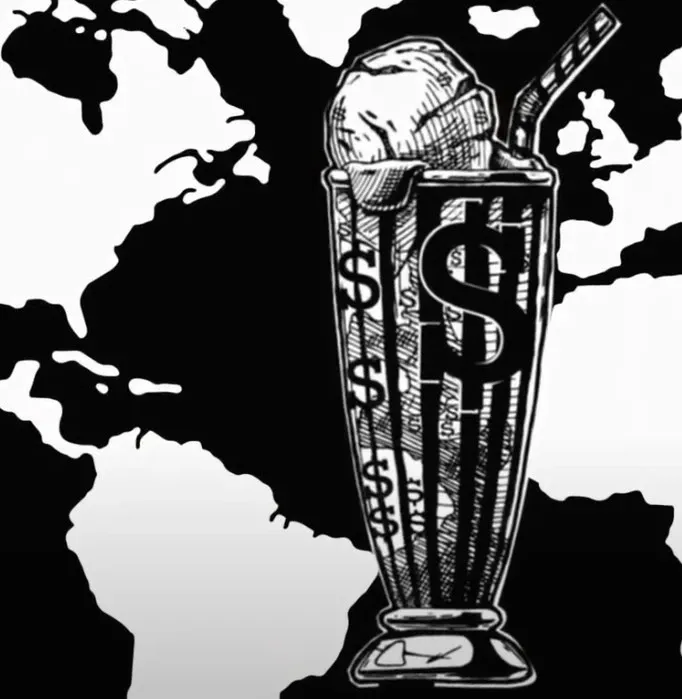
To summarize the DMT, according to @SantiagoAuFund , the global financial system can be imagined as one giant milkshake made up of liquidity, debt, and capital. The United States holds the largest straw, allowing it to "drink" capital from the rest of the world.
20
@SantiagoAuFund While many countries are engaged in similar monetary policies, such as low interest rates and quantitative easing, the U.S. enjoys a unique position, since it issues the world’s reserve currency and has some of the most liquid and trusted financial markets.
21
@SantiagoAuFund Sure, the U.S. might have a myriad of fiscal problems, but so does everyone else-this makes the U.S. the cleanest “dirty shirt” in the laundry, as Brent Johnson puts it.
22
@SantiagoAuFund This behavior creates a flow of capital into the United States, which in turn strengthens the dollar.
23
@SantiagoAuFund When the dollar rises, it puts pressure on other countries—especially emerging markets that have borrowed in U.S. dollars—because they now have to pay back their debts in a currency that has become more expensive.
24
@SantiagoAuFund This dynamic can create a feedback loop, where financial stress abroad leads to a stronger dollar, which then causes even more stress for dollar borrowers outside the U.S.
If foreigners sell USTs to intervene in their currency market (Japan, cough cough) this worsens things
If foreigners sell USTs to intervene in their currency market (Japan, cough cough) this worsens things
25
@SantiagoAuFund Brent recently had a slide deck presentation where he discussed the Milkshake in detail, link is below:
youtube.com/watch?v=da6hMy…
youtube.com/watch?v=da6hMy…
26
@SantiagoAuFund DXY rising therefore is a symptom of systemic liquidity issues- not a sign that investors are necessarily more confident in America.
27
@SantiagoAuFund Chinese buying of USDs, or Argentinian purchases of dollar assets, is more about those investors trying to escape their own failing currency, and less about the actual fundamentals of the American economy.
28
@SantiagoAuFund While this may benefit the United States in the short term by attracting capital and keeping its markets strong, Brent also concedes that the situation is not sustainable forever.
29
@SantiagoAuFund At some point, the system could break under the strain of a too-strong dollar and the pressures it places on global economies.
30
Anyways, what’s going on with the DXY? Well, in the last 3 months, we’ve seen a continuation of dollar weakening that is due to the market’s reaction to the trade war that Trump kicked off on Liberation Day back in early April.
(Less trade means less short-term demand for dollars)
(Less trade means less short-term demand for dollars)
31
@SantiagoAuFund This relatively cheaper dollar will actually enforce the Milkshake- I know that sounds paradoxical, but it’s true. Here goes:
32
@SantiagoAuFund Dollar-denominated debt is often created outside the United States through what's known as the eurodollar system — a vast network of offshore U.S. dollar banking activity that isn't regulated by the Federal Reserve

33
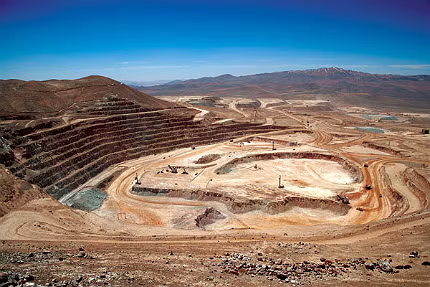
@SantiagoAuFund In this system, foreign banks extend U.S. dollar loans to non-U.S. borrowers, such as mining companies in Chile, oil producers in Nigeria, or car manufacturers in South Korea. (Again, please refer to the Eurodollar Substack piece for more depth)
34
@SantiagoAuFund These companies may be operating entirely within their own countries and generating revenue in their local currencies, but the loans they take on are priced and must be repaid in U.S. dollars.
35
@SantiagoAuFund Once those companies take on dollar debt, they’re locked into a financial structure where their liabilities are in dollars, but their income is usually not.
36
@SantiagoAuFund A copper miner in Peru might sell copper in the market and get paid in soles or another non-dollar currency.
37
@SantiagoAuFund To meet their dollar debt obligations — which could include interest payments or full loan repayments — they have to convert their local currency revenue into dollars.
38
@SantiagoAuFund This typically involves going into foreign exchange markets to swap their local currency for U.S. dollars. If the dollar rises relative to their home currency, the cost of that swap increases, making it more expensive and more painful to service their debt.

39
The company is now not just managing its business — it's also speculating on currency exchange rates without intending to.
40
@SantiagoAuFund Therefore, when the DXY is lower - meaning the U.S. dollar is relatively weaker compared to other major currencies - it becomes easier for foreign companies to service their dollar-denominated debts.
41
@SantiagoAuFund Not only can they more easily pay off existing dollar liabilities, but they may also feel confident enough to take on even more dollar debt to fund growth, expansion, or speculation.
42
This is where the feedback loop begins. As more companies around the world borrow in dollars during periods of dollar weakness, the overall size of the dollar debt system expands.
43
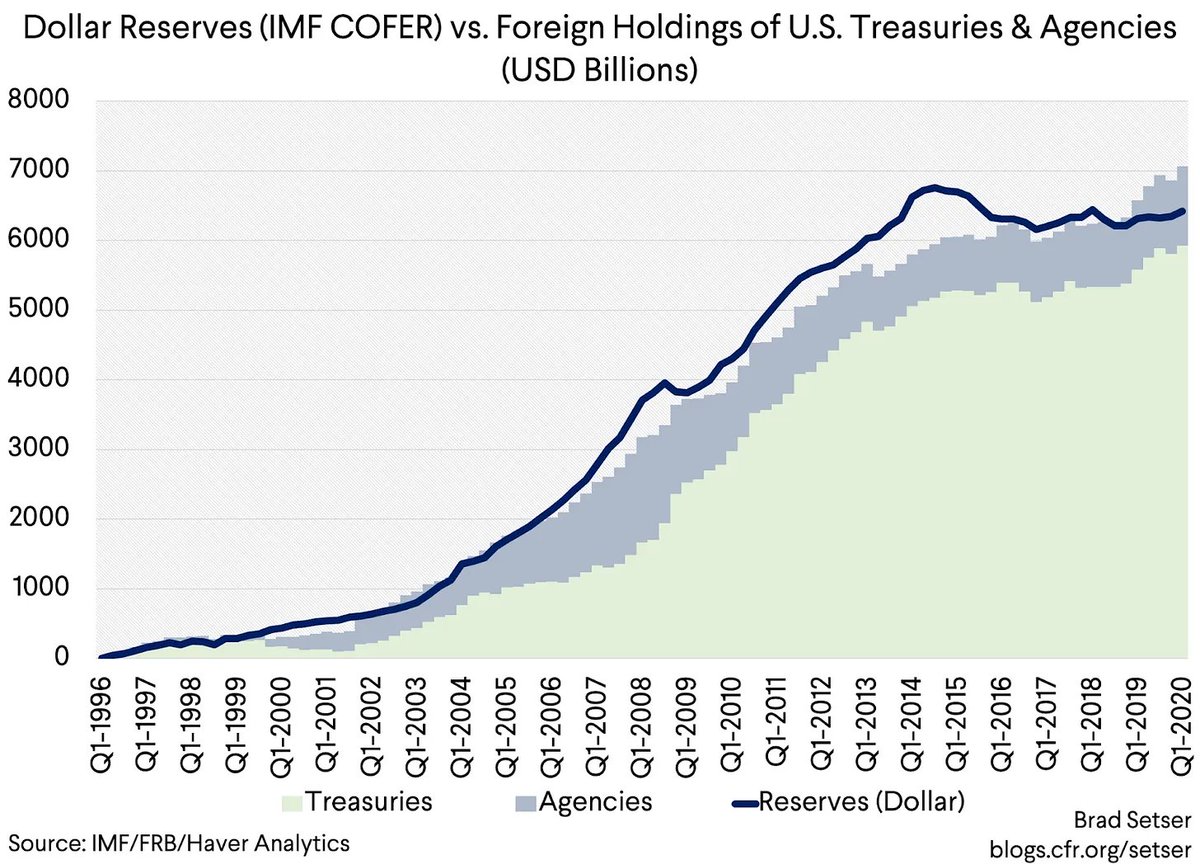
@SantiagoAuFund This doesn’t only relate to companies- entire sovereigns see this effect as well. When the dollar is cheaper, it also becomes easier for foreign nation states to accumulate U.S. dollar reserves, a crucial part of their financial defense mechanisms (see Japan’s Yenterventions)

44
@SantiagoAuFund Since their own currencies are stronger relative to the dollar in an environment with a lower DXY, they can exchange fewer units of their local currency to buy more dollars. This makes building up forex reserves far less costly.
45
@SantiagoAuFund While dollar bears point to rising U.S. debt or de-dollarization efforts as signs of the dollar’s decline, the reality is that the global hunger for dollar liquidity is still very much alive, and in many ways, it’s growing, not shrinking.
46
@SantiagoAuFund Paradoxically, all this means is that the Endgame (for lack of a better word) will not play out how the bears think it will.
47
@SantiagoAuFund A global monetary collapse will mean that the dollar index races higher, not lower. And if DXY falls, as Brent says, this just means that the game will continue as re-dollarization begins.

48
@SantiagoAuFund The Dollar having the status as a reserve asset and reserve currency are two separate functions- and although they are interlinked, in theory the greenback could lose the former without losing the latter.
49
@SantiagoAuFund The Milkshake, at least in the medium term, means it won’t lose reserve currency status easily.
50
@SantiagoAuFund And like a coiled spring, the lower DXY goes, the higher it will eventually pop, putting strain on the global monetary system.
(//END)
(//END)
51
@SantiagoAuFund Boom! Thank you for reading. If you enjoyed the post, give me a follow!
This was an excerpt of a longer paid piece on Substack, you can check the full piece out here:
dollarendgame.substack.com/p/the-milkshak…
This was an excerpt of a longer paid piece on Substack, you can check the full piece out here:
dollarendgame.substack.com/p/the-milkshak…