@EamonnFlanagan: A key schematic from Verkhosha...
@EamonnFlanagan
14 views
Oct 17, 2024
1
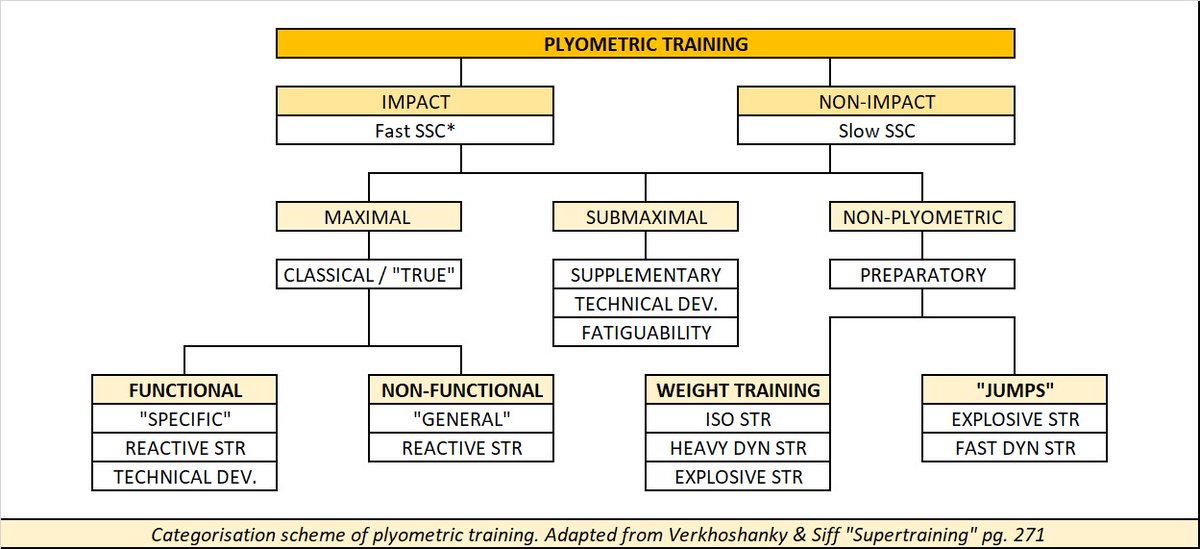
A key schematic from Verkhoshansky to understand the context and placement of your plyometric training
This helps understand the categories of plyometrics or "jump" training.
(figure is slightly adapted from original)
This helps understand the categories of plyometrics or "jump" training.
(figure is slightly adapted from original)
2
“Impact plyometrics” are the true or “classical” plyometrics. Here the rebound is stimulated by contact with the ground. These are often fast SSC actions but not exclusively so (eg. longer GCT depth jumps)
3
These impact plyometrics can be considered “general” or “specific”.
General methods are aimed at general development of the key strength qualities of the sport while specific methods are more biomechanically matched to the demands of the sport.
General methods are aimed at general development of the key strength qualities of the sport while specific methods are more biomechanically matched to the demands of the sport.
4
Submax methods can be fast or slow SSC in nature & are used to refine tech & build work capacity for more intensive work
"Jumps in place" circuits, "rudiment" work or "deep tier" work popularised by @booschex @altis & @mcinneswatson respectively could be in this category
"Jumps in place" circuits, "rudiment" work or "deep tier" work popularised by @booschex @altis & @mcinneswatson respectively could be in this category
5
Non-plyometric methods are in the slow stretching shortening cycle domain and can take the form of traditional strength training or slow SSC jump training.
Consider what you're doing, why you're doing and where it fits into overall strength quality development.
Consider what you're doing, why you're doing and where it fits into overall strength quality development.
6
More on this, plyometric programming, volume and intensity guidelines and testing options in the Sportsmith Course
View Tweet