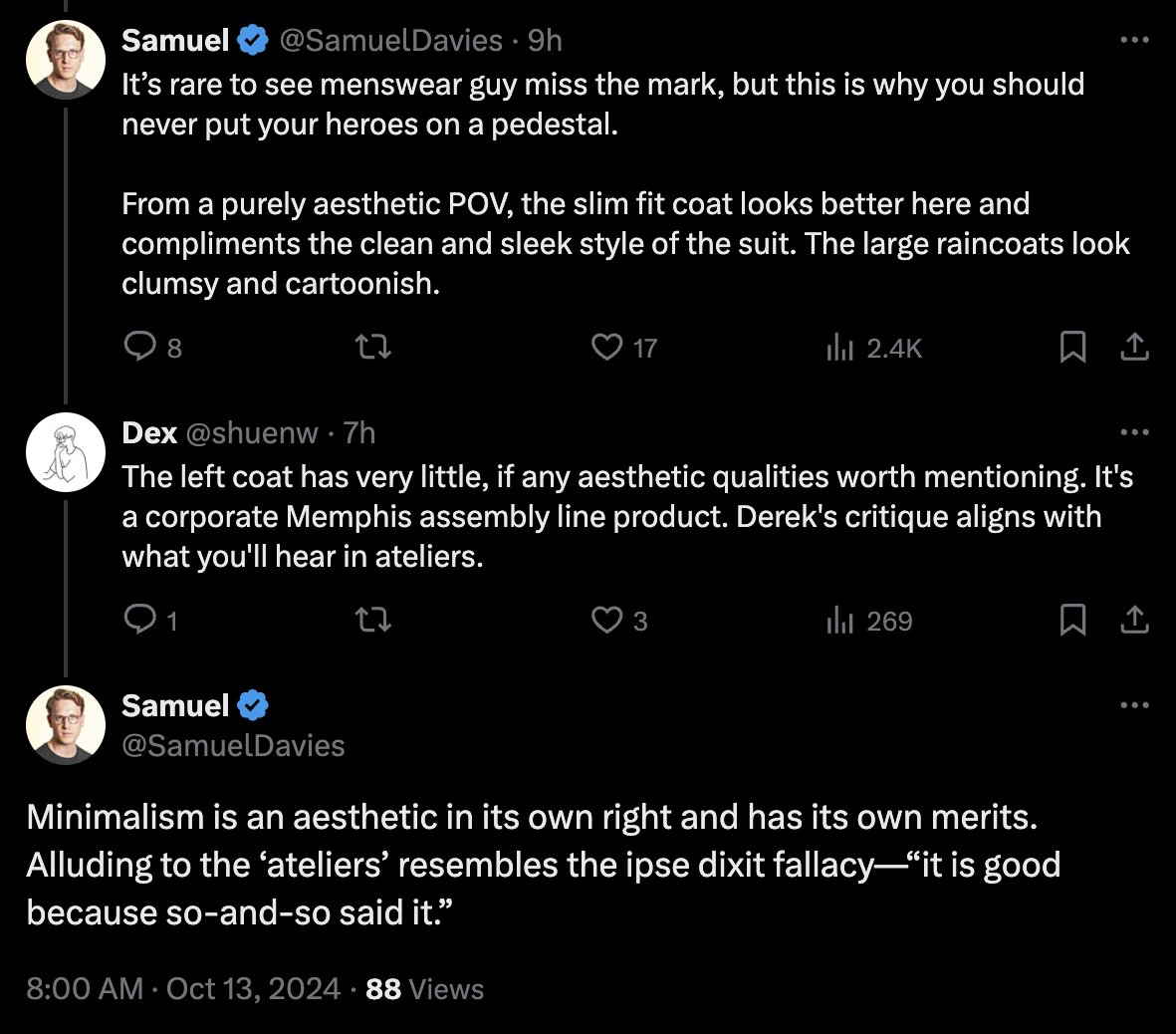
Let's talk about minimalism as an aesthetic in menswear. 🧵

derek guy@dieworkwear
101 views
Oct 28, 2024
~4 min read
1
Let's talk about minimalism as an aesthetic in menswear. 🧵
2
First, the coat in question. Samuel is referring to the coat on the left, which is just a slimmed up, truncated version of a single-breasted mac. This blue coat is made with a zip front and technical fabric. The originals had buttons and fit more like the ones on the right.


3
IMO, it's wrong to describe that coat as being part of the minimalist tradition. Instead, it flows from a different history. In the early 2000s, designers such as Hedi Slimane and Thom Browne shrank men's silhouettes as a counter reaction to the voluminous clothes of the 1990s.


4
At the start of this trend, the public derided these shrunken clothes as "metrosexual," which was basically a way to call into question the wearer's gender and sexuality (e.g., "are they feminine?" "are they gay?"). Over time, this silhouette seeped into the mainstream.
5
What started as a trickle (2000) became a stream (2005) and then turned into a torrent (2010). By 2012, we were so underwater with slim-fit silhouettes, it became normal. You can see this change in GQ covers. In order of appearance: 2000, 2002, 2005, 2013.


6
Menswear editorials during this transitional period were full of guides on how to dress better, which presented trends in false dichotomy and layered it with pseudo-scientific language. "Don't look like your sloppy manager." "Shoulder seams should always sit on shoulder bone."


7
It's worth noting that the original slim fit styles, as created by designers such as Hedi Slimane, were actually very good. Slide one shows Slimane's Dior AW01 show. Second slide is the Dior Homme 19cm "Dust Wash" jeans that were all the craze in 2005-2008.


8
But you'll notice that the clothes had a certain rock and roll vibe to them. Skinny silhouettes still work really well with this aesthetic, as Wisdom Kaye proves countless times in his videos. IMO, it's dumb to say that skinny or slim is always bad.
x.com/modsiwW/status…
x.com/modsiwW/status…
9
Much of what we see today, however, is just slim fit business casual, which sits downstream of those early 2000s designs. It's simply guys who think slimmer is better, so they transpose that silhouette on styles that are already basic, robbing the outfit of "shape and drape"


10
I would not call that part of the minimalist design tradition, which is much more thoughtful. This school of thought often emphasizes things such as geometric abstractions, repetition and gradual variation, uses of light and shadows, and simplicity.


11
In fashion, these ideas often come through designers such as Helmut Lang, Jil Sander, Calvin Klein, and Donna Karen. Klein once described his version of minimalism as "an indulgence in superbly executed cut, quiet plays of color tones and clean, strong shape."


12
These clothes can be distinguished by their shapes (e.g., silhouette), material (e.g., silky long-staple cotton t-shirts), or details (e.g., hidden drawstring on otherwise ordinary chinos). A quote from John Seabrook's Sept 2000 New Yorker article on the genius of Helmut Lang.
13
A good example of this is Common Projects Achilles Low, which were super popular with menswear guys from about 2005 to 2015. They're simple, all-white sneakers made from premium leather (and distinguished by gold foil). They look unoriginal now because everyone copied them.

14
There are some designers I really like in this tradition, such as Document (a South Korean label) and Lemaire. Again, notice the focus on shapes and figuration, small details like belted waist, and materials (stuff swishes and moves and flows!)


15
The danger of minimalism is that once you take away these elements—shape, material, and detailing—you can wind up with clothes that border on the generic, which make them indistinguishable from everything else. This puts the focus on the label (yuck). An excerpt from Rosenrot:
16
This discussion reminds of this thread by Cultural Tutor, who wrote about the "minimalism" that surrounds us. As they note, there is such a thing as thoughtful minimalist design. But what surrounds us is often a lack of identity. It's default blandness.
x.com/culturaltutor/…
x.com/culturaltutor/…
17
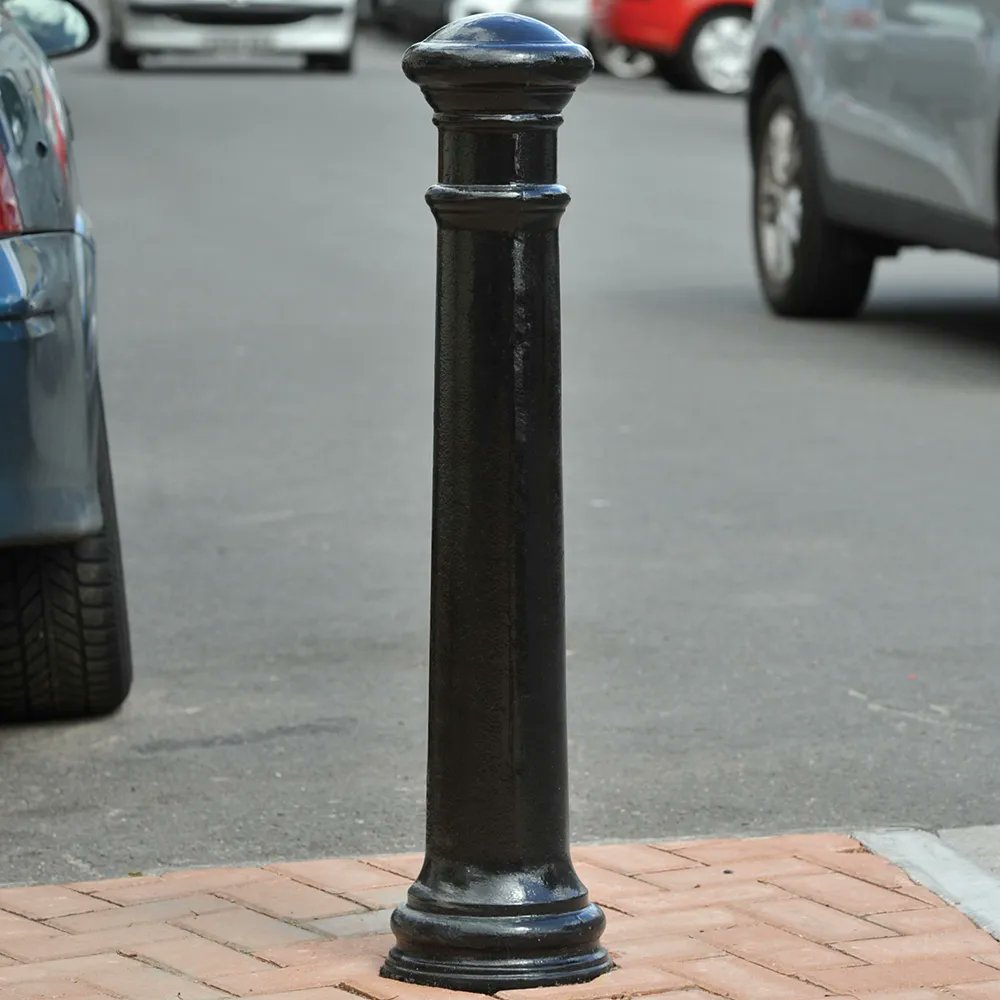
To me, the comparison is not dissimilar to these bollards. Yasuto's raincoat has a beautiful A-line shape and belt. It has drama and will swish when you walk. The other has no character or movement. It's so short, it even fails at the function of protecting you from the rain.


18
Describing that coat as minimalist is a disservice to people who do real minimalist design in menswear (see the emphasis on shapes below). It's also not historically accurate: the slimming up and shortening of business casual is simply downstream of early 2000s trends.


19
Will end with this QT of a thread that I hope you will read. IMO, a good outfit needs something—a bit of sauce, edge, texture, detailing, etc. Some of this can come through in what I call "shape and drape." The blue raincoat lacks that.
x.com/dieworkwear/st…
x.com/dieworkwear/st…
20
I forgot to add: De Bonne Facture is another great brand that pares things down so the focus is on shapes and interesting materials. I particularly like their grandad coat (pic 1) and boucle sweaters (pic 4).


